You found something worth keeping — an article, a recipe, a product page, a YouTube video — and you want it on your phone later. The tab will be gone. The bookmark might not sync. And copy-pasting a URL into a notes app is the kind of friction that makes you just give up and lose the thing entirely.
There are actually several solid ways to get a web page from your laptop to your phone, and the right one depends on how you work. This guide covers every real method — from browser sync tricks to cross-device clippers — so you can pick the one that actually fits your habit. If you want the fastest path, the Sticky Note Web Clipper does it in one click, for free, and the page shows up on your phone without any extra steps.
The Built-In Methods: Browser Sync and Send to Device
If you use Chrome on both your laptop and your phone and you're signed into the same Google account, your bookmarks sync automatically. Save a page on your laptop, open Chrome on your phone, go to Bookmarks, and it should be there. This works reasonably well for things you want to keep long-term.
Chrome also has a Send to Your Devices feature. Right-click any link or tab, hover over Send to your devices, and pick your phone from the list — it appears as a notification on your phone almost instantly. This is genuinely useful for one-off sends, but it requires Chrome on both ends, the same Google account, and your phone nearby and unlocked to catch the notification before it disappears.
Safari users on Mac and iPhone have it even smoother with iCloud Tabs — open tabs on your Mac appear in a section of Safari on your iPhone as long as you're signed into the same Apple ID and iCloud is enabled. No saving required; the tab just stays live across both devices.
The main weakness of all these built-in methods is that they're ephemeral or hard to find later. A synced bookmark gets buried in a flat list with no visual context. A sent tab notification vanishes. iCloud Tabs disappear once you close them. None of these give you a durable, findable record of what you saved and why.
Manual Methods That Work Without Any Special App
Don't want to rely on browser features? There are a few no-frills approaches that work on any combination of devices and browsers.
- Copy the URL, paste it into a note or message to yourself. Open your phone's notes app, email yourself, or use a messaging app like WhatsApp or Telegram where you can message your own number. Paste the URL in, send it. This works everywhere and needs nothing installed — but you lose the page title, any context about why you saved it, and it becomes a wall of bare URLs fast.
- Use a cross-platform notes app. Apps like Apple Notes, Google Keep, or Notion let you paste links that sync across devices. Some even unfurl the URL into a preview with a title. This is a step up from a plain list, but it still requires you to switch apps, paste manually, and keep the note organized yourself.
- Email yourself. Old-fashioned but genuinely reliable. Open your email on your phone whenever you want the link. The downside is that saved pages get mixed into your inbox and are nearly impossible to retrieve weeks later.
If you save pages infrequently — a few times a month — any of these manual methods is perfectly fine. The problem shows up when saving becomes a habit and you end up with hundreds of raw URLs scattered across apps you check for other things.
When You Save Pages Often: The Case for a Dedicated Clipper
If saving pages is something you do regularly — for research, reading later, tracking articles, collecting references — the overhead of manual methods adds up fast. You want something that lives in your browser, gets out of your way, and makes the saved item easy to find on your phone later without a scavenger hunt.
This is exactly what browser-based web clippers were built for. The most well-known is the Evernote Web Clipper, which saves pages into your Evernote account and syncs across devices. It's capable, but it's tied to a paid app ecosystem and saves into a note structure that's designed for deep document organization — more than most people need just to save a link.
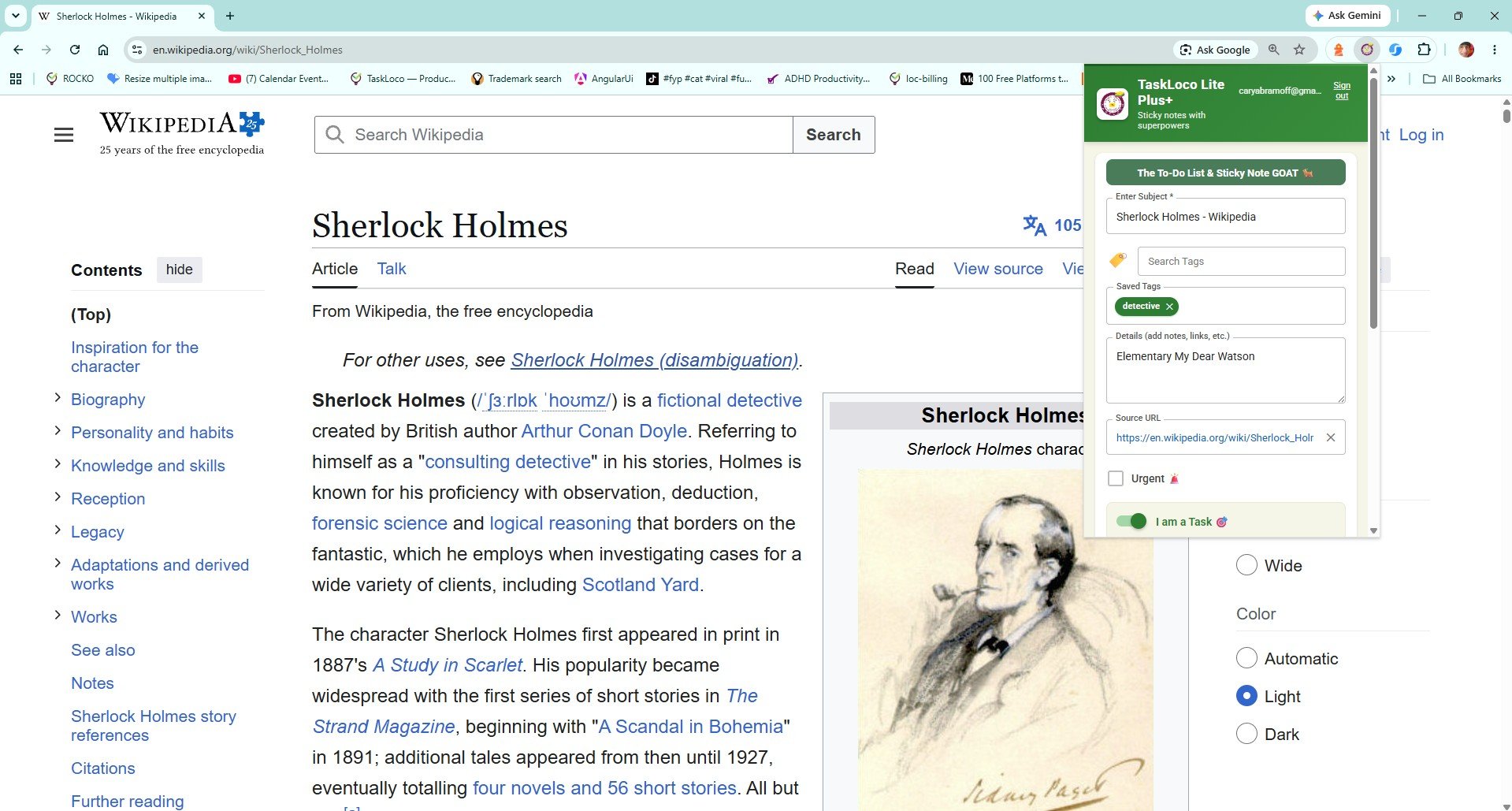
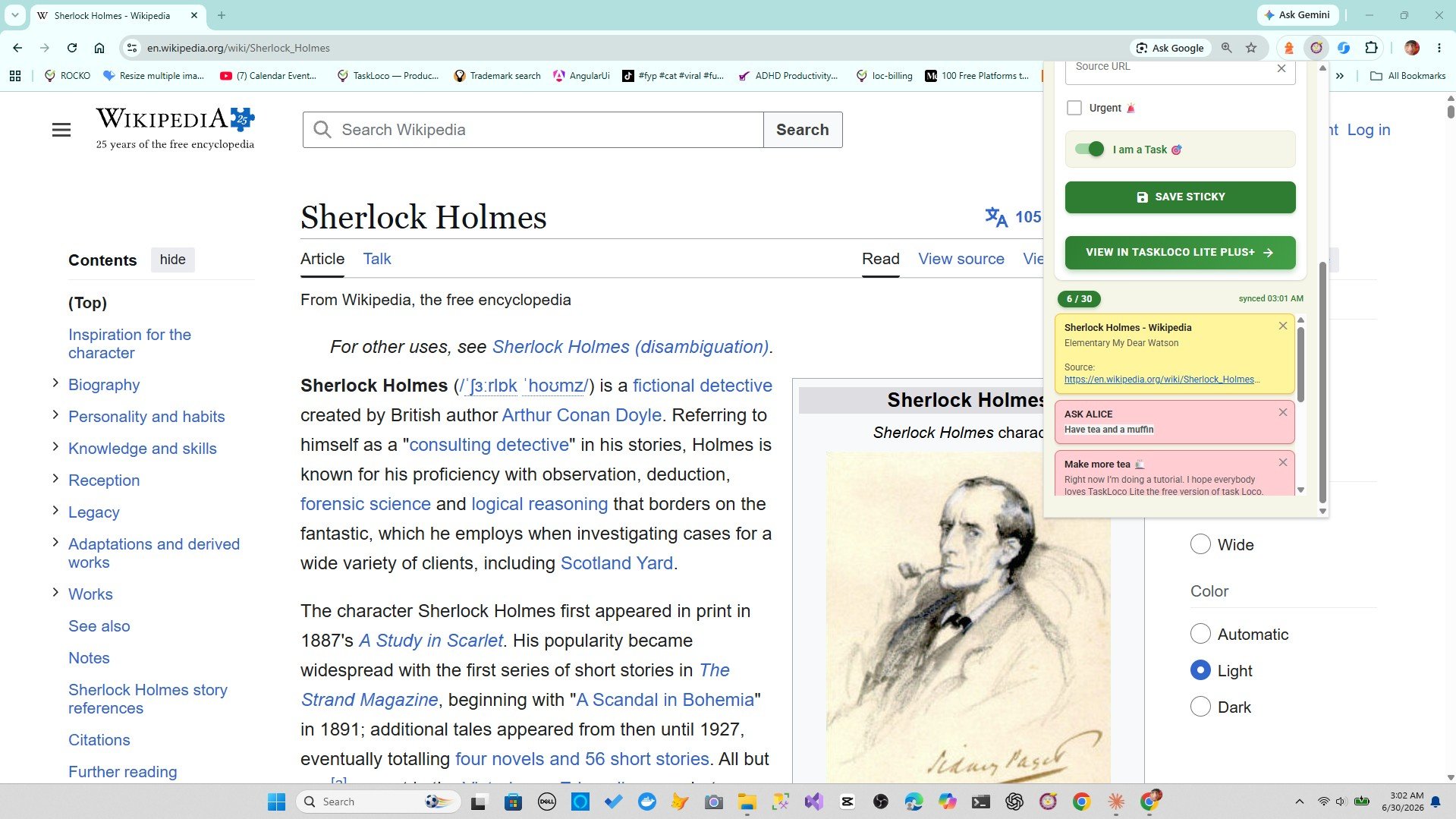
The Sticky Note Web Clipper takes the opposite approach: minimal friction, visual output, and it's free. Click the toolbar icon in Chrome, and the current page is instantly saved as a sticky note with the title and URL already filled in. No form to complete, no folder to choose, no format to pick. The note lands in TaskLoco, which you can open on your phone (iOS or Android) or any browser — no installation required on the phone side, just sign in with Google.
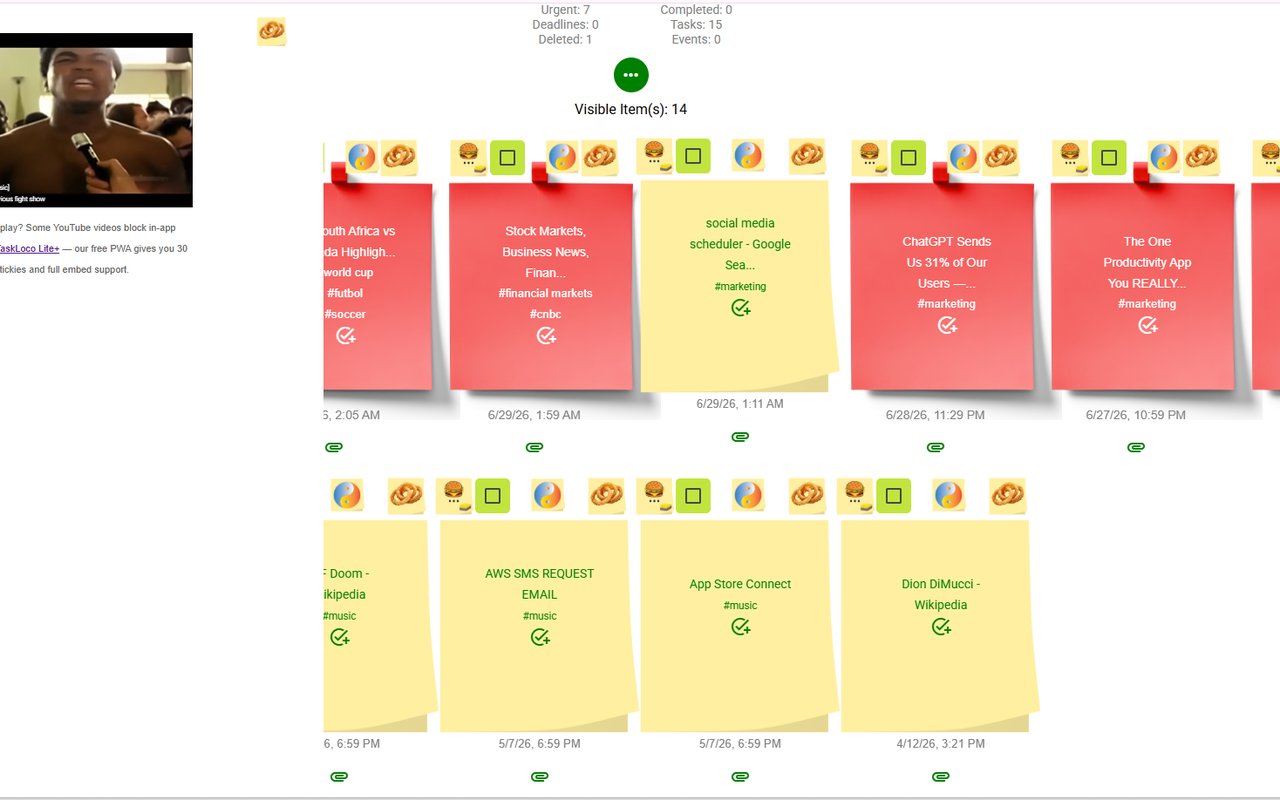
The visual sticky-note format matters more than it sounds. When you open your saved items on your phone, you see a wall of notes — each one showing the page title at a glance — rather than a plain text list of URLs. You can tag notes and search them, so finding that article you clipped three weeks ago doesn't require remembering which folder you put it in.
How to Set It Up in Under Two Minutes
Getting the Sticky Note Web Clipper running is genuinely fast. Here's the complete setup:
- Step 1: Go to the Chrome Web Store and search for Sticky Note Web Clipper by TaskLoco, then click Add to Chrome. It's free.
- Step 2: Pin the extension to your toolbar so the icon is always visible. Click the puzzle-piece icon in Chrome's toolbar, find the Sticky Note Web Clipper, and click the pin icon.
- Step 3: Sign in with Google. This is what connects your clips to your account and makes sync work.
- Step 4: Navigate to any page you want to save and click the toolbar icon. The page is saved as a sticky note — title and URL auto-filled — in under a second.
- Step 5: On your phone, open a browser and go to taskloco.com. Sign in with the same Google account. Your saved notes are already there.
There's no phone app to install, no pairing process, no cable. The sync happens through your account. If you want the native mobile experience, TaskLoco also has iPhone and Android apps — but the web version works fine right away.
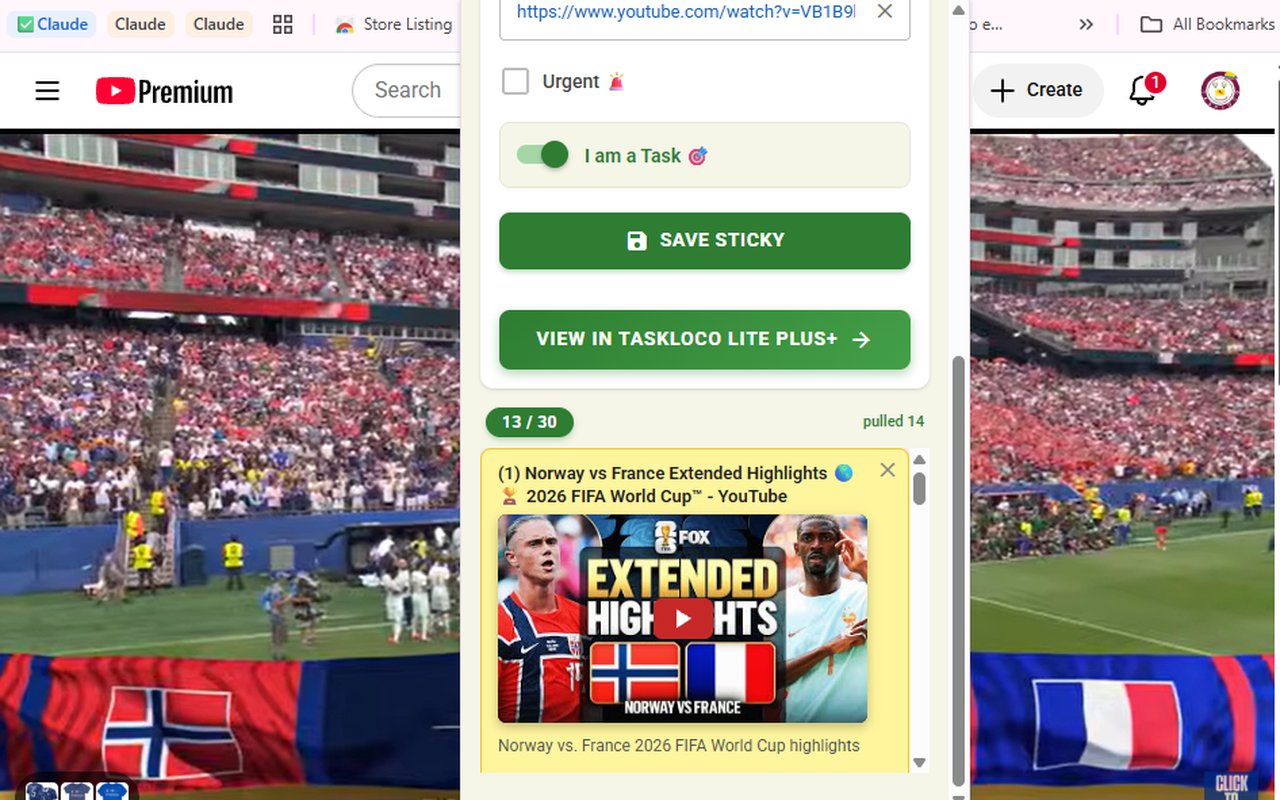
From the phone, tapping a saved note opens it with the source URL and the title. Tap the link to open the full page in your mobile browser, or if it's a YouTube video, watch it directly inside the note. Tags and search mean you can find anything you've ever saved without scrolling through everything.
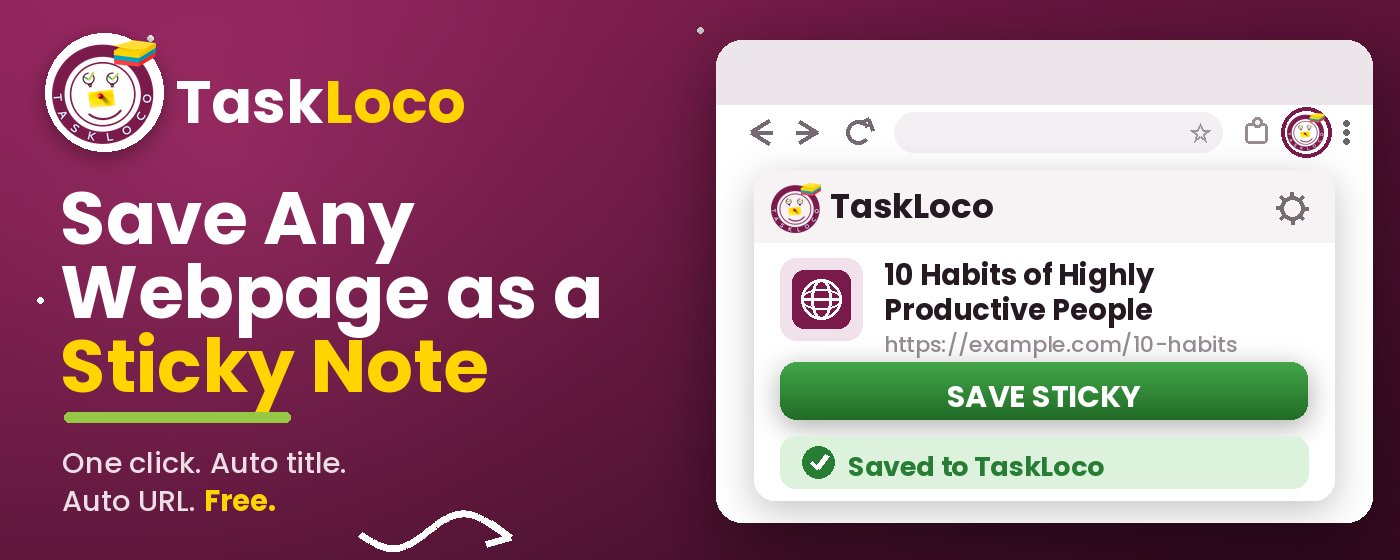
The Sticky Note Web Clipper is free. Install it from the Chrome Web Store, sign in with Google, and every page you clip becomes a sticky note you can find later.
Your clipped notes sync to TaskLoco across Chrome, desktop, iPhone, and Android — also free to start. No credit card to begin.
Get the Free Clipper
Sticky Note Web Clipper
- Free Chrome extension
- One-click save — any page, article, or video
- Title & URL auto-filled
- Tags & search
- Free forever
Synced to TaskLoco
- Sign in free with Google
- Your wall on Chrome, desktop, iPhone, Android
- YouTube videos embed & play in notes
- Visual sticky-note wall
- Free to start
Add It to Chrome — Free
One click saves any page, article, or YouTube video as a sticky note. Title and URL auto-filled.
Add to Chrome — FreeSee TaskLoco in Action
Frequently Asked Questions
What's the easiest way to save a web page on my laptop and open it on my phone?
The easiest method is a cross-device web clipper that syncs automatically. The Sticky Note Web Clipper saves any page in one click from Chrome on your laptop, and the saved note appears instantly in TaskLoco — accessible from your phone's browser or the TaskLoco mobile app without any extra setup.
Does Chrome sync bookmarks between laptop and phone?
Yes — if you're signed into the same Google account in Chrome on both devices, bookmarks sync automatically. The limitation is that bookmarks are a flat, text-only list with no visual layout, and there's no way to add context about why you saved something. For occasional saves, bookmark sync works fine. For regular saving, a visual clipper is easier to navigate later.
Can I send a tab from Chrome on my laptop to my phone instantly?
Yes. Right-click the tab or a link in Chrome and choose 'Send to your devices.' Your phone will receive a notification with the link. This works well for one-off sends, but requires Chrome on your phone, the same Google account, and notifications enabled. The notification disappears if you miss it, so it's not a reliable archive — just a quick handoff.
Do I need to install anything on my phone to use the Sticky Note Web Clipper?
No phone installation is required to access your saved notes. After installing the extension in Chrome on your laptop and signing in with Google, you can open taskloco.com in any browser on your phone and see everything you've clipped. TaskLoco also has free iOS and Android apps if you prefer a native experience.
Is the Sticky Note Web Clipper free?
Yes — the extension is completely free. TaskLoco also has a free tier. Install the extension from the Chrome Web Store, sign in with Google, and your saves sync across devices at no cost.
Can I save YouTube videos and watch them on my phone later?
Yes. When you save a YouTube page with the Sticky Note Web Clipper, the video embeds directly inside the sticky note. On your phone, open the note in TaskLoco and the video plays right there — no need to go back to YouTube and search for it again.
What if I save a lot of pages — how do I find them later on my phone?
This is where the Sticky Note Web Clipper has a clear advantage over bookmarks or copy-pasted URLs. Saved notes are displayed visually in TaskLoco so you can scan them at a glance. You can also add tags when you save and use search to find any note by keyword — useful when you've saved dozens of things and can't remember exactly what you named one of them.
Born in Brooklyn. Powered by AWS. Your data stays yours.
TaskLoco is available on iPhone, Android, Chrome, and every web browser.