You write the list. You feel productive for about four minutes. Then you stare at it and feel nothing — no urgency, no sense of what matters, no idea where to start. You're not lazy. You're not disorganized. Your brain just doesn't work in lines.
Visual thinkers — designers, architects, marketers, writers, anyone who thinks in pictures, maps, and space — are routinely failed by the default productivity advice the internet keeps recycling. "Just write it down." "Keep a simple list." "Pick your top three." None of that addresses the actual problem: linear lists are a text-based interface for a non-text brain. This article explains what's really going wrong and, more importantly, what to do instead.
The Actual Problem: Lists Are One-Dimensional, Your Brain Isn't
A to-do list is sequential by design. Item 1, item 2, item 3. It implies that tasks have a natural order, that priority flows from top to bottom, and that finishing one thing leads cleanly to the next. For a certain kind of mind, that works beautifully. For a visual thinker, it's almost unusable.
Visual and spatial thinkers naturally chunk information into clusters. You see "the design stuff," "the client stuff," and "the personal stuff" as three separate territories — not as a single ranked column. When a list mixes those territories together, your brain has to constantly re-sort them before it can act. That cognitive overhead isn't a small thing. It's the reason you feel exhausted just looking at your list even before you've done anything on it.
There's also the problem of invisible relationships. A list item that says "Send the proposal" looks identical in weight and urgency to "Buy coffee." Visual thinkers need to see that one item is blocking three others, or that a cluster of tasks belongs to a single project, or that something is time-sensitive versus low-stakes. A flat list communicates none of that. Everything looks equal because everything is formatted identically.
Research in cognitive psychology backs this up. Dual-coding theory, developed by Allan Paivio, established that visual and verbal information are processed through separate cognitive channels. People who think predominantly in images engage the visual channel heavily — and when they're forced to process everything through text alone, they lose the second channel entirely. You're essentially working with one hand tied behind your back.
What Visual Thinkers Actually Need (And How to Build It Without Any App)
Before you download anything, understand what your brain is asking for. Once you know the principles, you can apply them with a whiteboard, a stack of index cards, a wall, or a notebook — or later, a digital tool that respects the same logic.
1. Spatial separation instead of sequential order. Group tasks by project, energy level, context, or any other dimension that matters to you — and put physical or visual space between groups. On paper, this means drawing a box around each cluster. On a whiteboard, it means dedicating a zone to each area of your life. The key insight: proximity signals relationship. Things near each other belong together. Things far apart are independent. Your brain reads this instantly without having to decode it.
2. Color as a real signal, not decoration. Color is one of the fastest pre-attentive visual cues your brain processes. Use it deliberately. Red for urgent. Blue for waiting-on-someone-else. Green for personal. Yellow for someday. Pick a system with four or five colors and stick to it. When you scan your board, your eye will go straight to red without your conscious brain having to read anything.
3. Size and emphasis to show weight. Write big tasks on big cards. Write small tasks small. Draw a star or a border around the one thing that absolutely must happen today. Visual thinkers respond to size and prominence in a way they simply don't respond to bold text in a bulleted list.
4. A physical wall or board, even temporarily. If you've never tried sticking real sticky notes on a real wall, do it once before you judge it. The act of physically moving a note from "In Progress" to "Done" triggers a satisfaction response that dragging a checkbox in an app rarely matches. More importantly, standing in front of a wall of notes lets you take in 30 or 40 tasks in a single glance — something impossible when you're scrolling through a list.
5. Time-boxing on a visible calendar, not a list. Visual thinkers often struggle to connect tasks to time because lists don't show time — they just show tasks. Try placing your top three tasks for the day on an actual calendar block, even a hand-drawn one. When you can see "Tuesday morning" as a space with a specific task sitting inside it, the task becomes real in a way that "Task #4 on the list" never does.
Why the Wrong Tool Makes It Worse
Most productivity apps were designed by and for sequential thinkers. The default view is almost always a list. Even apps that offer a "board" view often bury it two clicks deep and treat it as a secondary option — the implication being that the list is the real product and the board is a cosmetic add-on.
This matters because tool friction is real. If you have to fight your app every time you open it — clicking past the list view to get to the visual view, re-sorting things that defaulted to alphabetical order, hunting for the color option that's hidden in a submenu — you will stop using it. Not because you lack discipline. Because the tool is creating extra work instead of reducing it.
The other trap visual thinkers fall into is tool complexity masquerading as organization. Apps that offer 15 views, nested subtasks seven levels deep, custom fields, and elaborate tagging systems can feel appealing because they look powerful. But for a visual brain, complexity isn't the same as clarity. A system with too many moving parts becomes its own cognitive burden — you spend your energy managing the tool instead of managing your work.
The ideal tool for a visual thinker is one where the visual layout is the default, not an option. Where you open it and immediately see your notes and tasks arranged spatially, with color and grouping built in — not something you have to configure every time.
How TaskLoco Applies These Principles Digitally
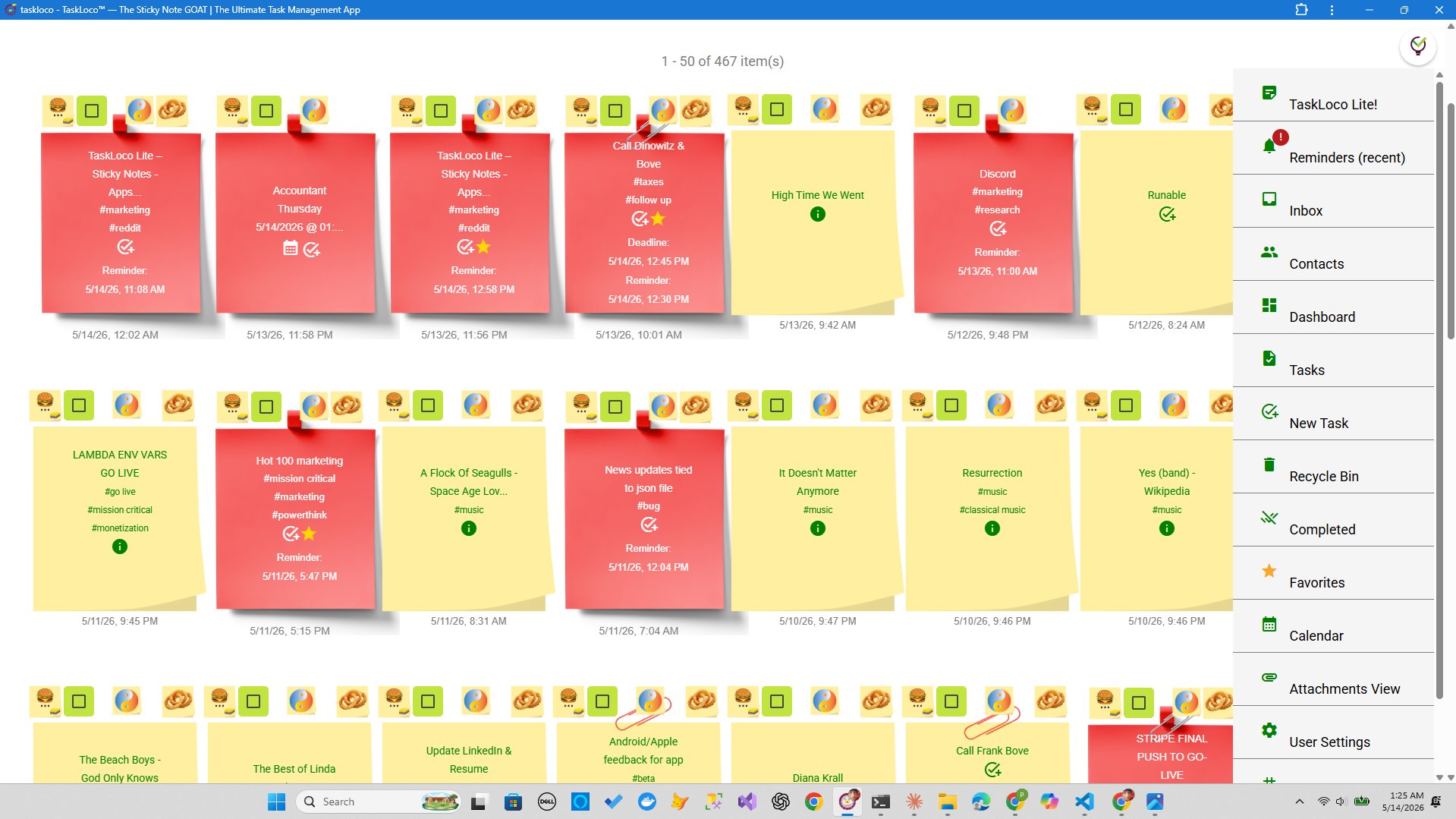
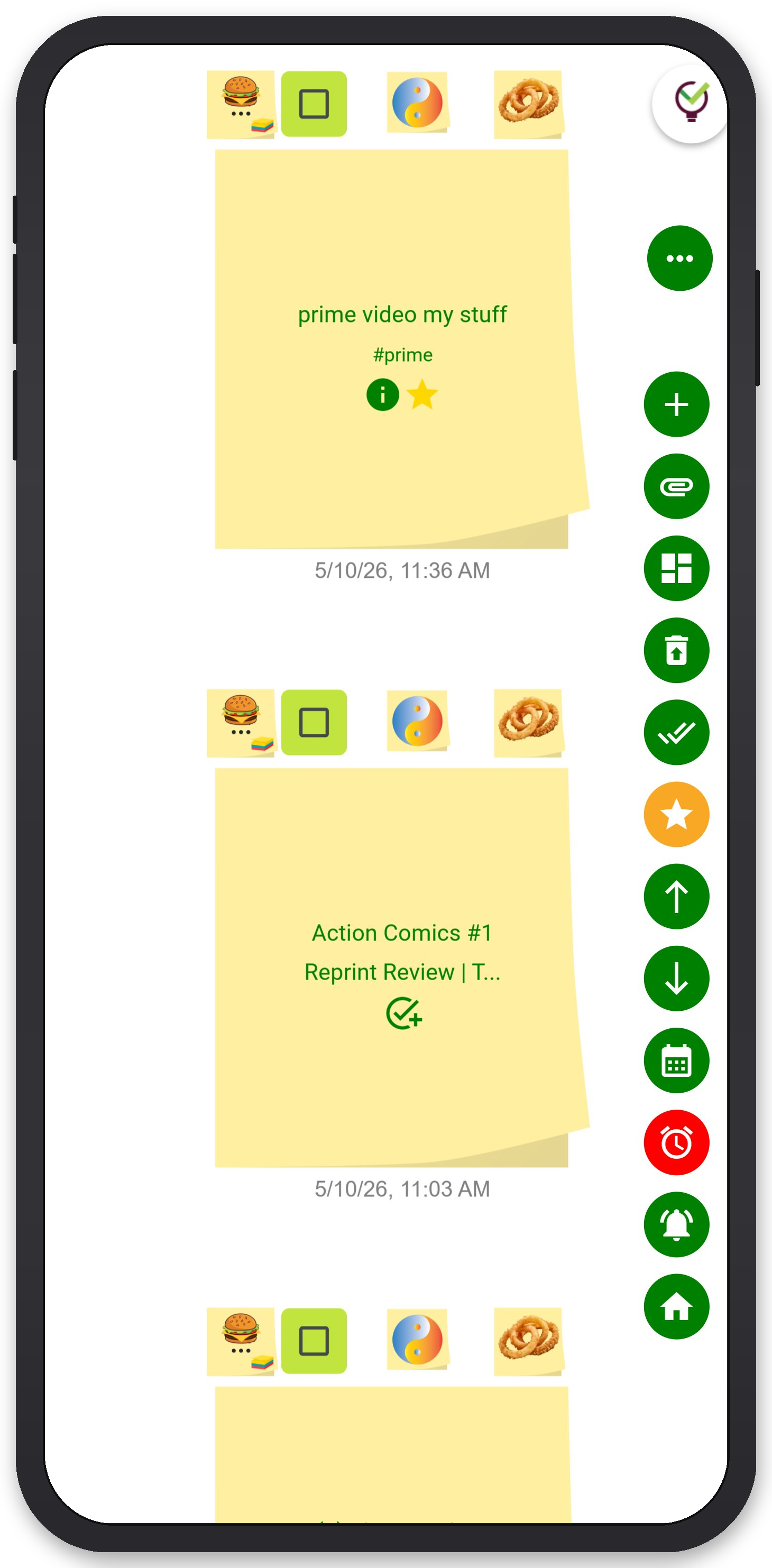
TaskLoco is built around sticky notes arranged on a wall — which sounds simple, but that's exactly the point. The Wall view is the default, not a buried option. You open the app and see your notes arranged spatially, grouped however you want, with color coding that you control. There's no list to escape from.
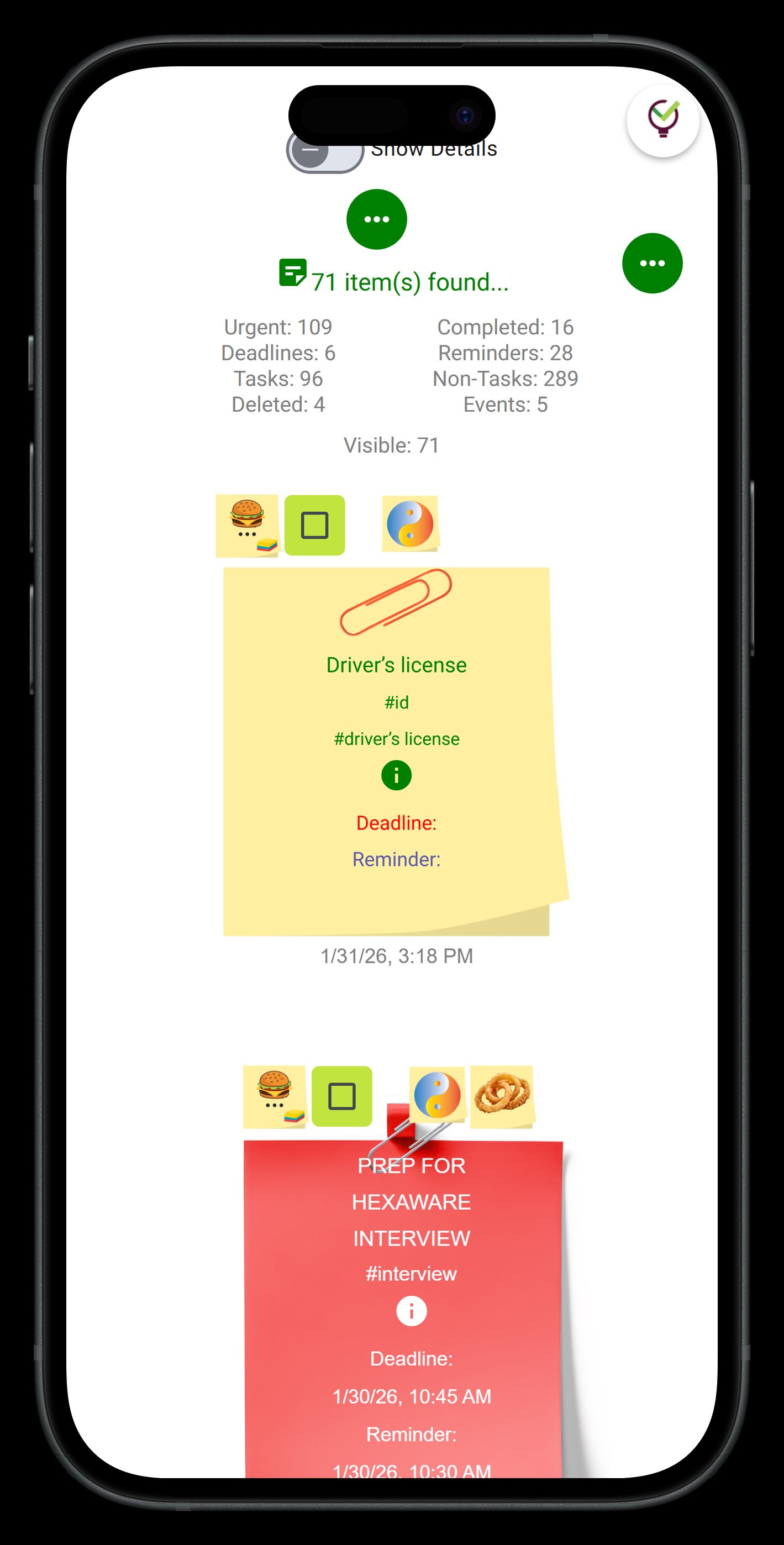
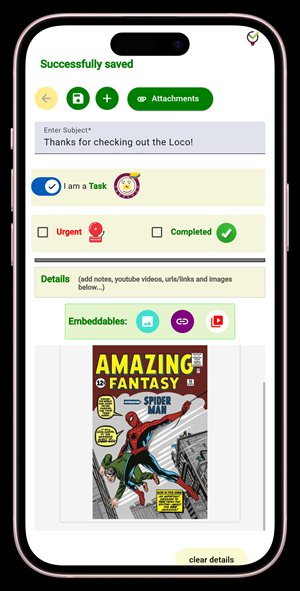
Each note on the Wall is a visual object. You can drag it, group it with related notes, color-code it by project or urgency, and attach files directly to it — images, documents, anything you need to keep the visual context attached to the task itself. That last part matters for visual thinkers specifically: being able to pin a reference image or a mockup directly to a task note means you don't have to hold that visual context in your head. It lives on the card.
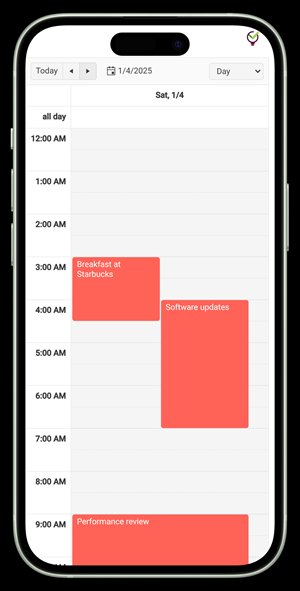
The calendar view lets you see tasks anchored in time — not as a list of due dates, but as events occupying actual space on a calendar. For visual thinkers who struggle to connect tasks to time, this is a meaningful difference. The task stops being abstract and becomes something with a visible location in your week.
Reminders in TaskLoco are delivered as push notifications to your phone and computer, and each one deep-links back to the exact note it came from. You don't get an alert that says "do the thing" and then have to find the thing. The alert takes you straight there. Optional email and SMS channels are also available if you want reminders to reach you through more than one channel.
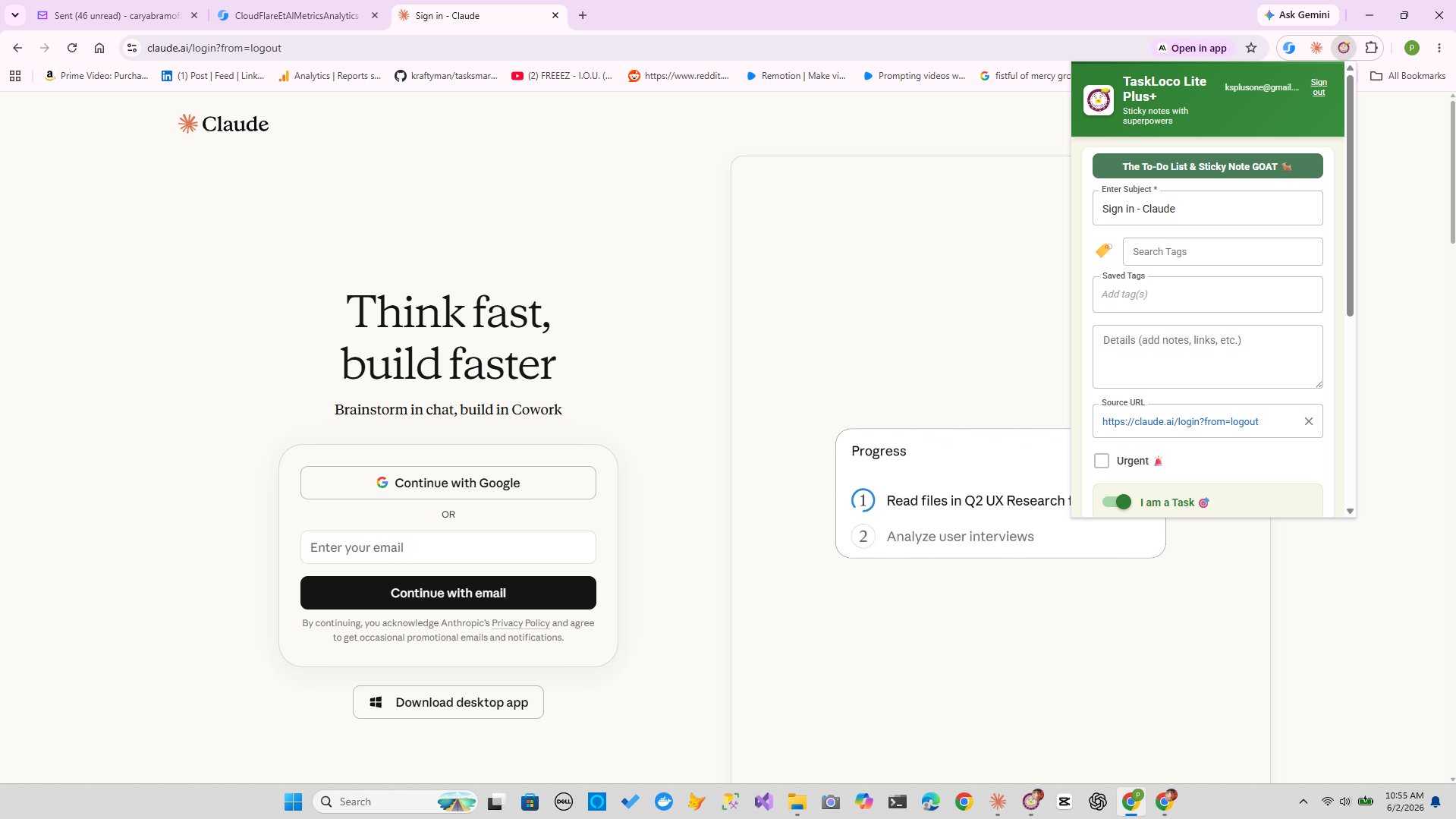
The Chrome extension lets you clip any webpage to a note in one click — useful for visual thinkers who do a lot of research and need to attach visual references quickly without breaking flow. For team use, shared notes work the way email does: the recipient gets their own copy, which they can edit and make their own, without needing permissions or access levels.
TaskLoco Premium is regularly $9.99/month per person. Right now, charter members can lock in 50% off the regular price — forever. That means $4.99/month per person today. And if our price ever goes up, you still pay half. Always.
Code CHARTER50 auto-applies at checkout. First 500 spots only — once they're gone, this offer is gone permanently. Act fast while spots last.
Every Premium subscription includes unlimited notes, 10GB file storage, reminders, calendar, and team sharing. Each team member requires a separate subscription. 7-day free trial — no charge until day 8. Cancel anytime.
Free Options: TaskLoco
TaskLoco Lite
- Native iPhone & Android app
- Completely anonymous — no sign-in
- Data stays on your device
- Up to 20 notes
- Free forever
TaskLoco Lite Plus+
- Web app + Chrome extension
- Sign in with Google
- Wall syncs across all devices
- Up to 30 notes
- Free forever
Lock In 50% Off — Forever
7-day free trial. No charge until day 8. CHARTER50 auto-applies at checkout.
🔒 Lock In My Charter SpotSee TaskLoco in Action
Frequently Asked Questions
Why do to-do lists feel overwhelming for visual thinkers?
Because lists are linear and visual brains are spatial. A flat list strips out the grouping, color, size, and proximity cues that visual thinkers use to extract meaning. Everything looks equal — same font, same indentation, same weight — which forces your brain to manually re-sort and re-prioritize every time you look at it. That cognitive overhead is real, and it accumulates fast.
What is the best productivity system for visual people?
Any system that makes structure visible rather than implied. Sticky note boards (physical or digital), kanban-style card views, color-coded grouping, and calendar views that show tasks occupying actual time blocks all work better than linear lists for spatial thinkers. The specific tool matters less than whether the default view is spatial rather than sequential.
Can visual thinkers use apps like to-do list managers?
They can, but most to-do list apps make it harder than it needs to be. If the app's primary view is a list and the board or card view is buried or optional, visual thinkers tend to abandon it quickly. Look for apps where the spatial view is the default — not something you have to opt into or reconfigure every session.
How does color coding help visual thinkers stay organized?
Color is a pre-attentive visual cue — your brain processes it before you consciously read anything. A consistent color system (red for urgent, blue for waiting, green for personal, for example) lets you scan a board and instantly know what needs attention without reading a single word. That speed and ease is exactly what a linear list can never offer, because lists communicate only through text.
What is the difference between visual thinking and sequential thinking for productivity?
Sequential thinkers process information best in order: step 1, step 2, step 3. A prioritized list maps perfectly onto that mental model. Visual thinkers process information spatially: they see clusters, relationships, and relative importance laid out in space. They need to see how things relate to each other, not just what order they come in. Forcing a spatial thinker to use a sequential system is like asking a left-handed person to write with their right — technically possible, but constantly working against a natural tendency.
How do sticky note systems work for visual thinkers?
Sticky notes work for visual thinkers because each note is a physical (or visual) object with its own space on a surface. You can group related notes together, separate unrelated ones, use color to signal priority or category, and rearrange everything without erasing and rewriting. The board becomes a spatial map of your work, which a visual brain can read at a glance. Moving a note from one column to another is a physical action that feels meaningful in a way that checking a checkbox rarely does.
Does TaskLoco work for visual thinkers?
TaskLoco is built around a sticky note Wall as its default view — not a list you have to escape from. Notes are spatial objects you can arrange, group, and color-code. File attachments let you pin visual references directly to a task. A calendar view connects tasks to real time blocks. And reminders are delivered as push notifications that deep-link back to the exact note they came from, so you always land back in context. There's a free native app (TaskLoco Lite, 20 notes, no sign-in) and a free web tier (Lite Plus+, 30 notes, synced) to try before committing to Premium. $9.99/month per person (currently $4.99/month per person for first 500 charter members with code CHARTER50)
Born in Brooklyn. Powered by AWS. Your data stays yours.
TaskLoco is available on iPhone, Android, Chrome, and every web browser.