Here's a pattern that plays out in offices everywhere: someone buys a project management tool to reduce chaos, spends two weeks configuring it, writes a guide nobody reads, and three months later half the team is still using a shared Google Doc. The tool became the job.
This article isn't a teardown of Trello or Notion — both are genuinely capable products. It's an honest look at what category of tool you actually need, what the real tradeoffs are, and why a sticky-note-based system like TaskLoco cuts through the noise that boards and databases quietly create.
What to Look for in a Personal and Team Productivity Tool
Before picking any productivity app, it helps to name what you're actually optimizing for — because Trello, Notion, and TaskLoco are solving for different things, and choosing the wrong one costs real time.
Capture speed. The single most underrated criterion. A tool that takes four seconds to open and three taps to create a note will get used. A tool that requires you to choose a workspace, a board, a list, and a card type before you can write anything will get abandoned at 9pm when you have a quick idea. Friction kills habits.
Organization model. The three dominant models are boards (Trello's Kanban columns), databases (Notion's tables, galleries, and linked pages), and spatial note walls (TaskLoco's sticky-note canvas). Each model has a mental overhead cost. Boards are great for linear workflows; databases are great for structured data with custom fields; spatial walls are great for fast-moving, context-rich thinking where you need to see everything at once without constructing a schema first.
Collaboration surface. Team tools need to answer: how does one person's work get to another? Shared boards work if everyone understands the board structure. Shared databases work if everyone agrees on the fields. Shared notes work if you trust your team to own their own copy of the information — which, for most knowledge workers, is the right model anyway.
With those three criteria in mind, here's where TaskLoco, Trello, and Notion actually land.
The Trello Board Problem (and When It's Actually a Feature)
Trello's Kanban model is genuinely elegant for one specific use case: a linear workflow where tasks move through discrete stages. Software releases, content calendars, hiring pipelines — Trello was built for these, and it does them well.
The problem is that most work isn't a pipeline. Most work is a swirling mix of in-progress tasks, quick notes, reference material, ideas that might become tasks, and deadlines that don't fit neatly into a column called "Doing." When you force that kind of work into a Kanban board, you end up with cards that never move, columns that mean different things to different people, and a board that becomes archaeological — something you dig through rather than actually use.
Trello also doesn't have a meaningful free-text note layer. A card has a title, a description field, and attachments — but it's a task container, not a thought container. The moment you want to write something that isn't a task, Trello starts to feel wrong.
When Trello wins: You're running a true pipeline workflow — something with clear stages, clear owners per stage, and a team that all understands the board structure. Marketing production, QA tracking, client onboarding steps.
When Trello loses: Daily personal task management, brainstorming, mixed project and reference material, any context where the work changes shape faster than you can update a board.
The Notion Database Problem (and Why It Scales Downward Badly)
Notion is probably the most powerful productivity tool available to individuals and teams who aren't engineers. Its database model — where pages can have custom properties, be filtered, sorted, and linked to other databases — is genuinely impressive. If you want to build a company wiki, a CRM, a content calendar, and a project tracker that all talk to each other, Notion can do it.
The catch is that it asks a lot of you upfront. Before you can use a Notion database effectively, you need to design the schema: what properties does this database have? What's the relation to that other database? What views do different people need? This is real intellectual work, and it's ongoing — every time your workflow changes, your database structure needs to change too.
For solo users and smaller teams doing varied, fast-moving work, this overhead is consistently reported as the biggest friction point. You spend Sunday setting up the "perfect" Notion system and by Wednesday you're back to a text file because the system got in the way of the work.
Notion also has a performance issue that's hard to ignore: deep nested pages with lots of linked databases get slow. Not broken, but noticeably not instant — and for a tool you open dozens of times a day, that matters.
Notion's genuine strengths: Team wikis, structured databases with custom fields, linked data across multiple projects, long-form documentation. These are real and not trivial.
Notion's real weaknesses for daily use: Setup cost is high, maintenance is ongoing, daily capture is slower than it needs to be, and the blank-page problem is real — opening Notion to jot a quick note can feel like showing up to a construction site to leave a Post-it.
Why TaskLoco's Sticky-Note Model Is the Smarter Default
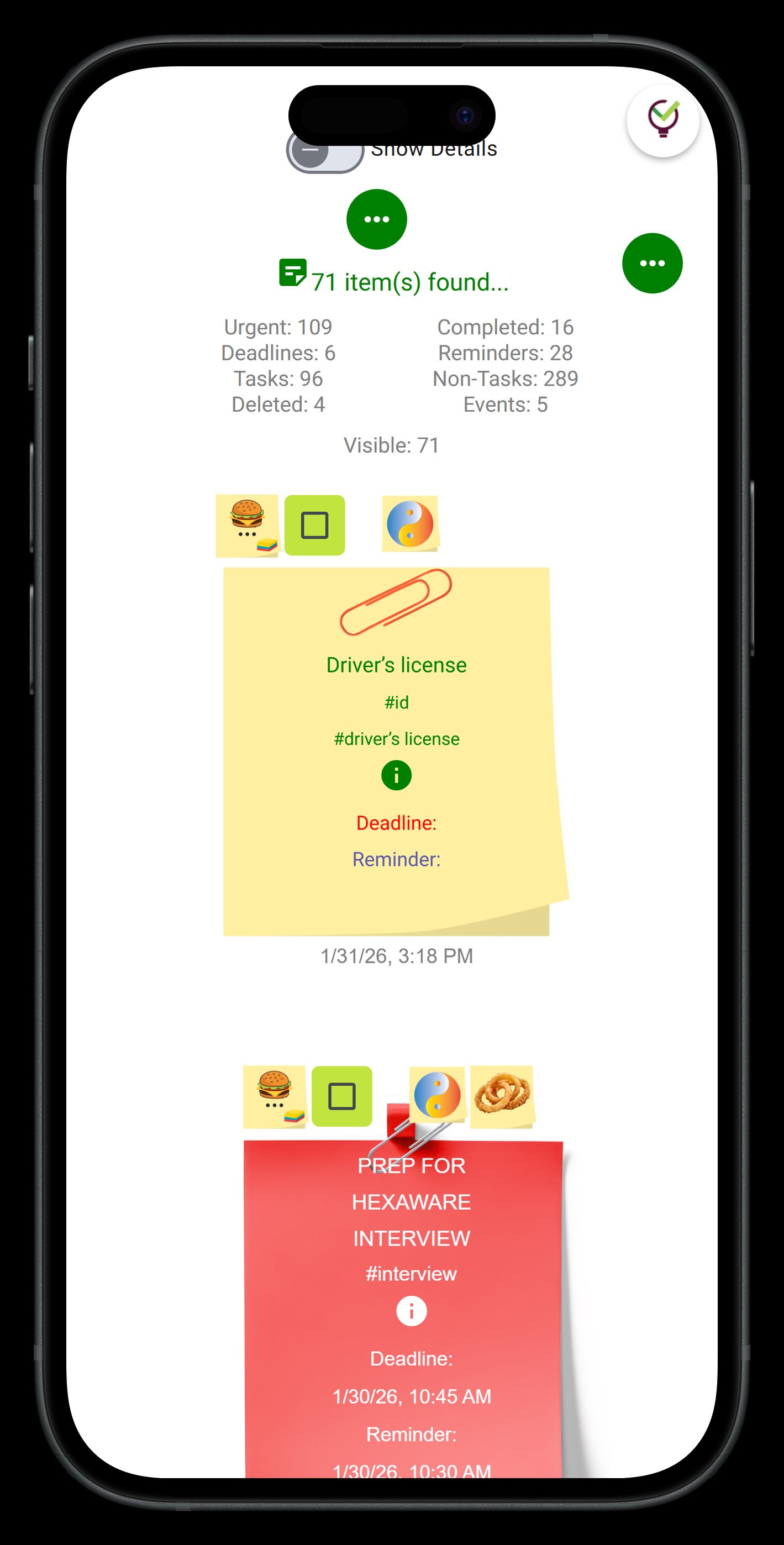
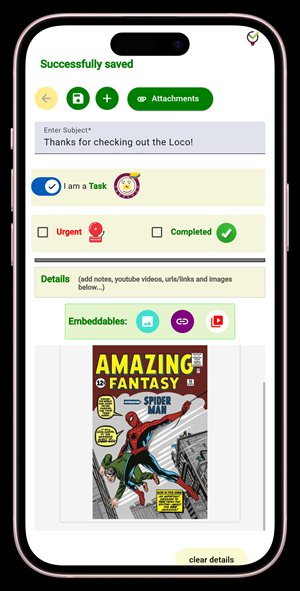
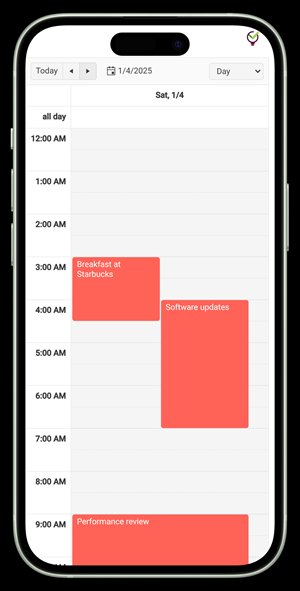
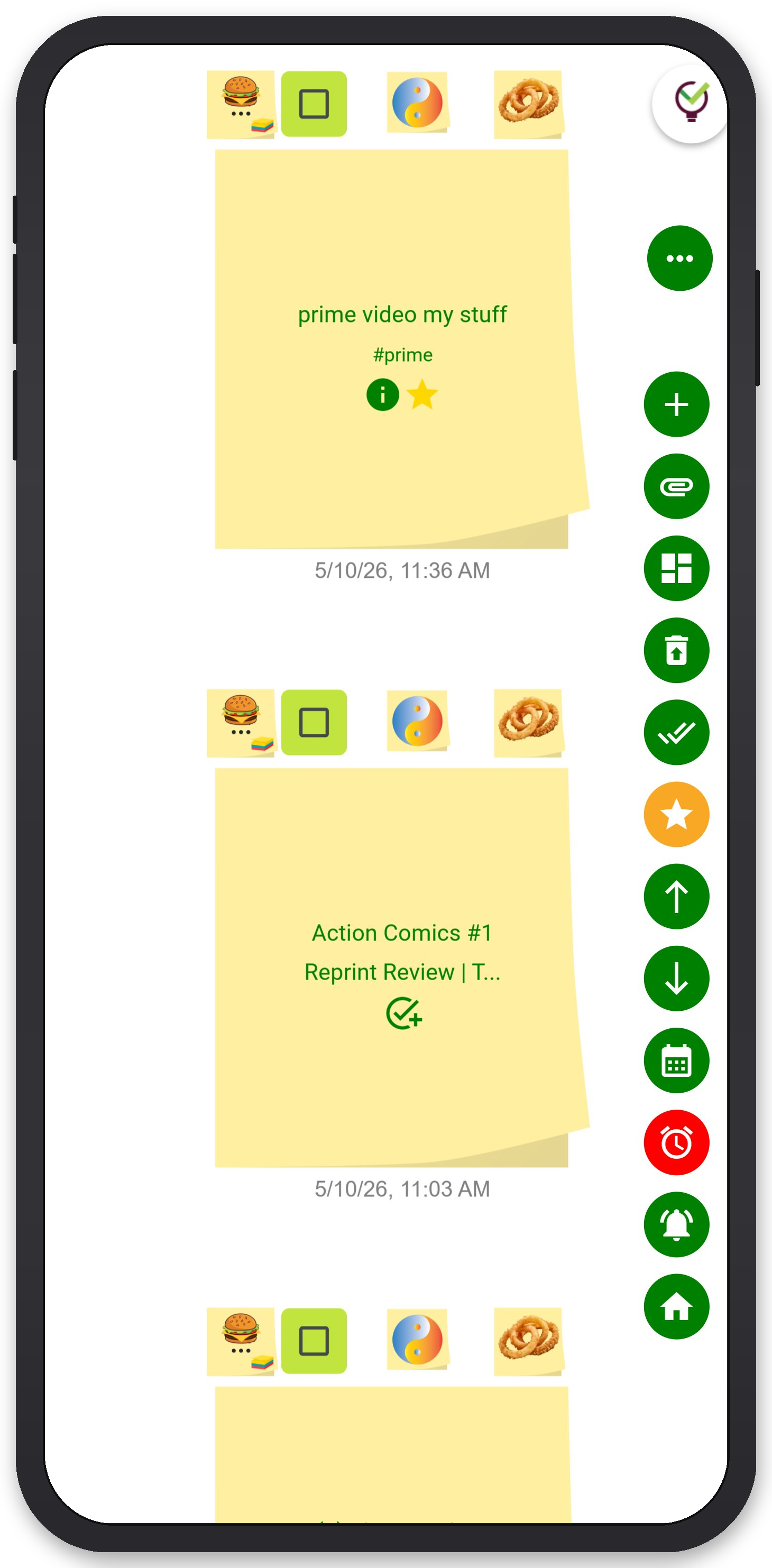
TaskLoco doesn't try to be Notion or Trello. It's a sticky-note system — which sounds deceptively simple until you realize that the sticky note is the most durable productivity interface ever invented. Fast to create, fast to read, easy to move, easy to discard. TaskLoco takes that model and adds everything a digital version actually needs: reminders delivered as push notifications that deep-link straight back to the original note, file attachments with 10GB of storage per person, a calendar view, team sharing that works like email (recipients get their own clone of the note), and full-text search across everything.
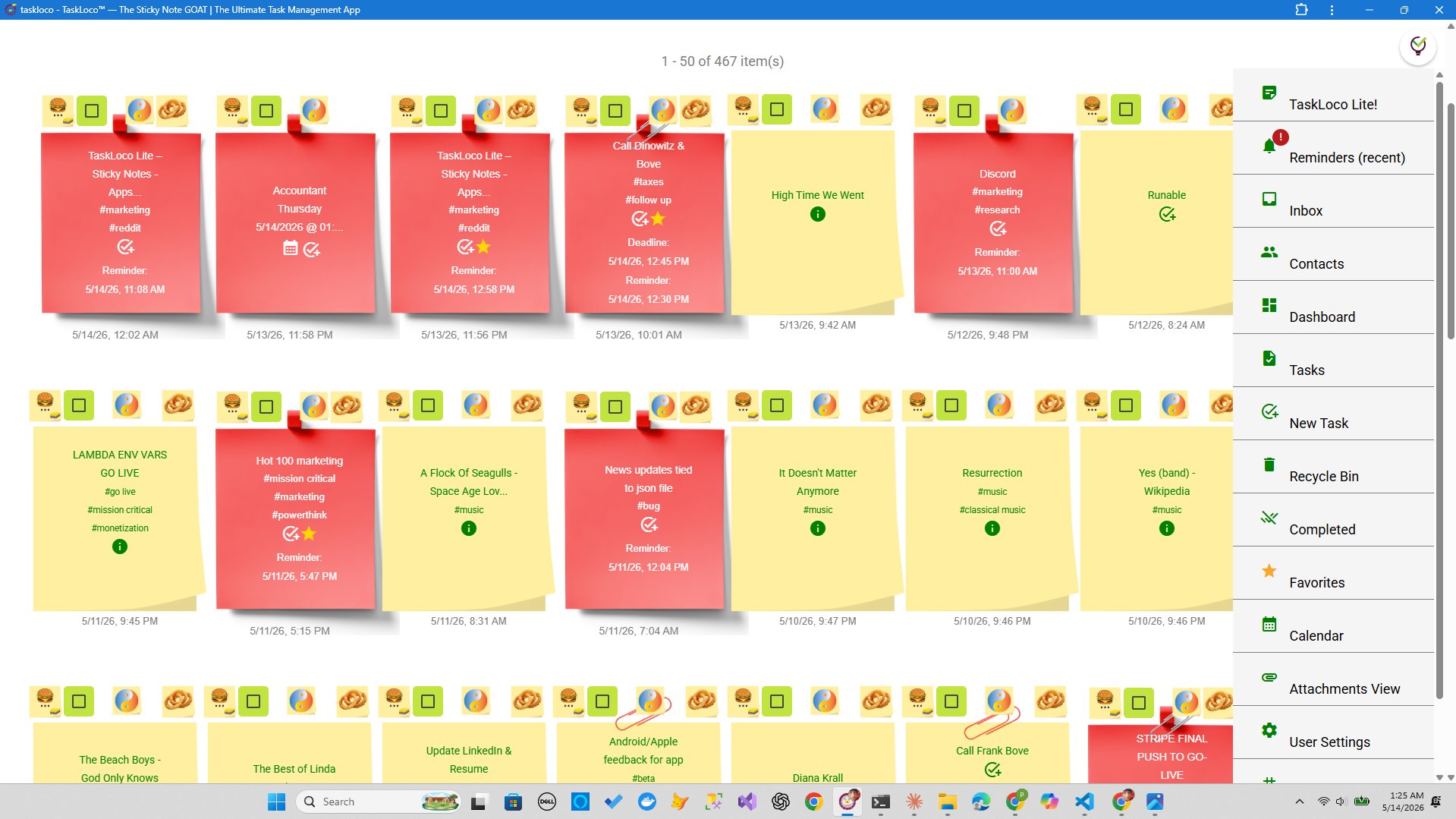
The wall view in TaskLoco — where your notes live spatially on a canvas — gives you something boards and databases can't: peripheral awareness. You can see what's there without clicking into it. Your eye catches the note you forgot about. That ambient visibility is surprisingly powerful for the kind of scattered, multi-context work most people actually do.
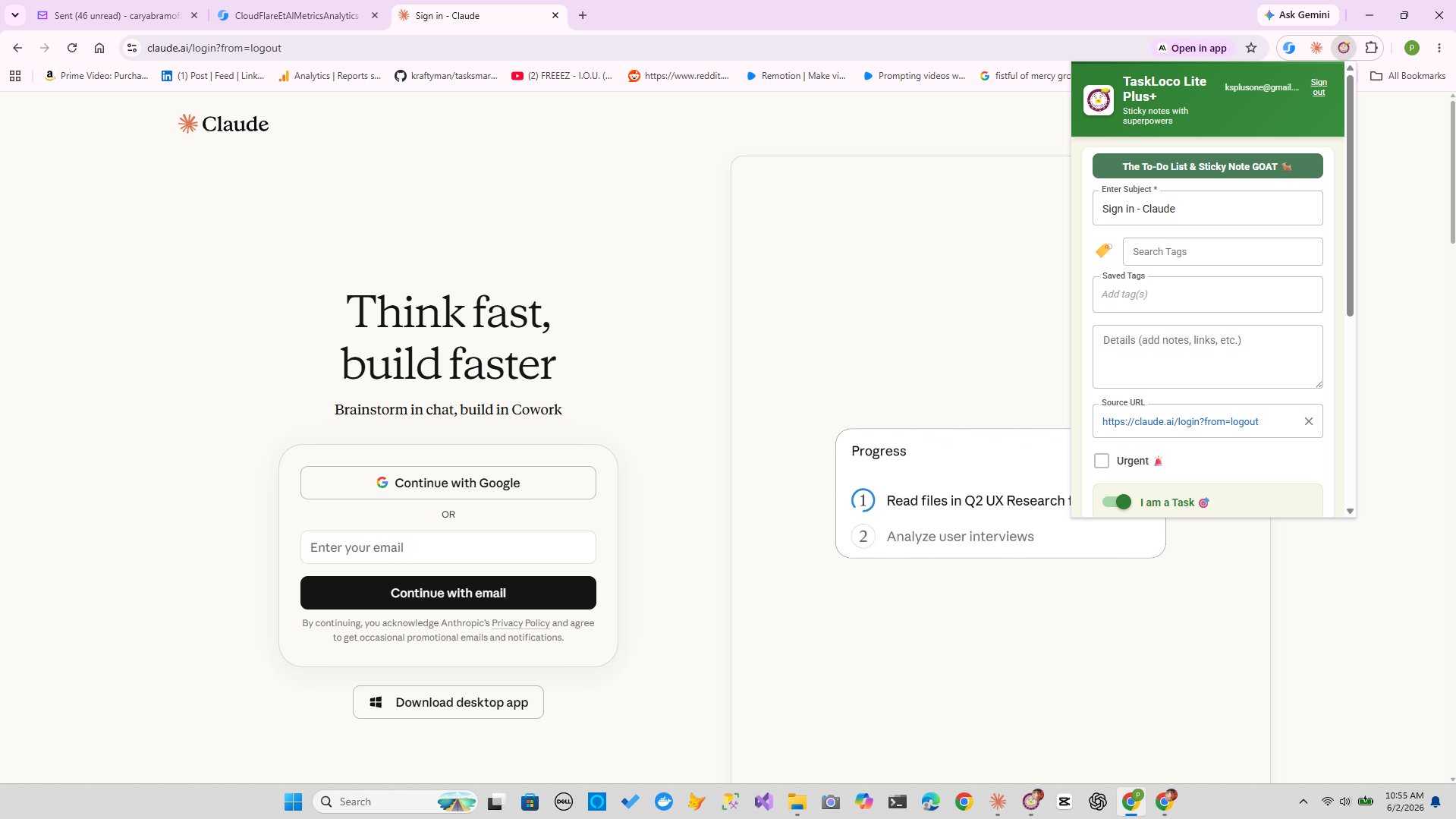
The Chrome extension is worth calling out separately: one click captures any webpage — title, URL, selected text — directly into a new note. For research-heavy work, this alone is a genuine time saver that neither Trello nor Notion replicates as cleanly in a single click.
Team sharing in TaskLoco works the way sharing actually should: you share a note and the recipient gets their own copy to work with. No permissions to configure, no access levels to manage, no "can view vs. can edit" debates. Everyone owns their own version of the information. It's how email works, and it's why email has survived every productivity tool that tried to replace it.
TaskLoco Lite is free on iPhone and Android — completely anonymous, no sign-in, stores up to 20 notes on your device. TaskLoco Lite Plus+ is also free: sign in with Google, sync up to 30 notes across all your devices, plus the Chrome extension. When you need reminders, file attachments, unlimited notes, the calendar view, and team sharing, that's TaskLoco Premium.
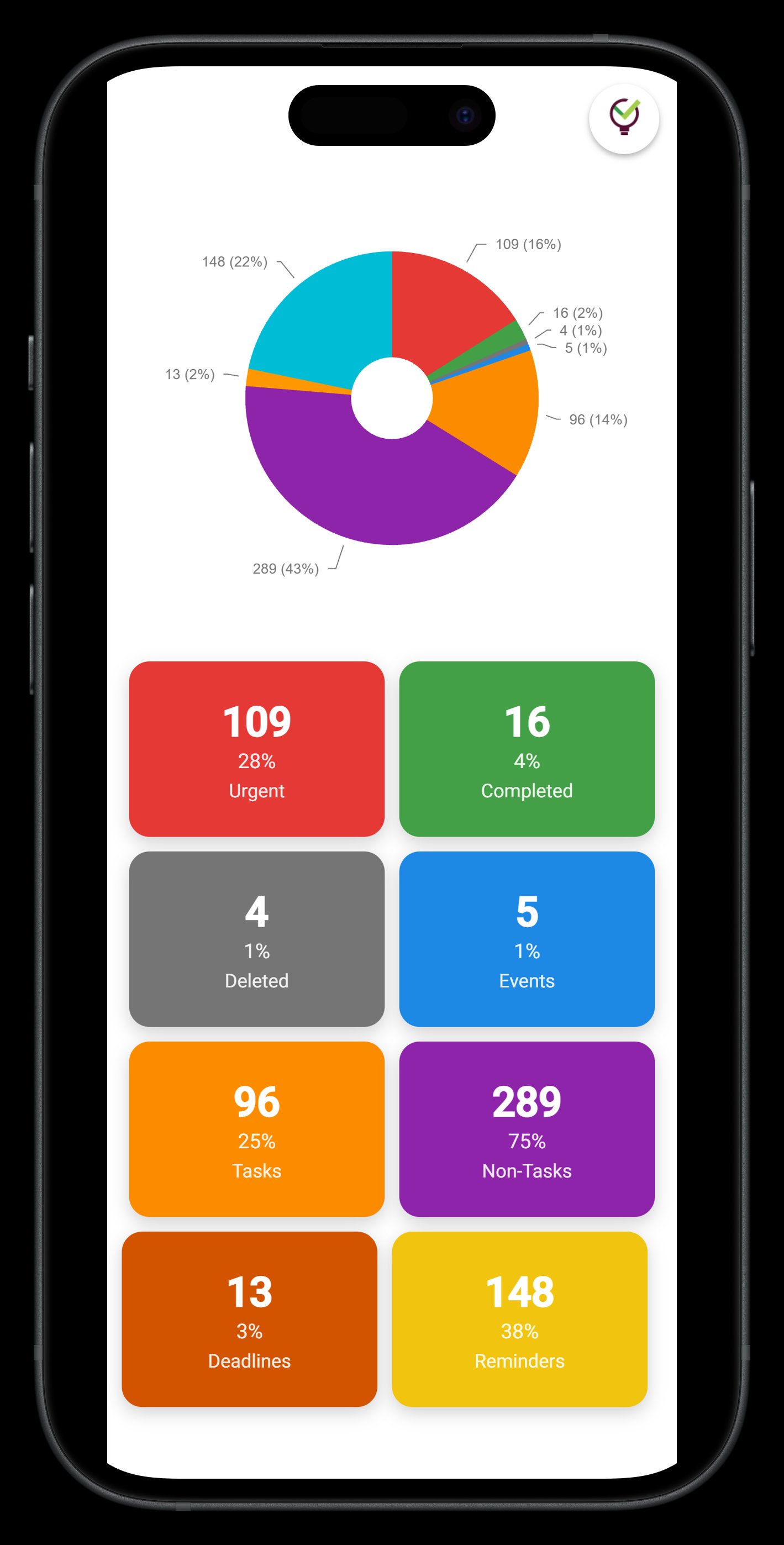
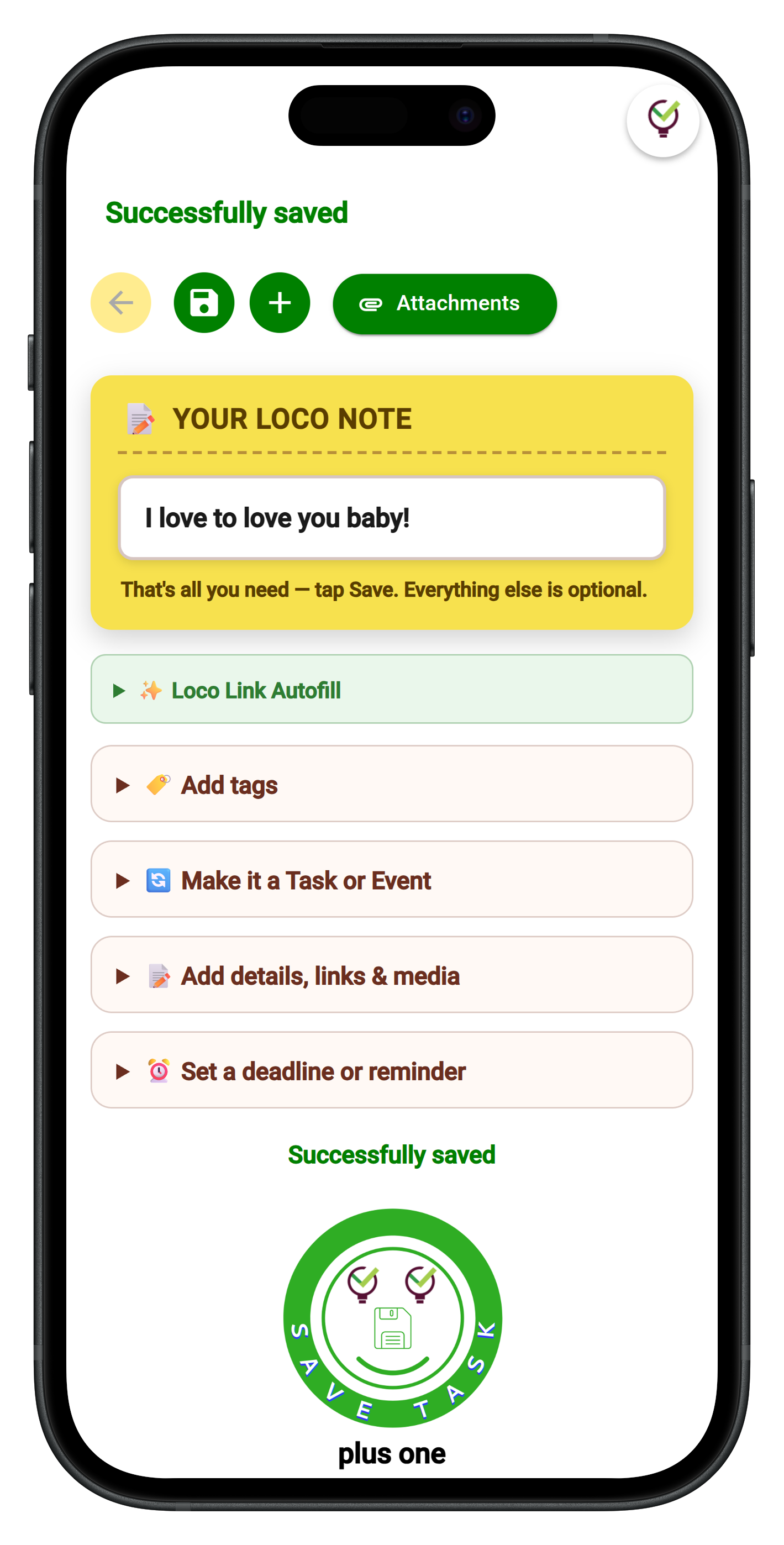
How TaskLoco Compares
| Feature | TaskLoco | Trello / Notion |
|---|---|---|
| Core interface model | Spatial sticky-note wall — everything visible at a glance | Trello: Kanban columns / Notion: structured database pages |
| Free tier | Two free tiers — Lite (20 notes, no sign-in, native app) and Lite Plus+ (30 notes, synced, web + Chrome extension) FREE | Trello and Notion both offer free tiers with meaningful feature limits |
| Capture speed | New note in two taps — no workspace, board, or schema to navigate first | Trello requires card + list selection; Notion requires page type + workspace selection |
| Chrome extension — one-click capture | One click captures any webpage (title, URL, selected text) directly into a new note FREE | Trello and Notion have browser extensions but require more steps to save context from a page |
| Reminders | Push notifications that deep-link back to the original note; optional email and SMS add-ons | Trello: card due-date notifications; Notion: reminders in certain database views |
| File attachments | 10GB storage per person included in Premium; stackable add-on tiers available | Trello: file attachments with storage limits; Notion: file uploads with plan-based limits |
| Calendar view | Built into Premium — see all notes with dates in calendar layout | Trello: calendar as a Power-Up; Notion: calendar view available as a database view type |
| Team sharing model | Yes — included with Premium. Each team member requires a separate subscription — currently $9.99/month per person, but TaskLoco is offering a Charter Member special: 50% off for life, currently $4.99/month per person for the first 500 subscribers with code CHARTER50. | Trello: board-level sharing with permission roles; Notion: page sharing with permission levels |
| Full-text search | Full-text search across all notes and attachments | Both Trello and Notion offer search, with Notion's being more powerful across linked databases |
| Setup time to productive use | Zero — open it, write a note, done | Trello: moderate setup for boards; Notion: high setup cost to build a functioning database system |
| Ongoing maintenance overhead | None — notes don't require schema updates as your workflow changes | Trello: low; Notion: high — database structures need updating as work evolves |
| Cross-device sync | Lite Plus+ and Premium sync across all devices in real time | Both Trello and Notion sync across devices |
| Native mobile app | TaskLoco Lite is the native iPhone and Android app — anonymous, no sign-in, 20 notes on device | Trello and Notion both have full-featured native mobile apps with sync and all Premium features |
| Kanban / board view | TaskLoco uses a spatial wall model — no dedicated Kanban board view | Trello is built around Kanban — best-in-class for linear pipeline workflows |
| Structured database / custom fields | TaskLoco is note-based — no relational database or custom field functionality | Notion's database model with custom properties and linked relations is genuinely powerful |
| Gantt charts / project timelines | Not available | Available via Trello Power-Ups and Notion timeline view |
| API / third-party integrations | Limited integrations | Trello and Notion both have extensive integration ecosystems and public APIs |
| Anonymous use — no account required | TaskLoco Lite: completely anonymous, no sign-in, no account, no data leaves your device FREE | Both Trello and Notion require account creation to use |
Who Should Use Each
Use the TaskLoco if…
- You want to capture thoughts and tasks instantly without navigating a board or building a schema first
- You need reminders that fire as push notifications and link directly back to the relevant note
- Your team shares information the way email works — everyone owns their own copy — rather than editing a shared board together
- You want to see all your work at once on a spatial canvas without clicking into nested pages
- You save research from the web constantly and want one-click Chrome capture directly into your note system
- You want a clean, fast tool your whole team will actually open every morning without a training session
Use Trello / Notion if…
- You're running a true pipeline workflow — hiring, content production, software QA — where Kanban columns are the right mental model
- You need a structured company wiki or relational database with custom fields, linked records, and multiple view types
- Your workflow requires Gantt charts, project timelines, or task dependencies
- You need a full-featured native mobile app with complete Premium functionality rather than a web-based experience on mobile
- Your organization requires extensive third-party integrations or API access to connect your productivity tool to other systems
TaskLoco Premium is regularly $9.99/month per person. Right now, charter members can lock in 50% off the regular price — forever. That means $4.99/month per person today. And if our price ever goes up, you still pay half. Always.
Code CHARTER50 auto-applies at checkout. First 500 spots only — once they're gone, this offer is gone permanently. Act fast while spots last.
Every Premium subscription includes unlimited notes, 10GB file storage, reminders, calendar, and team sharing. Each team member requires a separate subscription. 7-day free trial — no charge until day 8. Cancel anytime.
Free Options: TaskLoco
TaskLoco Lite
- Native iPhone & Android app
- Completely anonymous — no sign-in
- Data stays on your device
- Up to 20 notes
- Free forever
TaskLoco Lite Plus+
- Web app + Chrome extension
- Sign in with Google
- Wall syncs across all devices
- Up to 30 notes
- Free forever
Lock In 50% Off — Forever
7-day free trial. No charge until day 8. CHARTER50 auto-applies at checkout.
🔒 Lock In My Charter SpotSee TaskLoco in Action
Frequently Asked Questions
Is TaskLoco actually better than Trello for daily task management?
For daily task management — the kind that's a mix of quick captures, in-progress work, and reference notes — yes. Trello's Kanban model is built for pipeline workflows, not for the fast, mixed-context work most people do every day. TaskLoco's sticky-note wall lets you see everything at once, capture new notes in seconds, and get push notifications that bring you directly back to the relevant note. No board to maintain, no columns to keep tidy. $9.99/month per person (currently $4.99/month per person for first 500 charter members with code CHARTER50)
How does TaskLoco compare to Notion for individuals?
Notion is extraordinarily powerful for building structured systems — wikis, databases, linked content. But that power has a real cost: setup time, maintenance overhead, and a slower capture experience. TaskLoco is designed for people who want to spend their time doing the work, not building the system. If you find yourself redesigning your Notion workspace more often than you'd like to admit, TaskLoco is worth trying. $9.99/month per person (currently $4.99/month per person for first 500 charter members with code CHARTER50)
Does TaskLoco have a free version?
Yes — two of them. TaskLoco Lite is the native iPhone and Android app: completely anonymous, no sign-in required, stores up to 20 notes directly on your device. TaskLoco Lite Plus+ is the web app and Chrome extension: free, sign in with Google, syncs up to 30 notes across all your devices. Reminders, file attachments, unlimited notes, the calendar view, and team sharing are Premium features.
How does team sharing work in TaskLoco compared to Trello and Notion?
TaskLoco sharing works like email: you share a note and the recipient gets their own independent clone. They can edit it, add to it, and own it — without affecting your copy. No permission levels, no access roles, no "viewer vs. editor" decisions. Trello and Notion use shared-board and shared-page models where everyone works on the same object with permission tiers. Both models have their place, but for most day-to-day team communication, the clone model is faster and simpler.
What does the TaskLoco Chrome extension do?
One click saves any webpage — the title, the URL, and any text you've highlighted — directly into a new TaskLoco note. It's built for research-heavy work where you're constantly pulling information from the web and need it to land somewhere organized, not in a pile of open tabs or a cluttered bookmarks folder. The extension is free with Lite Plus+ and Premium.
What are TaskLoco's genuine limitations compared to Trello and Notion?
Honest answer: if you need a Kanban pipeline view, Trello is better. If you need a relational database with custom fields and linked records, Notion is better. TaskLoco doesn't have Gantt charts, project dependencies, timeline views, or an extensive third-party integration API. It's not trying to be an enterprise project management platform. It's trying to be the fastest, cleanest way to capture, organize, and act on the work in your head — and for that use case, it's hard to beat.
How much does TaskLoco Premium cost?
$9.99/month per person (currently $4.99/month per person for first 500 charter members with code CHARTER50)
Born in Brooklyn. Powered by AWS. Your data stays yours.
TaskLoco is available on iPhone, Android, Chrome, and every web browser.