You found something worth keeping. A recipe, a research source, a YouTube tutorial, a news story you want to come back to. So you do what everyone does: you bookmark it, or you leave the tab open. Three days later, the tab is buried under forty others, and the bookmark is sitting in a folder you haven't opened since last year. The page is gone from your memory even if it isn't gone from your browser.
The real problem isn't saving — it's saving with enough context to actually use what you saved. A bare URL tells you nothing when you stumble across it later. What you actually need is a way to clip a page and attach a thought to it in the same motion, without switching apps or writing anything from scratch. That's what a web clipper with notes does. And the best ones do it in a single click.
What to Look for in a Web Clipper with Notes
Before settling on any tool, it helps to understand what actually separates a useful clipper from one you abandon after two weeks. There are three things that genuinely matter.
Speed of capture. If saving a page takes more than two seconds of your attention, you will stop using the tool. The whole point is to stay in your browsing flow. A clipper that requires you to open a sidebar, fill out a form, choose a folder, and confirm a save is slower than just emailing yourself a link — which is already bad enough. The best clippers live in the toolbar and act on a single click.
Attached context, not just a URL. A saved link without any context is nearly useless. You need the title at minimum, and ideally a place to add a quick note — why you saved it, what you plan to do with it, which project it belongs to. Clippers that save only the raw URL force you to reconstruct your thinking later, which most people never do.
Retrieval that actually works. Saving is only half the job. If you can't find what you clipped when you need it — across devices, without digging — the whole system breaks down. Tags, search, and cross-device sync are not nice-to-haves; they determine whether your saved collection is a resource or a junk drawer.
Why Most Clippers Fall Short — and What Bookmarks Get Wrong
Browser bookmarks are the default answer, and they get the job done just well enough to mask how bad they are. They capture a URL and a title, full stop. There's no way to attach a thought. There's no visual layout. And they live in a nested folder system that made sense in 2005 but feels archaic when you're managing dozens of saved pages across work, personal projects, and research. Most people's bookmark bars are a graveyard of links they saved with good intentions.
Traditional web clippers like the Evernote Web Clipper or the Notion Web Clipper are more powerful, but they come with real friction. They require you to be already using those apps as your primary workspace. If you're not an Evernote user, installing its clipper means committing to Evernote. If you're not deeply embedded in Notion, clipping into it means navigating Notion's structure just to save a link. The clipper is a trojan horse for the app — and if the app doesn't fit your workflow, neither does the clipper.
Then there's the open-tab approach, which isn't really a saving strategy at all. It's a delay tactic. Open tabs feel like saved thoughts, but they're actually just deferred decisions piling up until you either lose them in a crash or close them in a panic during one of those periodic browser cleanups.
The gap all of these leave: a fast, visual, note-attached way to clip a page that doesn't require you to already live inside a specific app. Something that works like a sticky note — grab it, write a quick thought on it, and post it where you'll see it again.
How the Sticky Note Web Clipper Actually Works
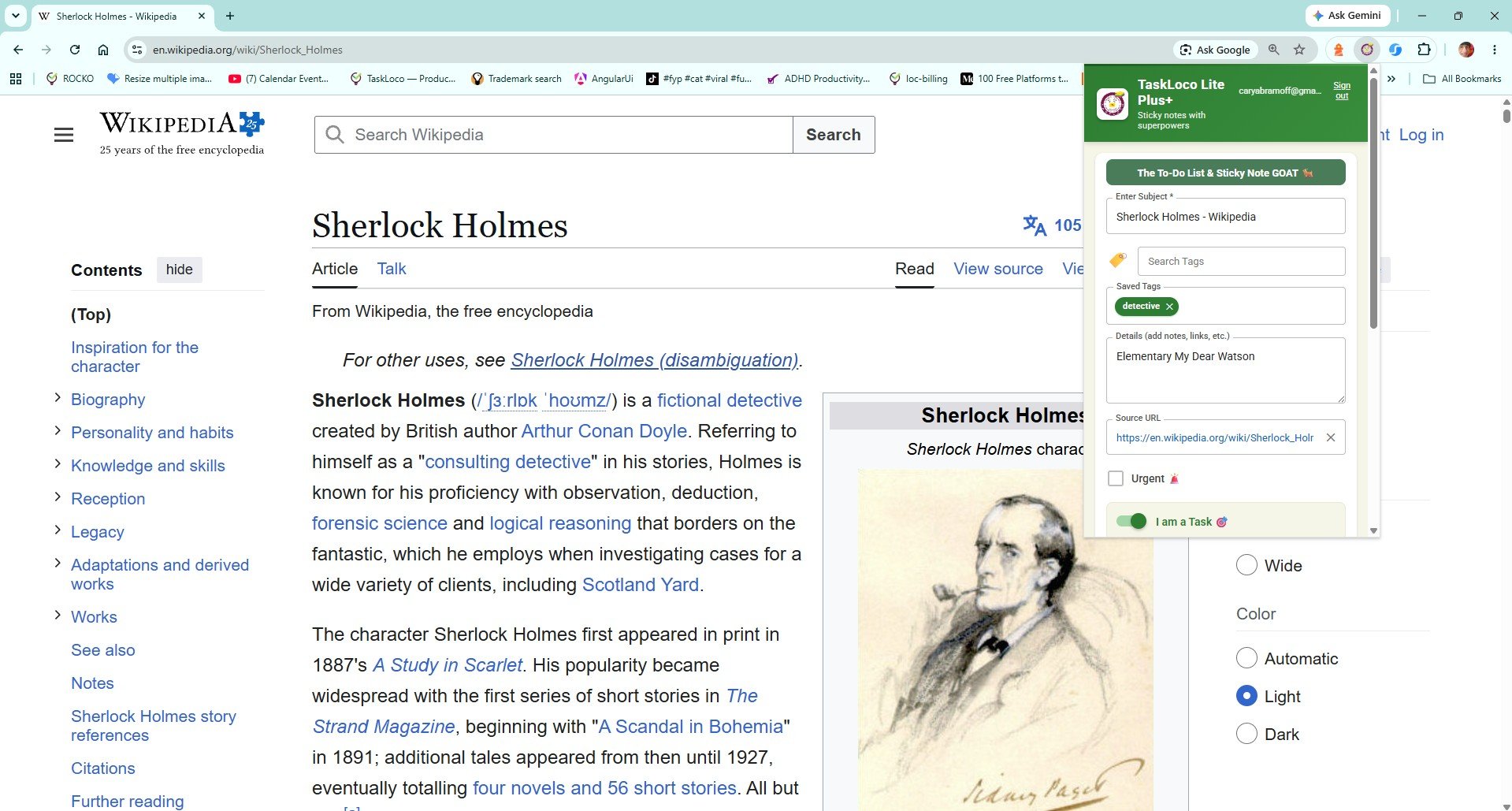
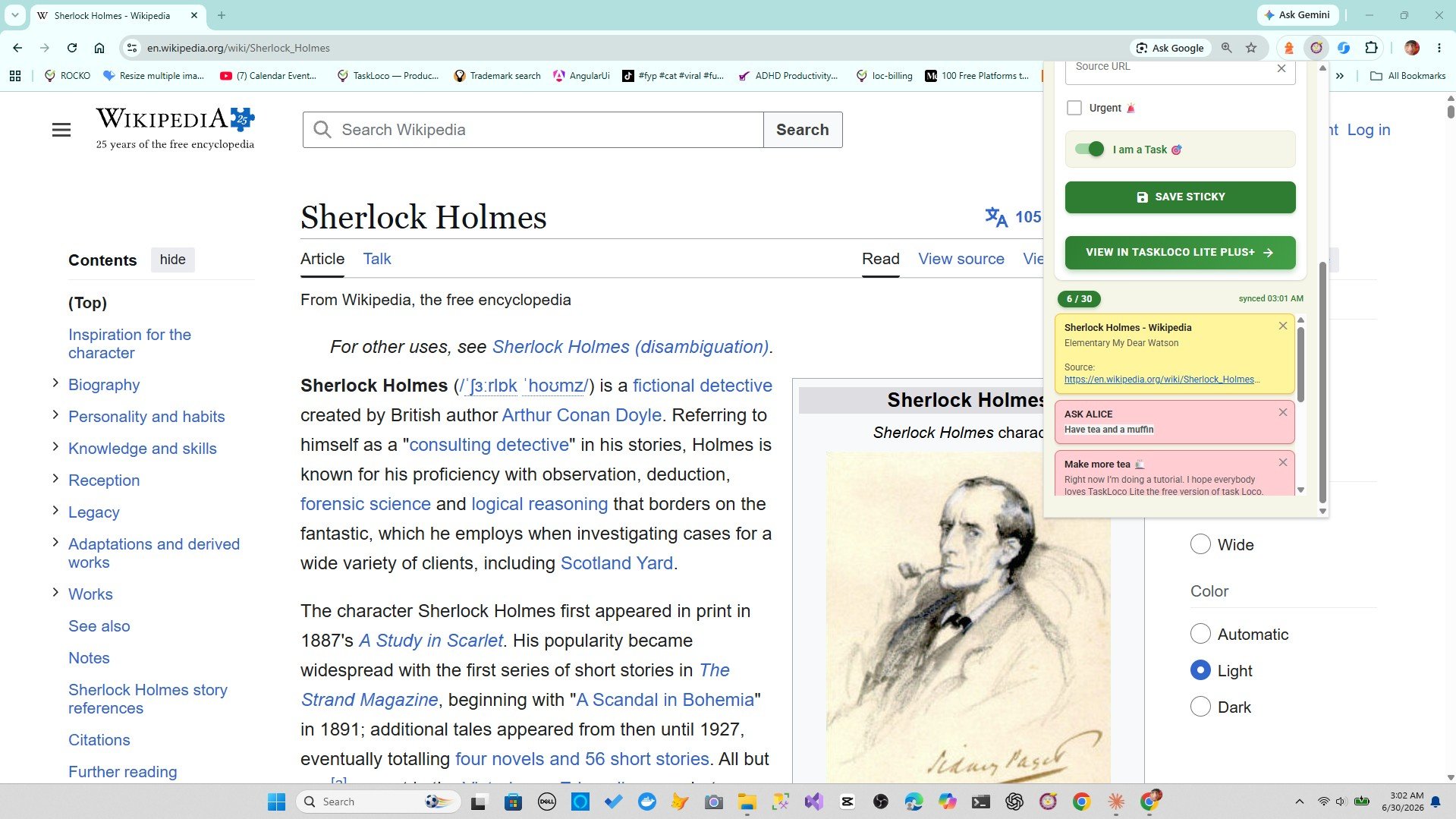
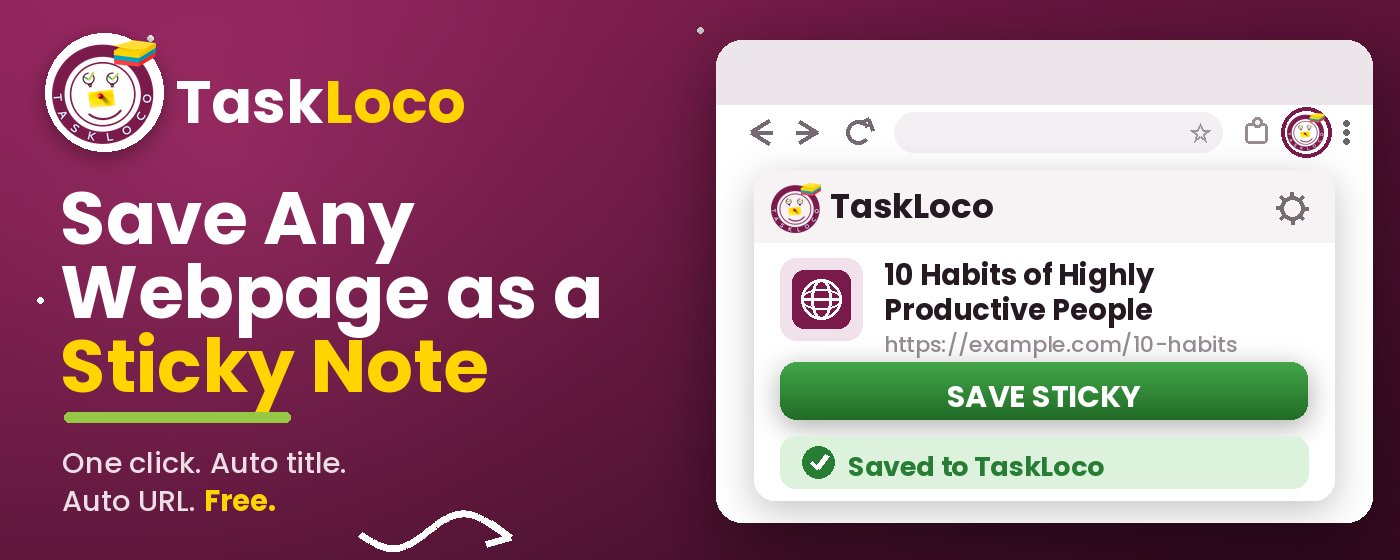
The Sticky Note Web Clipper by TaskLoco is a free Chrome extension that sits in your toolbar and captures the current tab as a sticky note the moment you click it. The title and URL are auto-filled — you don't type anything unless you want to add a note. The whole interaction takes about two seconds.
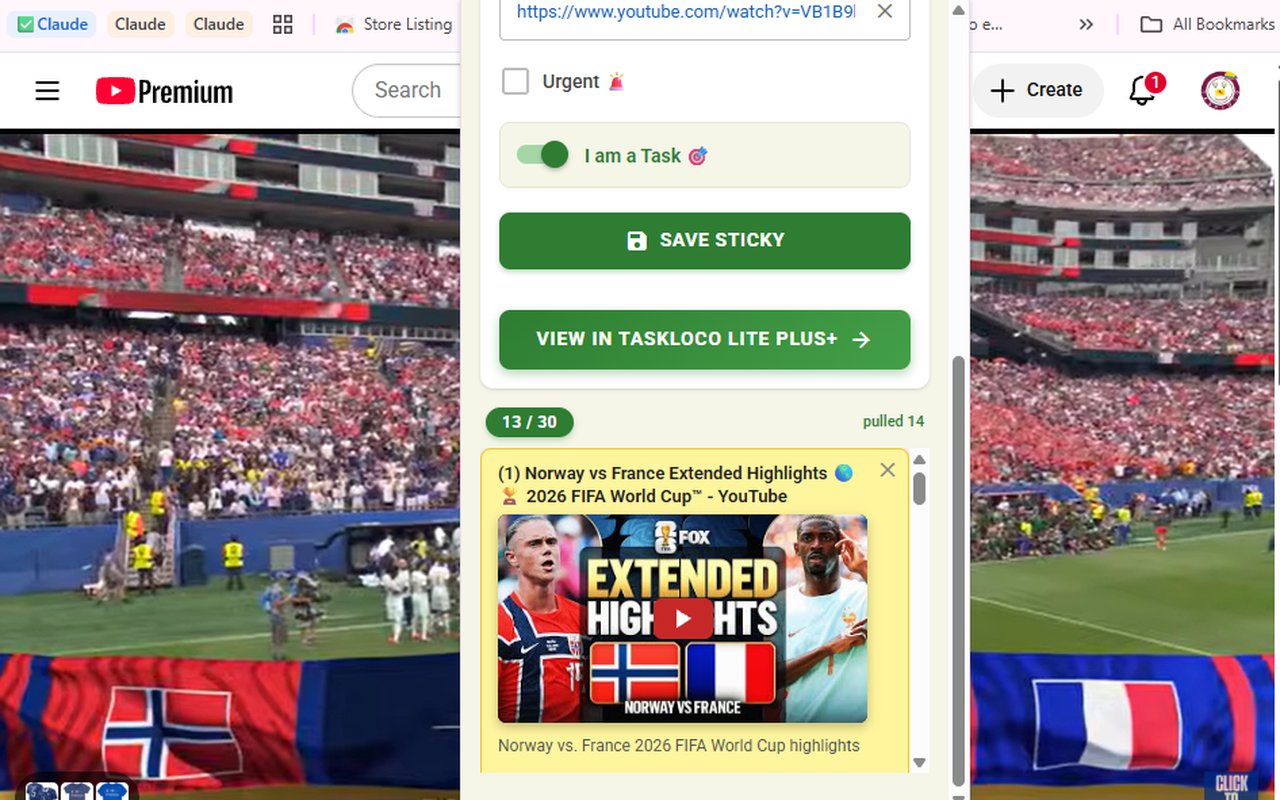
What comes out the other side isn't a raw link in a list. It's a visual sticky note on a wall — something you can actually see and scan. If you saved a YouTube video, the video embeds directly in the note and plays from there, so you never lose track of a tutorial or talk you meant to watch. If you saved an article or research page, the note shows the title, the source URL, and anything you wrote when you clipped it.
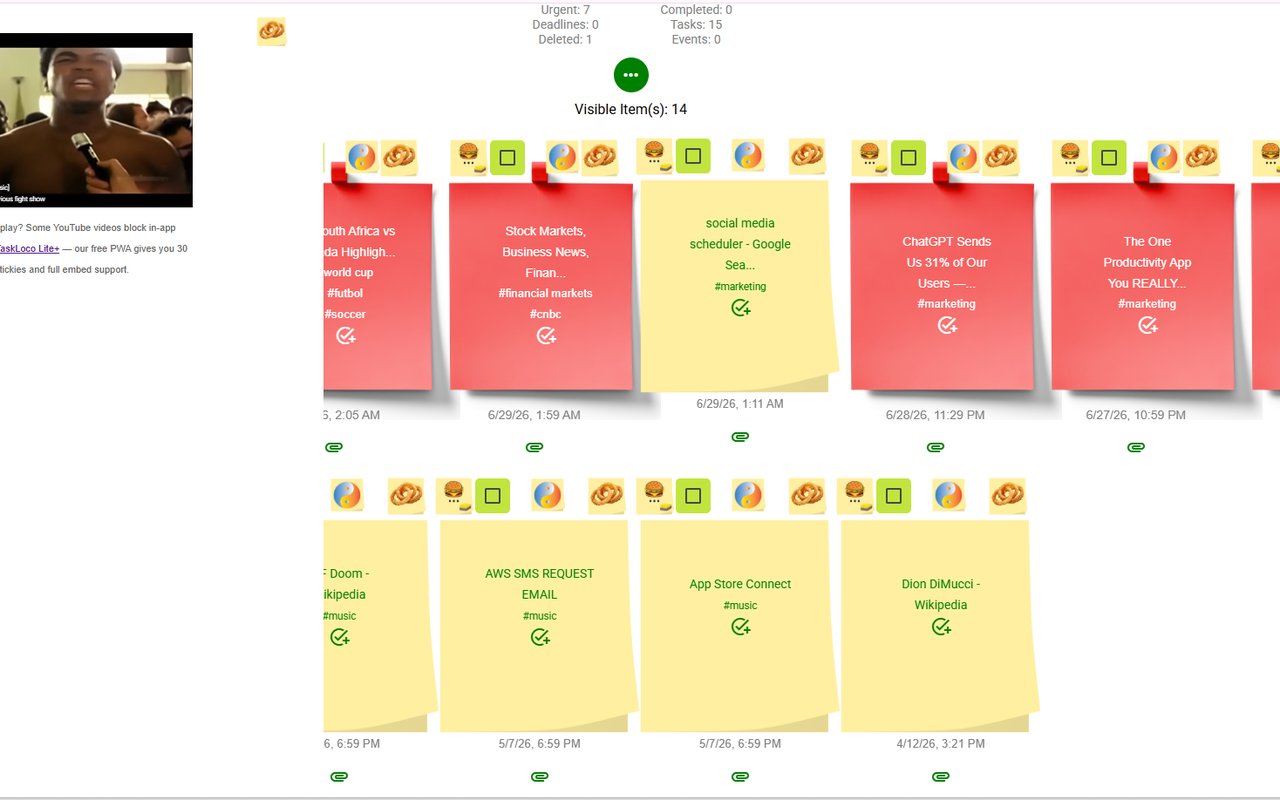
Notes are organized on your TaskLoco wall, which syncs across Chrome, desktop, iPhone, and Android. Everything you clip from your browser is waiting for you on your phone without any manual export. Sign-in is free with Google, and the extension itself is free — there's no paywall between clicking the toolbar icon and finding your saved notes on your phone five minutes later.
Search and tags let you retrieve anything quickly. If you've been clipping articles on the same topic for weeks, a single search surfaces all of them. That's the retrieval piece that most clippers ignore, and it's what turns a collection of saved pages into something you can actually use.
The Kinds of Things People Actually Save with It
The clipper is general-purpose by design, but a few use patterns show up constantly among people who actually stick with it.
- Research and reading lists. You're reading about a topic and keep finding sources you want to revisit. Instead of fourteen open tabs, you clip each one as a note with a quick thought about why it's relevant. When you sit down to write or decide, everything is organized and searchable.
- YouTube tutorials and talks. A video you want to watch later is the most common thing people lose track of. Clipping it saves the embed so the video plays directly from the note — no hunting through watch history, no re-searching for a title you half-remember.
- Articles you want to act on. A how-to guide, a news story that affects something you're working on, a product page you're considering. These aren't just reads — they require follow-through. Saving them as notes with context attached means the action item travels with the link.
- Reference pages you return to. Documentation, style guides, frequently visited resources. Instead of re-bookmarking in a folder you'll lose, a note on your wall is visible and searchable every time you open TaskLoco.
What ties all of these together is that they're things worth saving with context — not just saving. The one-click flow means you do it in the moment, while the reason you saved it is still fresh, rather than promising yourself you'll organize it later.
How TaskLoco Compares
| Feature | Sticky Note Clipper | Most Clippers |
|---|---|---|
| Save the current page | One click on the toolbar icon — page saved instantly as a sticky note FREE | Most clippers require multiple steps: open sidebar, choose destination, confirm |
| Title auto-filled | Yes — the page title is captured automatically, no typing required FREE | Some clippers auto-fill the title; plain bookmarks do but nothing else |
| URL auto-filled | Yes — the source URL is captured and stored with every note FREE | Bookmarks store the URL but strip all context; clippers vary |
| Attached note or thought | Write a note directly on the sticky note at the moment of saving FREE | Browser bookmarks have no note field; most clippers require a separate edit step |
| Visual layout | Saved pages appear as sticky notes on a visual wall — scannable at a glance FREE | Bookmarks are a flat text list; most clippers use list or document views |
| YouTube video embed | Saved YouTube videos embed in the note and play directly from it FREE | Most clippers save only the link; video does not embed or play in-note |
| Syncs to iPhone and Android | Notes sync to TaskLoco on iPhone, Android, and desktop automatically FREE | Browser bookmarks sync within the browser only; many clippers require paid plans for mobile |
| Search saved notes | Full search across all your saved notes by title or content FREE | Browser bookmark search is limited; clipper search quality varies widely |
| Tags for organization | Add tags to any note to group and filter saved pages by topic or project FREE | Most clippers offer tags only on paid tiers; bookmarks rely on folder nesting |
| No app commitment required | The clipper works on its own; TaskLoco is the free destination where notes live FREE | Evernote and Notion clippers require active use of those apps to be useful |
| Free to install and use | The extension is free; TaskLoco has a free tier — no paywall for core clipping FREE | Many clippers lock sync or search behind paid plans |
| Sign-in friction | Sign in free with Google — one tap, no new account form to fill out FREE | Some clippers require a separate account signup with email verification |
| Captures articles and news pages | Any webpage — article, news story, research source — saved as a note in one click FREE | All clippers handle basic pages, but few pair the save with an attached note in one step |
| Available as a Chrome extension | Yes — free on the Chrome Web Store, installs in seconds FREE | Most clippers are also Chrome extensions, so this is a tie on availability |
Who Should Use Each
Use the Web Clipper if…
- You want to save pages, articles, and YouTube videos as visual sticky notes with a thought attached — in one click
- You want what you clip in Chrome to sync to your phone and desktop for free, without any extra steps
- You do research, reading, or project work in the browser and need a fast way to collect sources with context
- You're tired of open tabs and empty bookmarks folders and want a clipping system that actually surfaces what you saved
- You want to embed and play YouTube videos directly from your saved notes without hunting for them again
Use Most Clippers if…
- You only ever need a plain URL with no note attached and a flat bookmark list is genuinely enough for you
- You're already deeply committed to Evernote or Notion and want clipping to feed directly into that existing workspace
- You never revisit what you save, so the retrieval side of the equation doesn't matter to you
The Sticky Note Web Clipper is free. Install it from the Chrome Web Store, sign in with Google, and every page you clip becomes a sticky note you can find later.
Your clipped notes sync to TaskLoco across Chrome, desktop, iPhone, and Android — also free to start. No credit card to begin.
Get the Free Clipper
Sticky Note Web Clipper
- Free Chrome extension
- One-click save — any page, article, or video
- Title & URL auto-filled
- Tags & search
- Free forever
Synced to TaskLoco
- Sign in free with Google
- Your wall on Chrome, desktop, iPhone, Android
- YouTube videos embed & play in notes
- Visual sticky-note wall
- Free to start
Add It to Chrome — Free
One click saves any page, article, or YouTube video as a sticky note. Title and URL auto-filled.
Add to Chrome — FreeSee TaskLoco in Action
Frequently Asked Questions
Is the Sticky Note Web Clipper free?
Yes — the extension is free to install from the Chrome Web Store. TaskLoco, where your saved notes live, has a free tier. Sign in with Google and start clipping immediately at no cost.
How do I save a web page with a note attached using this extension?
Install the Sticky Note Web Clipper from the Chrome Web Store. When you're on any page you want to save, click the extension icon in your toolbar. The page title and URL are auto-filled into a sticky note. You can add your own note right there before saving, or leave it as-is. The whole thing takes about two seconds.
Can I save YouTube videos and watch them later inside my notes?
Yes. When you clip a YouTube video using the extension, the video embeds directly inside the sticky note. You can play it from there without going back to YouTube — useful for tutorials, talks, or anything you want to watch but not right now.
Will my saved notes be available on my phone?
Yes. Notes you clip in Chrome sync to TaskLoco, which is available on iPhone, Android, and desktop. Whatever you save while browsing on your computer is available on your phone without any manual transfer.
How is this different from just using bookmarks?
Browser bookmarks save a URL and a title, nothing more. There's no place to attach a thought, no visual layout, and no way to search by context. The Sticky Note Web Clipper saves the page as a visual sticky note where you can write why you saved it, tag it, and find it later by searching. Bookmarks are a list; this is a system.
How is this different from the Evernote or Notion web clipper?
Those clippers are designed to feed content into Evernote or Notion. If you already live in one of those apps, that can make sense. But if you don't, you're committing to a whole separate app just to clip a page. The Sticky Note Web Clipper is lightweight, visual, and free — and the destination, TaskLoco, is built around exactly this use case rather than being a document editor that also happens to accept clips.
Do I need to create a new account to use it?
No new account form. You sign in free with Google. That's the whole setup. Install the extension, sign in with Google, and your first clip is one toolbar click away.
Born in Brooklyn. Powered by AWS. Your data stays yours.
TaskLoco is available on iPhone, Android, Chrome, and every web browser.