Spencer Silver invented the adhesive in 1968 by accident. Arthur Fry figured out the application in 1974 when a bookmark kept falling out of his hymnal. By 1980, the Post-it Note was on shelves. None of that explains why, five decades later, the sticky note remains the most-trusted memory tool in the world — from hospital operating rooms to NASA mission control to the walls of startups. That staying power is not nostalgia. It is cognitive science.
The sticky note hits several psychological mechanisms at once: it offloads working memory, creates a visible commitment, rewards the act of writing, and uses physical or spatial context as a retrieval cue. Understanding exactly why it works helps explain not just the paper square, but why digital tools that faithfully replicate the format consistently outperform more complex alternatives for day-to-day task capture.
Working Memory Is the Bottleneck — Sticky Notes Are the Relief Valve
Human working memory is notoriously limited. George Miller's landmark 1956 paper established that the average person can hold roughly seven items (plus or minus two) in conscious awareness at once. More recent research by Nelson Cowan suggests the actual functional limit may be closer to four chunks. Either way, it is a small number, and modern knowledge work routinely asks people to juggle far more than that simultaneously.
This is where the sticky note earns its keep. Cognitive scientists call the strategy cognitive offloading — using an external object to hold information so the brain doesn't have to. When you write a task on a sticky note and post it somewhere visible, you are not just reminding yourself of the task; you are actively freeing up working memory capacity for deeper thinking. The note becomes a reliable external node in your cognitive system.
The key word is visible. A task buried in a list app or a notes folder requires active recall — you have to remember to look. A sticky note on your monitor, your desk, or a shared wall enters your peripheral visual field without demanding effort. Researchers refer to this as ambient information: data that sits at the edge of attention and surfaces when relevant, rather than requiring deliberate retrieval.
The Generation Effect, Constraint, and Why Writing It Yourself Matters
In 1978, psychologists Norman Slamecka and Peter Graf published a finding that has been replicated dozens of times since: people remember information significantly better when they generate it themselves compared to when they simply read it. This is called the generation effect, and it is one of the strongest results in memory research.
Writing a sticky note is a generation event. You are not copying text verbatim. You are reading or hearing something, processing it through your own understanding, and producing a condensed, personal version. That encoding process — summarizing, choosing words, deciding what matters — creates a far richer memory trace than passive consumption. The note itself becomes almost secondary; the act of writing it does most of the cognitive work.
The physical constraint of a sticky note amplifies this. A standard 3×3 Post-it holds roughly 30–50 words comfortably. That is not a bug. Forced brevity is a compression algorithm for your thinking. To fit an idea on a sticky note, you have to understand it well enough to reduce it to its core. If you cannot write it small, you probably do not understand it clearly yet. This is why sticky notes are so effective for capture in meetings, brainstorming, and planning — the constraint does intellectual work that open-ended writing tools leave entirely to the user.
There is also a commitment dimension. Behavioral economists have studied how implementation intentions — plans stated in concrete, specific terms — dramatically increase follow-through compared to vague goals. A sticky note that says Call Maria re: invoice before noon is an implementation intention. It specifies action, object, and time. Research by Peter Gollwitzer shows this kind of specific, written commitment can double or triple the likelihood of actually doing the thing.
Where Sticky Notes Break Down �� and What That Reveals About the Format
Honest science means accounting for the failure modes, and sticky notes have real ones. The cognitive benefits depend on the notes remaining visible and meaningful. A physical wall covered in 200 notes stops being ambient information and becomes noise — the brain habituates to it and stops registering the individual items. Researchers call this attentional habituation: novel stimuli capture attention; repeated stimuli are filtered out. A sticky note you have walked past 40 times without acting on is effectively invisible.
The format also has no memory of itself. Physical sticky notes get lost, fade, fall off surfaces, and provide no searchable record. They cannot remind you of themselves when you are away from the wall. They cannot be shared with a colleague in another city without being photographed. They cannot be attached to a file, a calendar date, or a follow-up thread. The constraint that makes them cognitively powerful — simplicity and immediacy — is the same constraint that limits them in complex, collaborative, or time-sensitive work.
There is also a categorization problem at scale. A dozen sticky notes on a wall is a system. A hundred sticky notes is chaos unless significant effort goes into grouping, color-coding, and spatial organization. The wall itself becomes the information architecture, and maintaining it requires discipline that many people cannot sustain under pressure.
These are not arguments against sticky notes — they are arguments for understanding what the format is genuinely good at. It is excellent for capture, short-horizon tasks, visible commitment, and rapid brainstorming. It is poor for archival, search, collaboration across distance, and anything requiring structured follow-up. Any tool — physical or digital — that claims to replicate the sticky note experience should be measured against exactly this list of strengths and weaknesses.
How TaskLoco Is Built Around These Principles
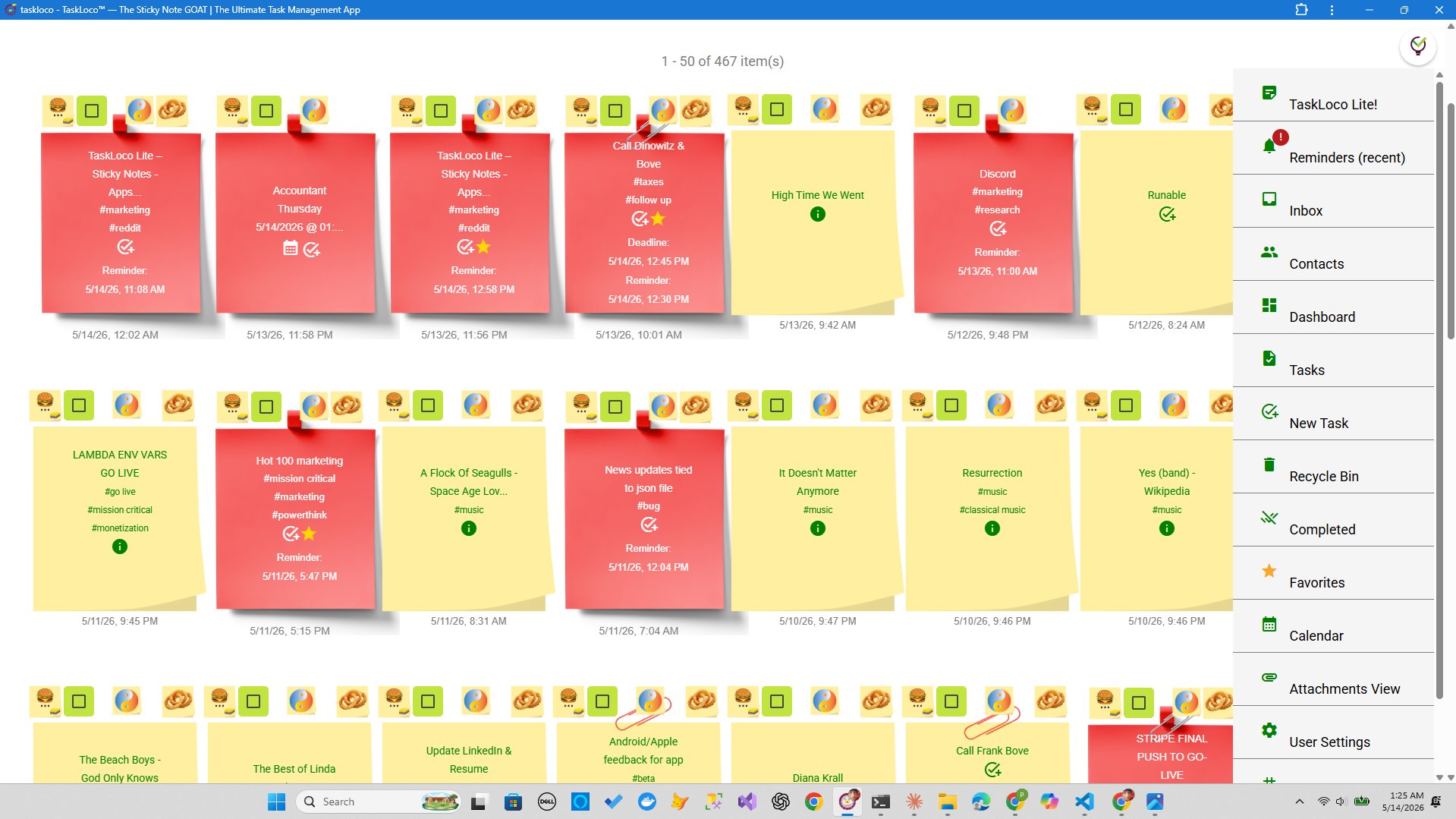
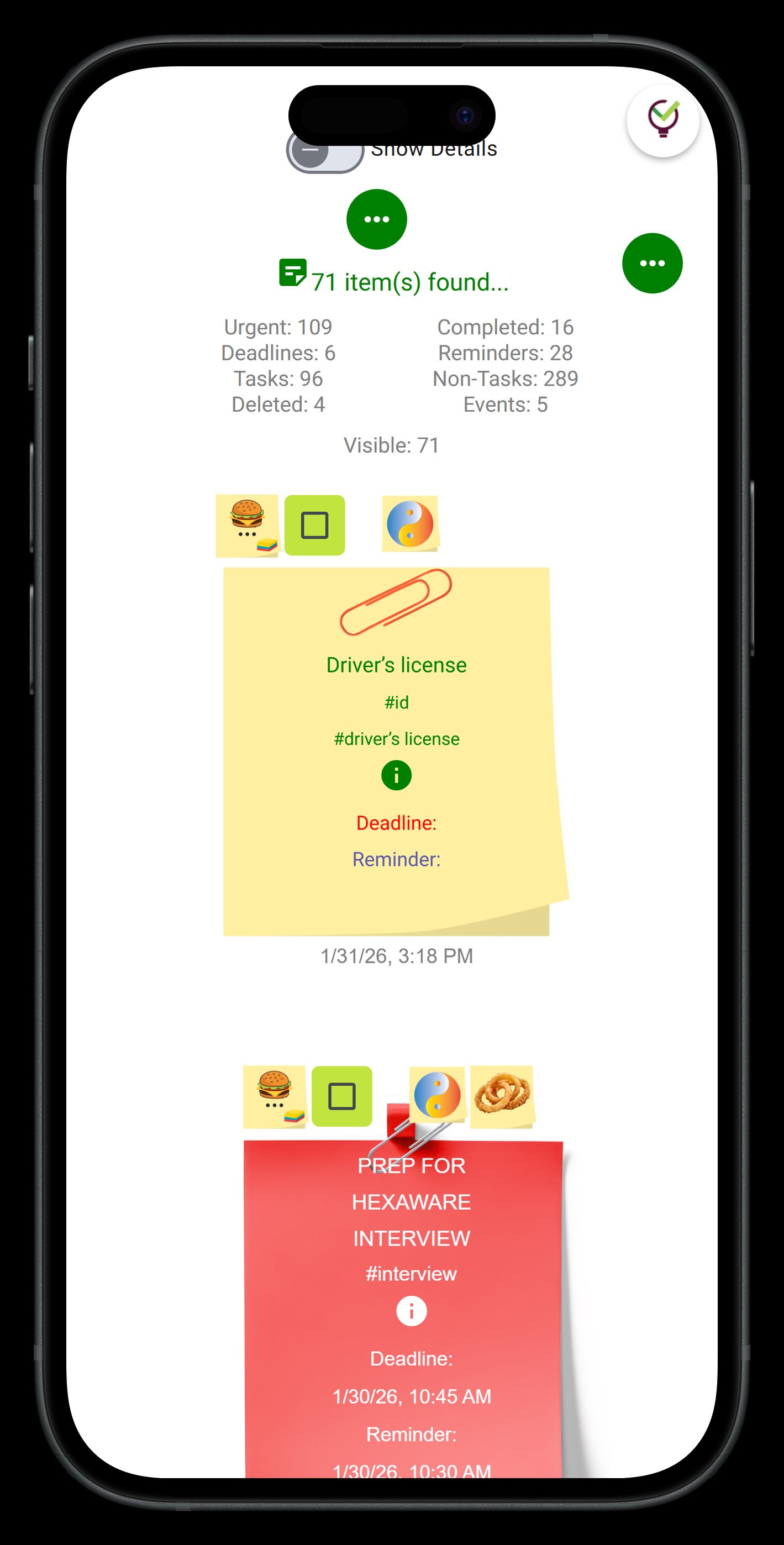
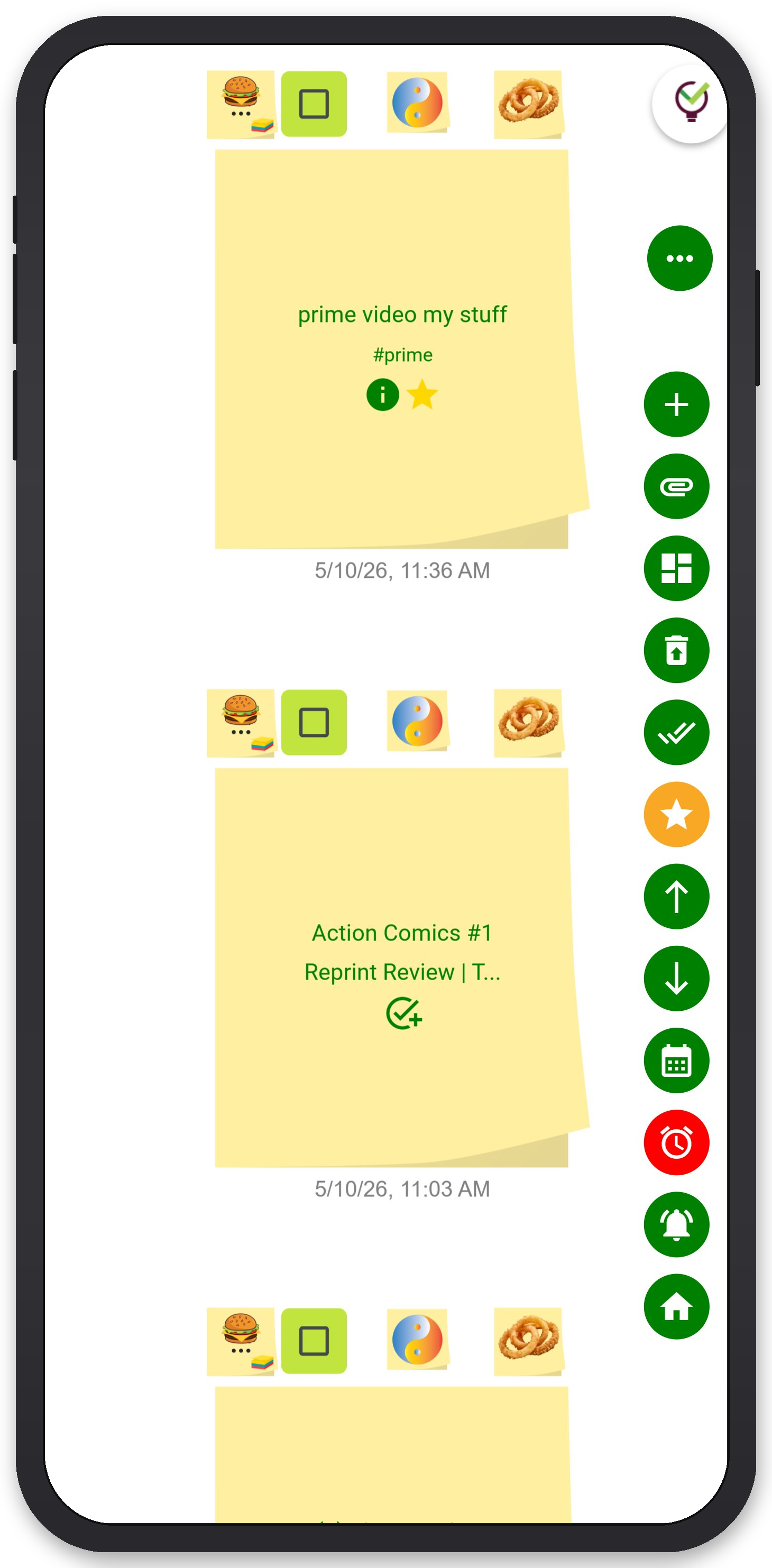
TaskLoco is a productivity app whose core unit is the sticky note — not as a metaphor, but as the actual organizing object. The wall view gives you a spatial canvas where notes are placed, grouped, and rearranged, preserving the ambient-information and spatial-memory benefits that make physical sticky notes effective. You can see everything at once, which is the whole point.
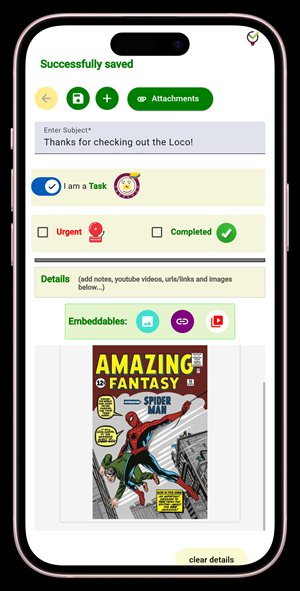
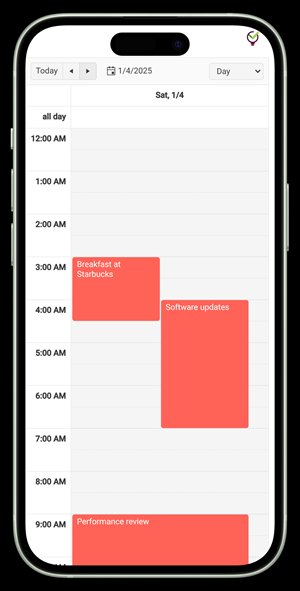
Where physical notes fail, TaskLoco fills the gaps directly. Notes sync across devices so nothing is lost when you leave the room. TaskLoco Premium includes reminders — delivered as push notifications that deep-link back to the exact note that triggered them, so you land in context, not just in an app. File attachments (10GB included with Premium) mean a note can hold a contract, a photo, or a reference document alongside the task it relates to. And team sharing works the way email does — a recipient gets the note and can clone it as their own, no permissions setup, no access-level confusion.
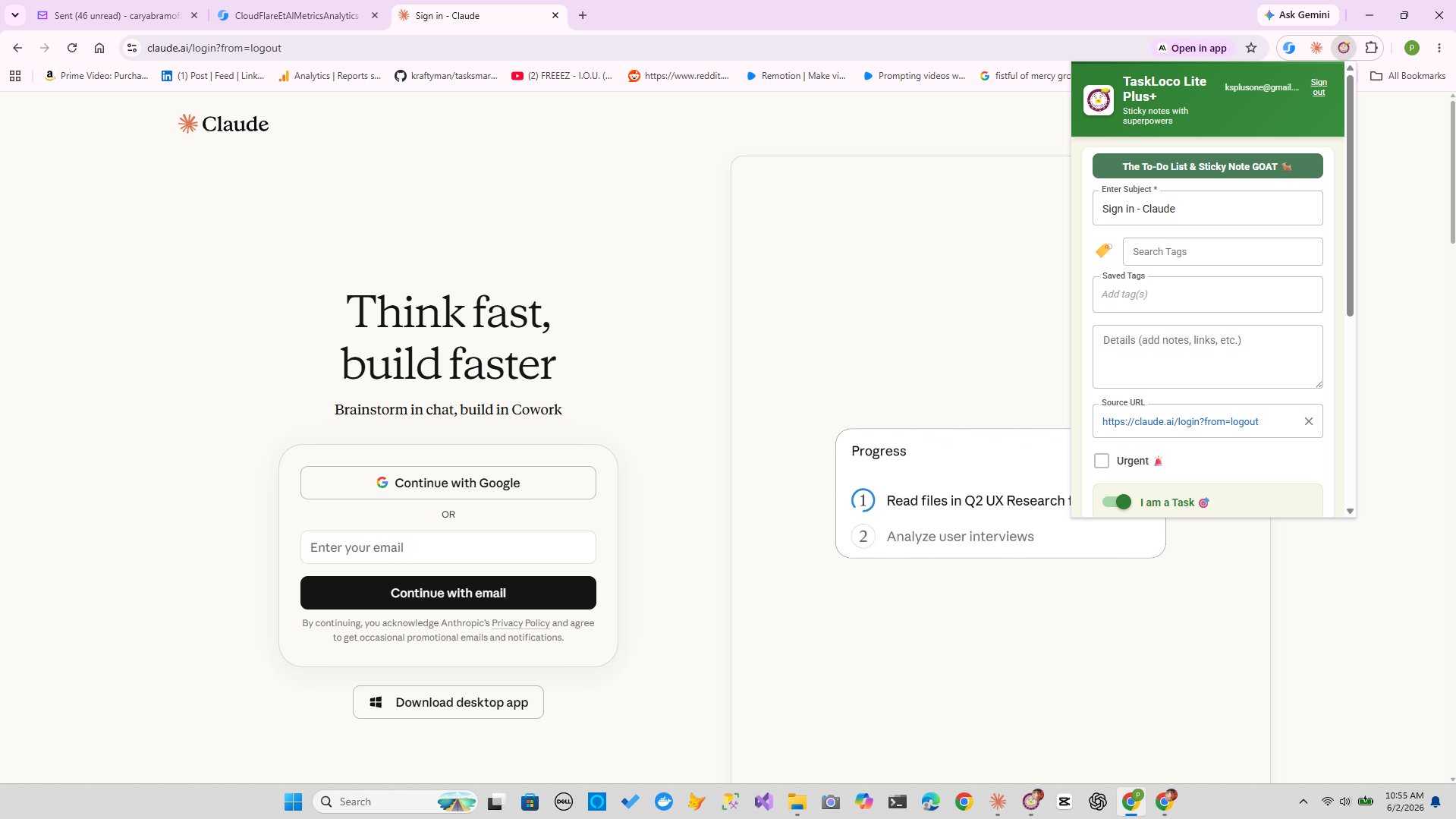
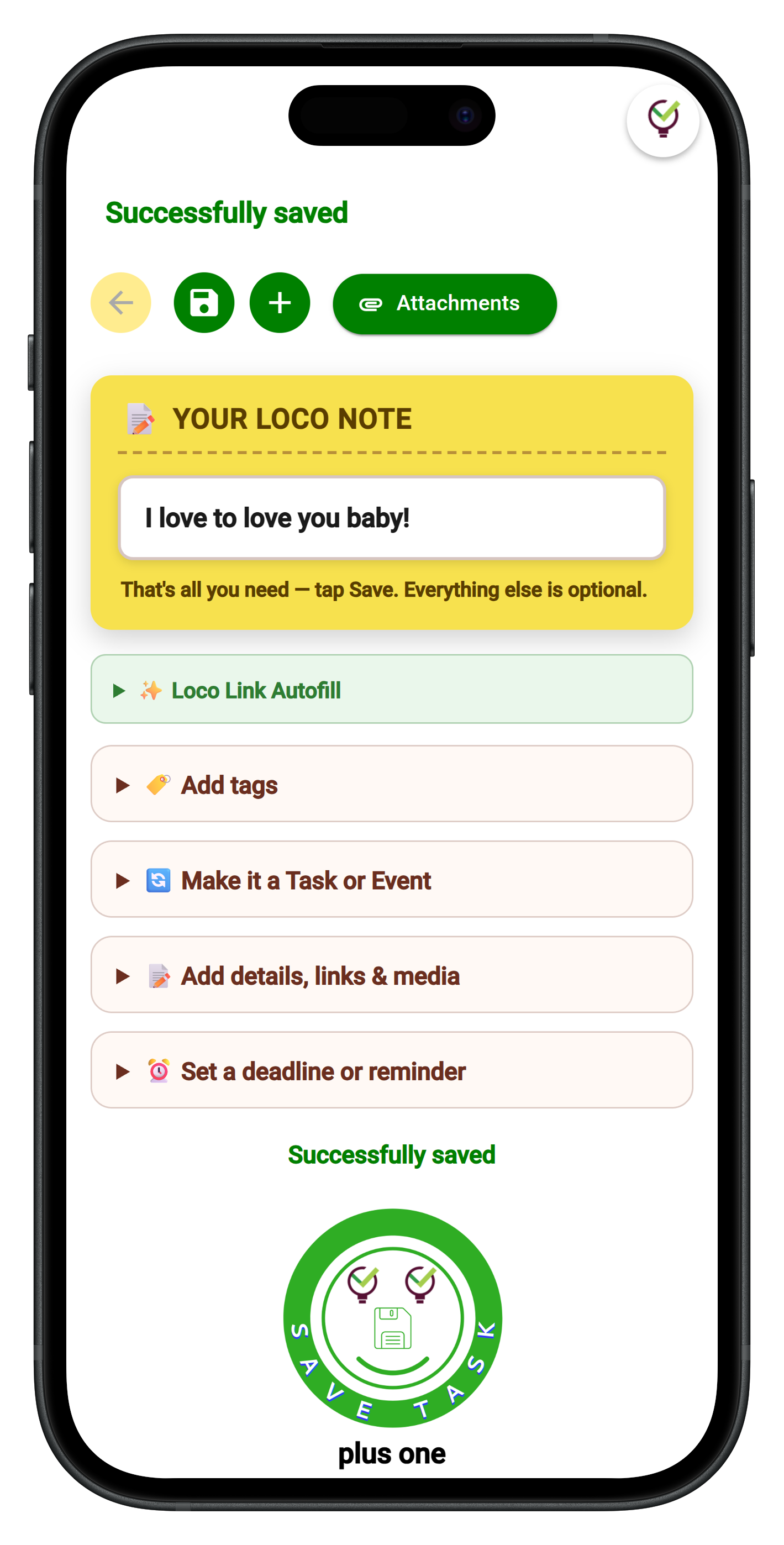
The free tiers are real and usable. TaskLoco Lite is a native iPhone and Android app — completely anonymous, no sign-in, no account, stores up to 20 notes on your device. TaskLoco Lite Plus+ is the web app and Chrome extension, free, syncs across all your devices after a Google sign-in, and captures any webpage in one click. Neither free tier includes reminders, file attachments, or team sharing — those are Premium. But both give you the core sticky-note experience with no commitment required.
TaskLoco Premium is regularly $9.99/month per person. Right now, charter members can lock in 50% off the regular price — forever. That means $4.99/month per person today. And if our price ever goes up, you still pay half. Always.
Code CHARTER50 auto-applies at checkout. First 500 spots only — once they're gone, this offer is gone permanently. Act fast while spots last.
Every Premium subscription includes unlimited notes, 10GB file storage, reminders, calendar, and team sharing. Each team member requires a separate subscription. 7-day free trial — no charge until day 8. Cancel anytime.
Free Options: TaskLoco
TaskLoco Lite
- Native iPhone & Android app
- Completely anonymous — no sign-in
- Data stays on your device
- Up to 20 notes
- Free forever
TaskLoco Lite Plus+
- Web app + Chrome extension
- Sign in with Google
- Wall syncs across all devices
- Up to 30 notes
- Free forever
Lock In 50% Off — Forever
7-day free trial. No charge until day 8. CHARTER50 auto-applies at checkout.
🔒 Lock In My Charter SpotSee TaskLoco in Action
Frequently Asked Questions
Why do sticky notes help with memory?
Sticky notes trigger the generation effect — the well-documented finding that information you produce yourself is remembered significantly better than information you passively read. Writing a note forces you to compress and rephrase, which creates a richer memory encoding. The note also serves as a visible, external cue that reduces the load on working memory, freeing up cognitive capacity for thinking rather than remembering.
What is cognitive offloading, and how do sticky notes use it?
Cognitive offloading is the practice of using the external environment to store information so your brain doesn't have to hold it in working memory. When you write a task on a sticky note and post it somewhere visible, you are offloading that item from your mental scratch pad onto a physical object in your environment. Your brain can then stop actively rehearsing the item and redirect that working memory capacity to other tasks. It is not a shortcut — it is one of the most efficient cognitive strategies humans use.
Why does writing something down work better than typing it?
Several studies, most notably Mueller and Oppenheimer's 2014 work on laptop versus longhand note-taking, show that handwriting produces better retention than typing. The leading explanation is that handwriting is slower, which forces the writer to process and summarize rather than transcribe verbatim. This deeper processing — selecting what matters, rephrasing in your own words — produces stronger memory traces. Typing tends toward verbatim capture, which feels thorough but encodes less deeply.
When do sticky notes stop working?
Sticky notes lose effectiveness in three main scenarios. First, at volume — once a surface is saturated with notes, the brain habituates and stops registering individual items. Second, over distance — physical notes cannot follow you, be searched, or be shared remotely. Third, for complex tasks — a sticky note cannot carry a file, trigger a reminder when you are away from your desk, or maintain a structured relationship with other tasks. These are not flaws in the concept; they are simply the boundaries of the format.
What is the generation effect?
The generation effect is a memory phenomenon, first formally described by Slamecka and Graf in 1978, in which people remember information significantly better when they generate it themselves compared to when they read it from a source. The effect holds across word lists, definitions, mathematical facts, and conceptual material. It is one of the most replicated findings in cognitive psychology, and it underlies the practical value of writing, teaching, and explaining as learning strategies — not just reading or highlighting.
Do digital sticky notes have the same cognitive benefits as physical ones?
They share most of the core benefits: the generation effect applies whether you type or write by hand (though handwriting may have a slight edge for deep retention), cognitive offloading works as long as the notes are visible, and brevity constraints can be preserved by design. Digital sticky notes solve the main failure modes of physical ones — loss, invisibility when you leave the space, inability to share remotely, and the absence of structured follow-up like reminders. The trade-off is that screens carry more attentional competition than a wall, so placement and organization still matter.
How does TaskLoco relate to the cognitive science of sticky notes?
TaskLoco is built around the sticky note as its core unit, preserving the spatial wall view and the brevity-first format that give the physical version its cognitive properties. TaskLoco Premium extends the format to solve the places physical notes break down — reminders delivered as push notifications that deep-link back to the original note, file attachments so context lives with the task, team sharing, and full-text search across all notes. The free tiers (Lite on native mobile and Lite Plus+ on the web) give you the core experience with no account required. $9.99/month per person (currently $4.99/month per person for first 500 charter members with code CHARTER50)
Born in Brooklyn. Powered by AWS. Your data stays yours.
TaskLoco is available on iPhone, Android, Chrome, and every web browser.