You're in the middle of a conversation when your brain interrupts with: don't forget to reschedule that call. You're almost asleep and suddenly remember three things you forgot to do. You sit down to work and spend the first twenty minutes just trying to remember what you were supposed to be working on. This isn't disorganization — it's biology. And there's a name for what's happening.
The term is open loop, coined by productivity author David Allen in his Getting Things Done framework. The concept draws on real cognitive science: the human working memory is not a storage system. It's a processing system. Ask it to hold too many unresolved commitments at once and it starts dropping things — or worse, it starts interrupting everything else you're trying to think about. Understanding why this happens, and what actually fixes it, is one of the most practical things you can learn about your own mind.
Where the Idea Comes From: Zeigarnik, Allen, and the Restless Mind
The psychological root of open loops predates GTD by about 70 years. In 1927, Soviet psychologist Bluma Zeigarnik noticed something strange in a Vienna café: waiters could hold enormous orders in their heads with perfect accuracy — but the moment a table paid and left, they forgot everything about that order instantly. Completion erased the memory. Incompletion preserved it.
She tested this in her lab and confirmed what's now called the Zeigarnik Effect: unfinished tasks are held in a kind of active, intrusive memory that persists until the task is resolved. Your brain literally allocates ongoing cognitive resources to track incomplete things. It's not neurotic. It's adaptive — in a hunter-gatherer context, forgetting that you left a trap set could mean going hungry. But in a world where you have 47 unread emails and three projects in flight, that same mechanism becomes noise.
David Allen reframed this in practical terms: every commitment you've made — to yourself or anyone else — and haven't yet resolved is an open loop. A loop can be as trivial as 'buy toothpaste' or as significant as 'finalize the Q3 proposal.' Your brain doesn't sort by importance. It just tracks. And the more loops you have open simultaneously, the higher your baseline cognitive load, and the lower your capacity for actual deep work.
Why Writing It Down Actually Works (and Why Your App Matters)
Here's the counterintuitive part: you don't close an open loop by finishing the task. You close it by making a decision about it and recording that decision somewhere you trust. Allen calls this a trusted system — an external repository your brain has learned to defer to. Once your mind believes the loop is captured and won't be lost, it releases the background process.
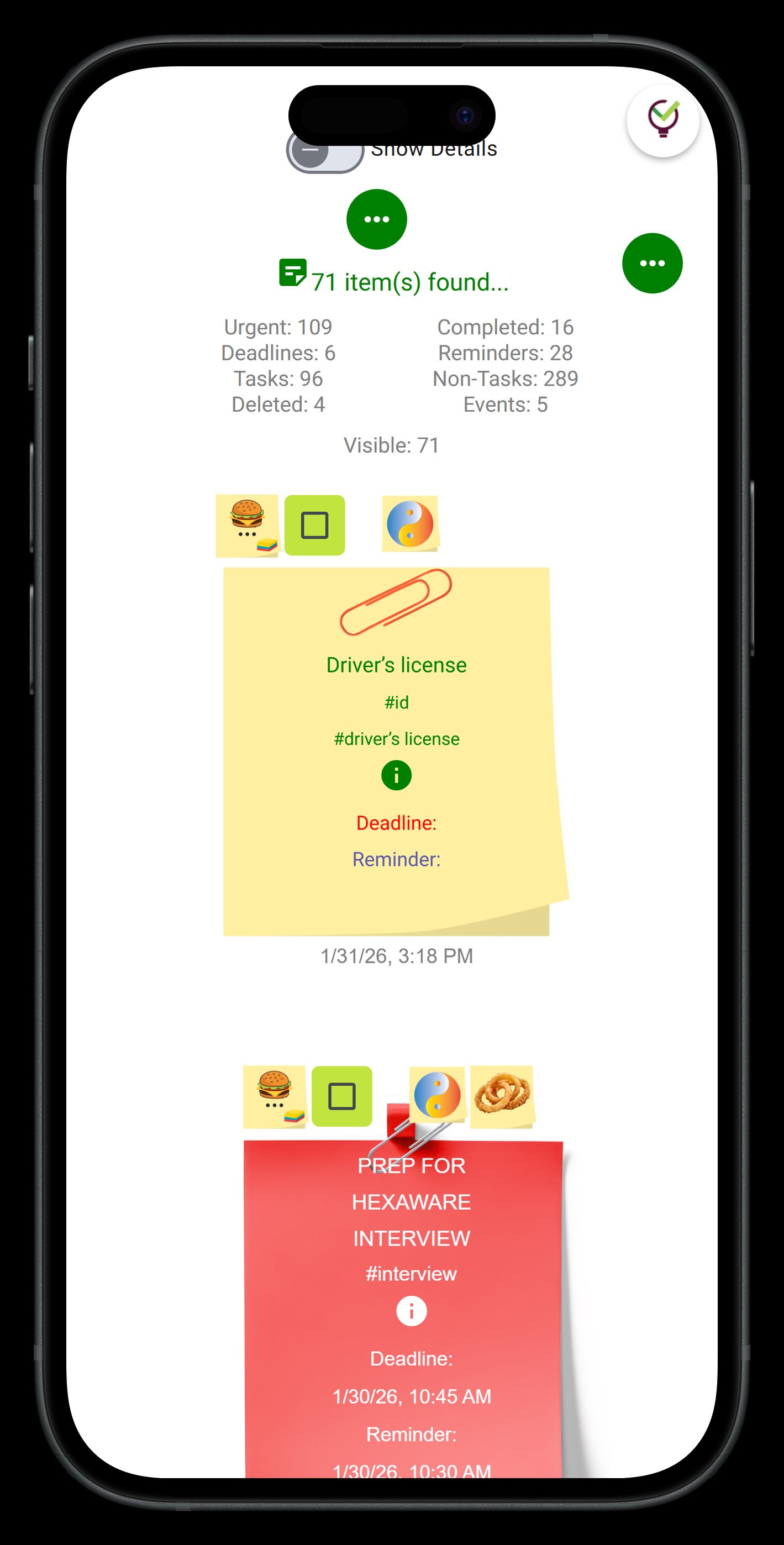
This is why a sticky note on your monitor can be more calming than a mental note. It's not about the paper — it's about the signal. Your brain gets confirmation: this is recorded, you don't need to hold it. The cognitive weight lifts. You can think about what you're actually supposed to be thinking about right now.
But there's a failure mode here that most productivity advice glosses over: the capture system has to be trusted. If you write things on random scraps of paper, in three different apps, in a notes app you never open, and also on your hand ��� your brain doesn't buy it. The system is fragmented. You still feel like something might fall through the cracks, so the background pinging continues. You've added friction without gaining relief.
This is why the specific tool matters more than most people admit. A trusted system needs to be fast enough to capture a thought before it evaporates, organized enough that you can find things again, and consistent enough that your brain actually learns to hand off to it. The difference between a system your brain trusts and one it doesn't is the difference between feeling calm and feeling like you're constantly treading water.
Where the Open Loop Model Breaks Down
The GTD open loop framework is genuinely useful, but it has limits worth understanding honestly. First, it assumes that all cognitive load is created equal — that capturing 'buy toothpaste' and 'prepare for board meeting' provide the same relief once written down. In practice, emotionally charged or high-stakes loops don't close as cleanly. Writing down 'call Mom back' doesn't eliminate the guilt or anxiety around the loop — it just externalizes the reminder. Some open loops are emotional, not logistical, and no capture system fully resolves those.
Second, the model can create a different problem: list inflation. Once people start capturing everything, they often capture too much. A trusted system that contains 340 items stops being trusted because it becomes unprocessable. Allen's full methodology includes regular review and pruning specifically to prevent this — but most people adopt the capture habit without the review habit, and the list becomes its own source of anxiety.
Third, open loops assume linear time and sequential attention. For people with ADHD or highly nonlinear work styles, the 'capture and close' model can conflict with how their brains actually generate ideas — in bursts, associatively, not as neat action items. The system can start to feel like a cage rather than a relief. These people often do better with visual, spatial organization — where relationships between ideas are visible at a glance — rather than a flat list they have to mentally navigate.
None of this invalidates the core insight. Externalizing commitments reduces cognitive load. That's real. But the specific format of your capture system should match how your brain actually works, not how a productivity book says it should work.
How TaskLoco Fits This Model
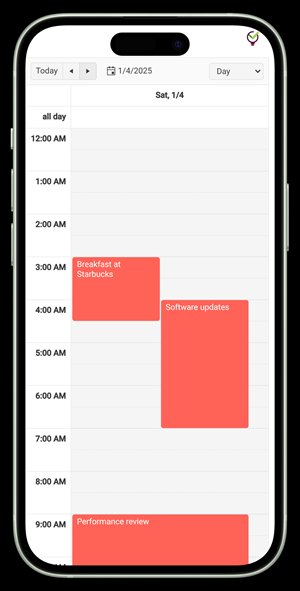
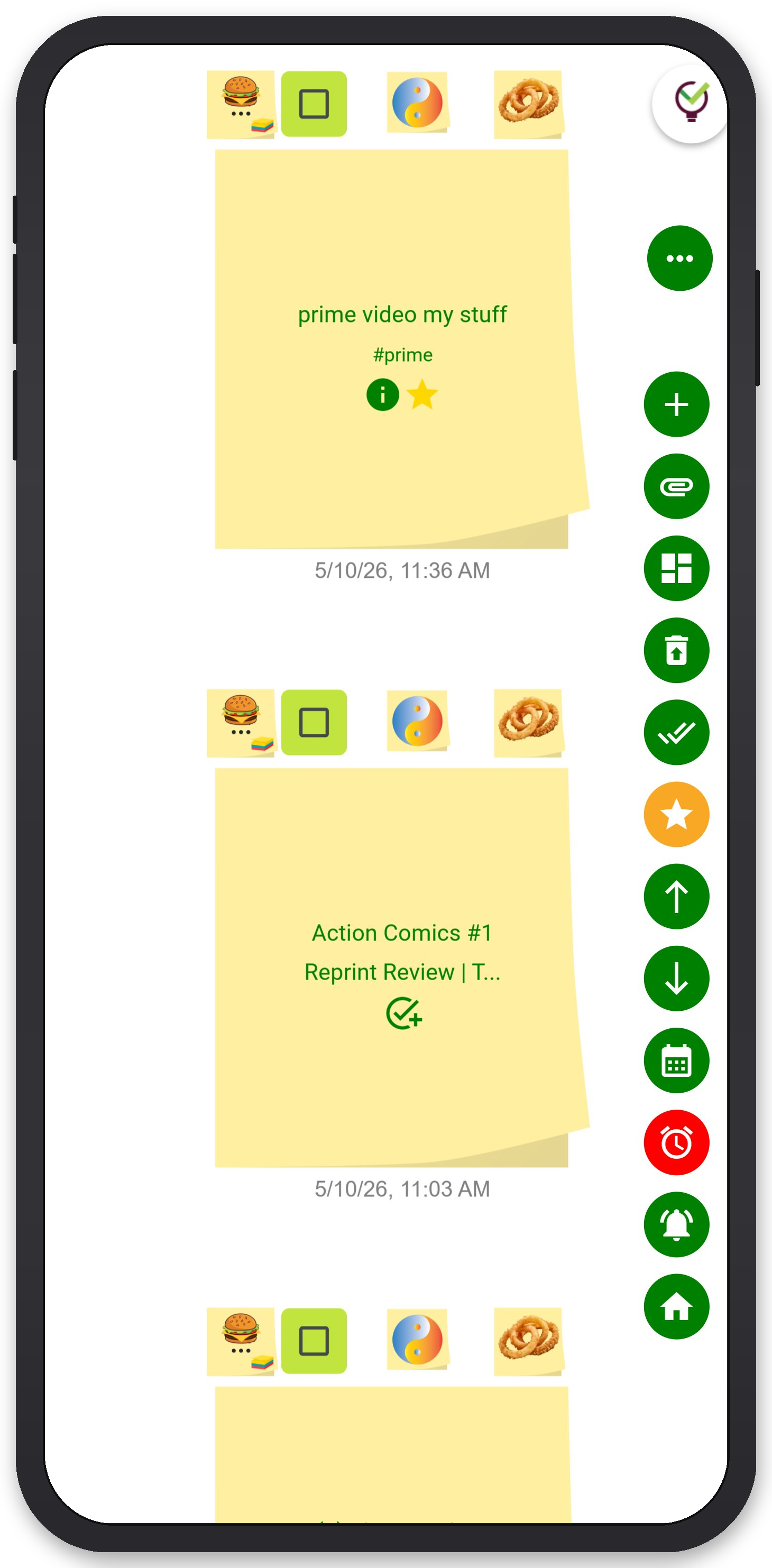
TaskLoco was built around the sticky note — the original fast-capture tool. The analog sticky note works because it's zero-friction: you grab it, you write, you stick it somewhere visible. TaskLoco brings that same immediacy into a digital system that actually syncs, files things, and reminds you. The gap between thinking something and having it captured is as small as the app can make it.
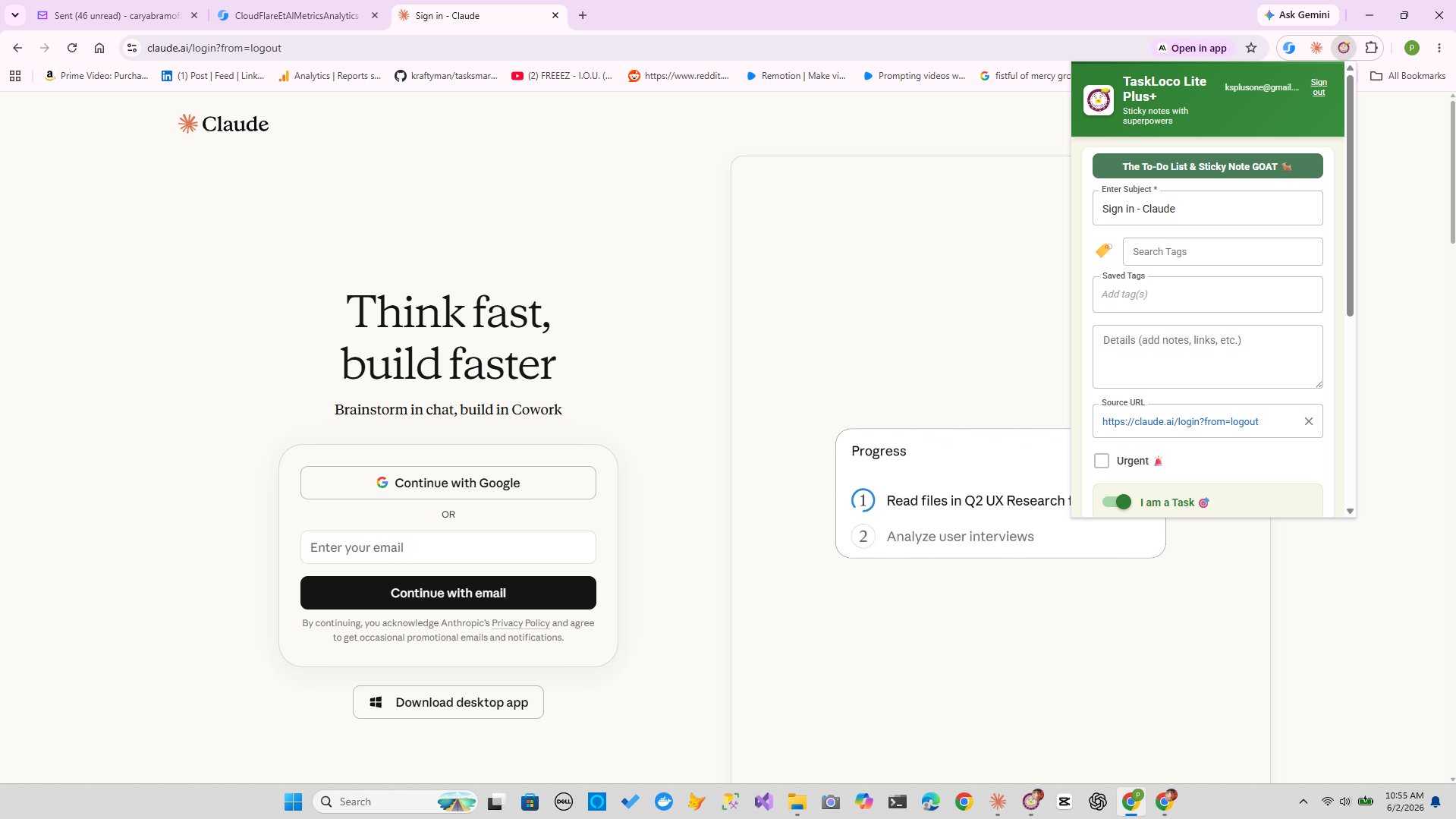
For people who've struggled to build a trusted system because their tools were too slow, too buried in menus, or spread across too many places — TaskLoco collapses that into a single wall of notes that's visual, fast, and searchable. The Chrome extension captures a webpage in one click. Reminders are delivered as push notifications that deep-link straight back to the original note, so you land in context, not at an inbox. Files live attached to the note they belong to — not in a separate folder you have to go find.
That's the practical version of what 'closing open loops' actually looks like in software: one place, fast capture, reminders that return you to the exact thought you had. Your brain gets the signal it needs — this is handled, you can let it go.
TaskLoco Premium is regularly $9.99/month per person. Right now, charter members can lock in 50% off the regular price — forever. That means $4.99/month per person today. And if our price ever goes up, you still pay half. Always.
Code CHARTER50 auto-applies at checkout. First 500 spots only — once they're gone, this offer is gone permanently. Act fast while spots last.
Every Premium subscription includes unlimited notes, 10GB file storage, reminders, calendar, and team sharing. Each team member requires a separate subscription. 7-day free trial — no charge until day 8. Cancel anytime.
Free Options: TaskLoco
TaskLoco Lite
- Native iPhone & Android app
- Completely anonymous — no sign-in
- Data stays on your device
- Up to 20 notes
- Free forever
TaskLoco Lite Plus+
- Web app + Chrome extension
- Sign in with Google
- Wall syncs across all devices
- Up to 30 notes
- Free forever
Lock In 50% Off — Forever
7-day free trial. No charge until day 8. CHARTER50 auto-applies at checkout.
🔒 Lock In My Charter SpotSee TaskLoco in Action
Frequently Asked Questions
What is an open loop in productivity?
An open loop is any unfinished commitment your brain is actively tracking — a task you haven't done, a decision you haven't made, or an idea you haven't captured. The term comes from David Allen's Getting Things Done framework and is grounded in the Zeigarnik Effect, a psychological finding showing that incomplete tasks occupy persistent mental space until they are resolved or externalized.
Why does my brain keep reminding me of things at random times?
This is the Zeigarnik Effect in action. Your brain allocates ongoing attention to unfinished tasks because — evolutionarily — forgetting incomplete things had real consequences. It doesn't filter by importance or timing. It just pings you whenever cognitive resources are available. The fix is to capture the thought in a system your brain trusts, which gives it permission to stop tracking the item actively.
Does writing things down actually reduce mental stress?
Yes — and this is well-supported by cognitive science. When you externalize a commitment into a trusted system, your brain receives a signal that the item is handled and no longer needs to be actively held in working memory. The key word is 'trusted': the system has to be one you actually use and review, or your brain won't hand off to it. A list you never open doesn't close loops.
What makes a capture system 'trusted' enough for the brain to let go?
Three things: speed (capturing a thought must be fast enough that you don't skip it), consistency (you have to use the same system reliably), and retrievability (you have to be able to find things again when you need them). If any of these fail — if the app is buried, if you have three different systems, if you can't find notes later — your brain keeps holding on as a backup.
Can an app actually help close open loops, or is this just a metaphor?
It's not just a metaphor — the right app can genuinely reduce background cognitive load. The mechanism is real: fast capture gives your brain the external confirmation it needs to release the background tracking process. Where most apps fall short is friction. If opening the app takes too long, if filing the note requires too many steps, your brain learns the system isn't reliable and keeps holding things itself. Apps designed around fast capture — like a digital sticky note that's immediately visible — tend to work better for this than complex project tools.
What's the difference between open loops and a to-do list?
A to-do list is a format. Open loops are a cognitive state. The goal of capturing open loops is not to make a comprehensive list — it's to reduce the number of things your brain is silently tracking. A good to-do list closes loops. A bad one (too long, never reviewed, hard to trust) can actually create new anxiety by making the backlog visible without making it manageable. The distinction matters: capture is about cognitive relief, not about having a complete inventory.
How does TaskLoco help with open loops specifically?
TaskLoco is built around fast capture — the sticky note model, where writing something down is the whole point. The Chrome extension grabs a webpage in one click. Reminders deliver push notifications that deep-link back to the original note, so you return to the exact thought in context rather than hunting for it. Everything — notes, files, reminders, calendar — lives in one place, which is what makes a system trustworthy enough for your brain to actually defer to it. $9.99/month per person (currently $4.99/month per person for first 500 charter members with code CHARTER50)
Born in Brooklyn. Powered by AWS. Your data stays yours.
TaskLoco is available on iPhone, Android, Chrome, and every web browser.