Most people don't fail at productivity because they're lazy. They fail because they write 22 things on a list and call that a plan. The 1-3-5 rule fixes the root problem: it forces you to decide, before the day starts, what actually matters. One big thing. Three medium things. Five small things. Nine total. That's your day. No negotiation.
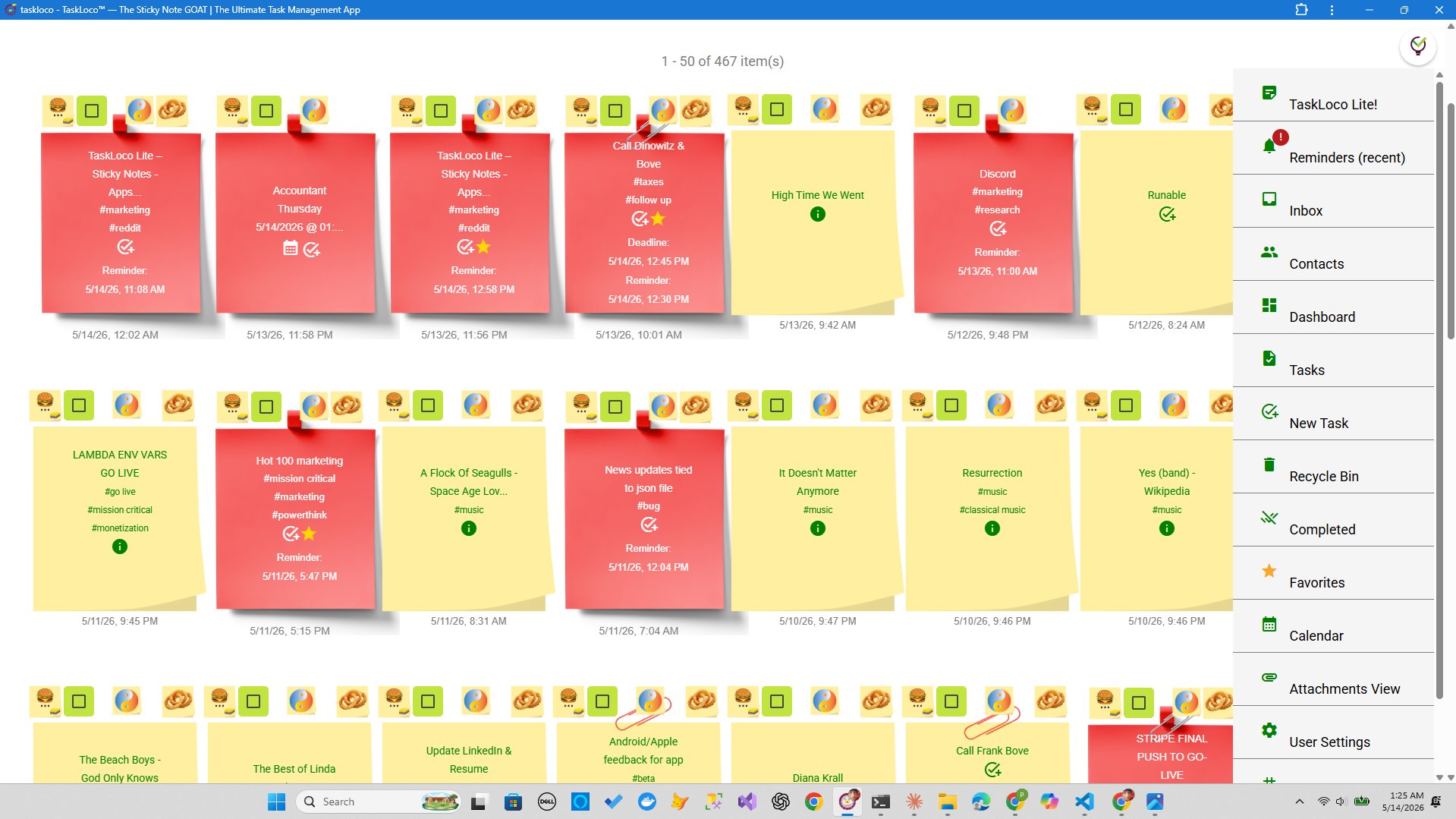
The rule works on paper — but paper doesn't push back when you cheat. Visual layouts do. When your 1 sits alone at the top and your 5 small tasks are clearly grouped below it, the structure becomes self-enforcing. You can see when you've overloaded a slot. You can see at 2pm whether you've touched your big task yet. This article walks through what the 1-3-5 rule is, why visual execution beats list-based execution, and how to build a morning ritual around it that actually sticks.
What the 1-3-5 Rule Actually Is — and Why It Works
The 1-3-5 rule is a daily planning framework built on a simple constraint: you may plan exactly one large task, three medium tasks, and five small tasks per day. That's nine items maximum. The rule doesn't care how busy you are, how many meetings you have, or how long your backlog is. Nine tasks. Pick your nine. Start.
The power isn't in the number — it's in the forced prioritization that happens before the number. To write down your 1, you have to admit that everything else is not the most important thing today. That admission is where most productivity systems break down. The 1-3-5 rule makes it unavoidable.
Size categories matter too. A large task is something that requires sustained focus — writing a proposal, shipping a feature, having a hard conversation. A medium task is meaningful but bounded — responding to a batch of emails, reviewing a document, preparing for a meeting. A small task is something you can knock out in under 15 minutes — scheduling a call, filing an expense, leaving a comment. When you categorize by cognitive weight rather than by topic, you build a day that has rhythm instead of chaos.
Why Visual Beats List-Based Every Single Time
A numbered list treats every item equally. The font size is the same. The spacing is the same. Task 1 and task 9 look identical. That's fine when you're grocery shopping. It's fatal when you're trying to protect your most important work from a flood of small tasks that feel urgent because they're recent.
Visual layouts break that equality on purpose. When your single big task sits in its own zone — larger, higher, alone — your eye goes there first. When your five small tasks are clustered together in a clearly smaller section, you feel the constraint without having to count. The layout does the cognitive work so your brain doesn't have to.
There's a reason physical sticky notes on a whiteboard have survived every wave of digital productivity tools. Spatial memory is real. You remember where things are, not just what they say. A sticky note in the top-left corner of your wall carries different psychological weight than a sticky note at the bottom of a list. That's not nostalgia — that's how the brain works.
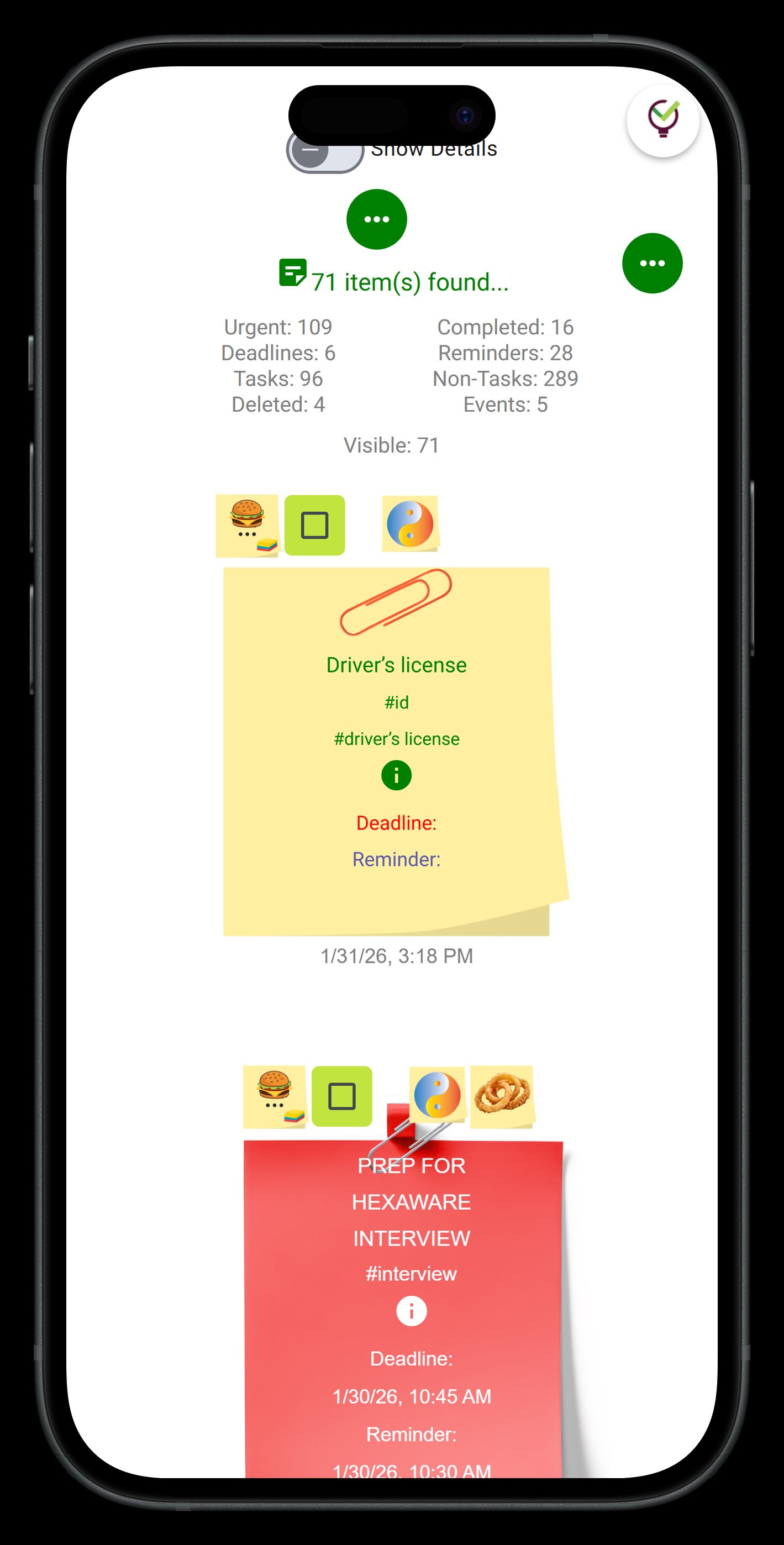
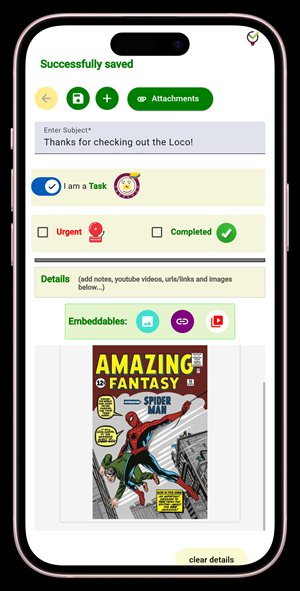
The upgrade over physical sticky notes isn't abandoning the visual metaphor — it's keeping it while adding what paper can't do: reminders that fire as push notifications directly to your phone and computer and deep-link back to the original note, file attachments so every task has its context, and a calendar view so your 1-3-5 plan lives alongside your actual schedule.
Building Your Morning 1-3-5 Ritual in TaskLoco
The ritual has to be fast or it won't survive. If setting up your 1-3-5 board takes ten minutes, you'll skip it on hard mornings — which are exactly the mornings when you need it most. The target is under two minutes from opening the app to having your day planned.
Here's how the morning flow works in TaskLoco. Open your wall. You have a pinned template: one note labeled TODAY'S 1, three notes labeled MEDIUM, five notes labeled SMALL. Each morning, you clone the template, fill in the tasks, and you're done. The visual separation is already built into the layout — you're not designing it fresh every day.
TaskLoco Premium's team sharing works the way sharing should: when you share a note with a teammate, they receive it and can clone it and make it their own. No permissions to configure, no access levels to manage. If you're a manager who wants to share context with someone before they build their own 1-3-5 plan, you send the note. They own their version. Clean and simple.
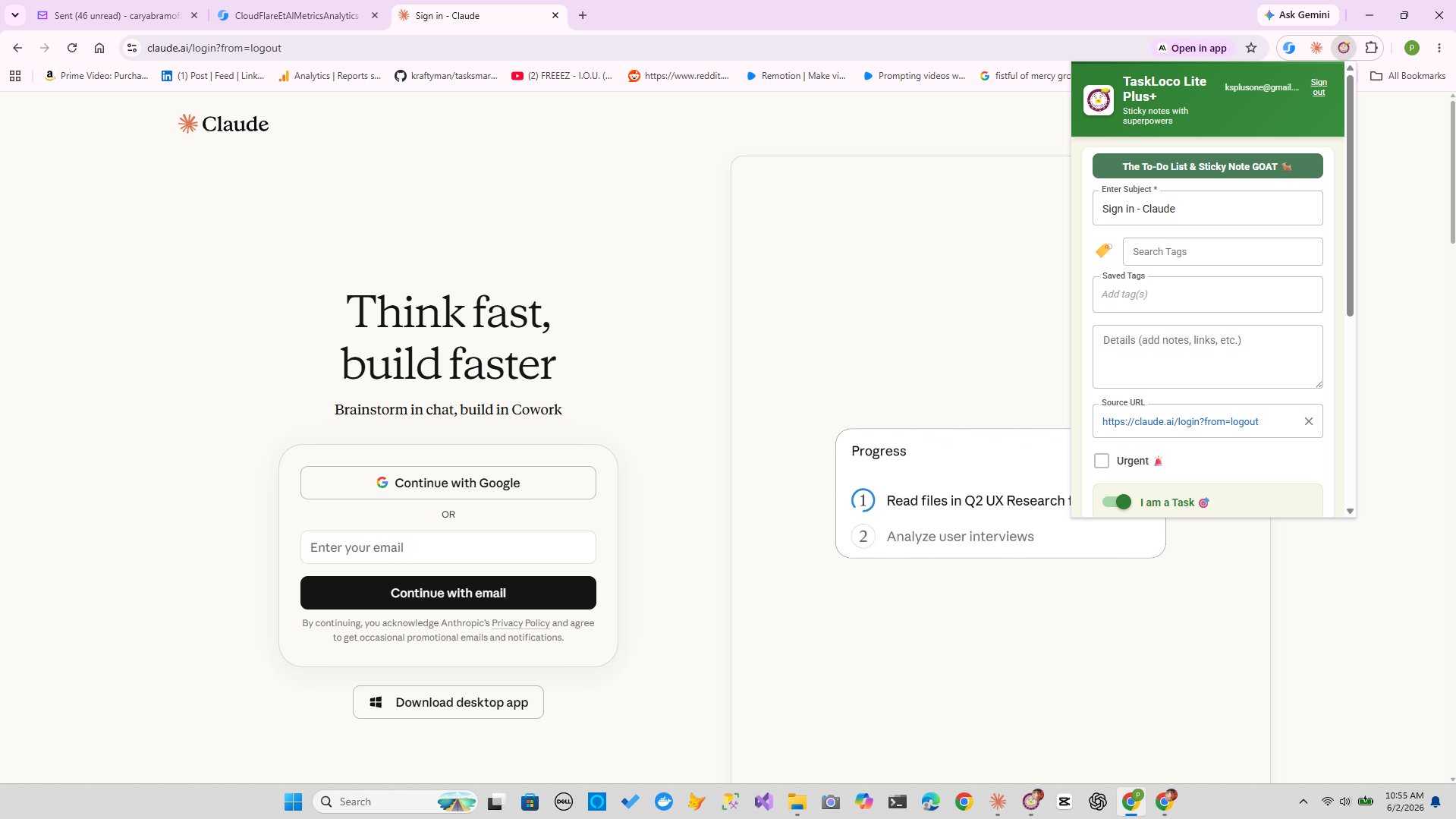
The Chrome extension matters more than it sounds for this workflow. When you hit a webpage mid-morning that needs to become a small task — an article to read, a form to fill out, a thread to respond to — you capture it in one click and it lands on your wall as a note. No copy-pasting, no context-switching. The task is captured; you go back to your big thing.
For files and context, Premium's 10GB storage means every note can carry its own attachments. Your big task note can hold the brief, the draft, the reference doc — everything in one place so starting the task has no friction.
Common 1-3-5 Mistakes and How to Fix Them
Mistake 1: Treating the small tasks as a to-do list overflow valve. Five small tasks is not a dump zone for everything you don't want to prioritize. Each one still has to be a real task you intend to finish today. If you're routinely hitting day-end with four of your five small tasks undone, they weren't small — or they weren't real commitments. Either reclassify them or drop them.
Mistake 2: Not protecting your big task in the morning. The 1-3-5 rule only works if you actually work on your 1 before the day fills up. Most people plan the big task and then spend the morning on the five small ones because small tasks feel satisfying to check off. Invert it: touch your big task first, even for 25 minutes, before you do anything else.
Mistake 3: Rebuilding the board from scratch every day. The ritual should be a fill-in, not a design exercise. Use a template. In TaskLoco, your wall persists — you can duplicate yesterday's structure, clear the content, and fill in today's tasks. The layout is already there. You're just updating the words.
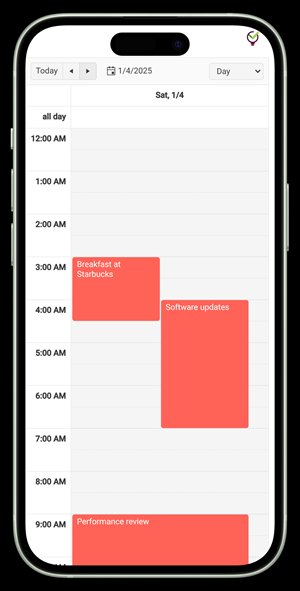
Mistake 4: Planning in isolation from your calendar. Your big task is meaningless if you've scheduled three two-hour meetings and a lunch on the same day. TaskLoco Premium's calendar view puts your 1-3-5 tasks alongside your actual schedule so you can see the collision before you commit. If your day has two hours of real work time, your 1 needs to fit in two hours.
The reminder system in TaskLoco is built for exactly this kind of accountability. Set a reminder on your big task for 9am. When it fires as a push notification to your phone and computer, it deep-links back to the note — one tap and you're in the task, not searching for it. That single friction removal is worth more than any motivational system.
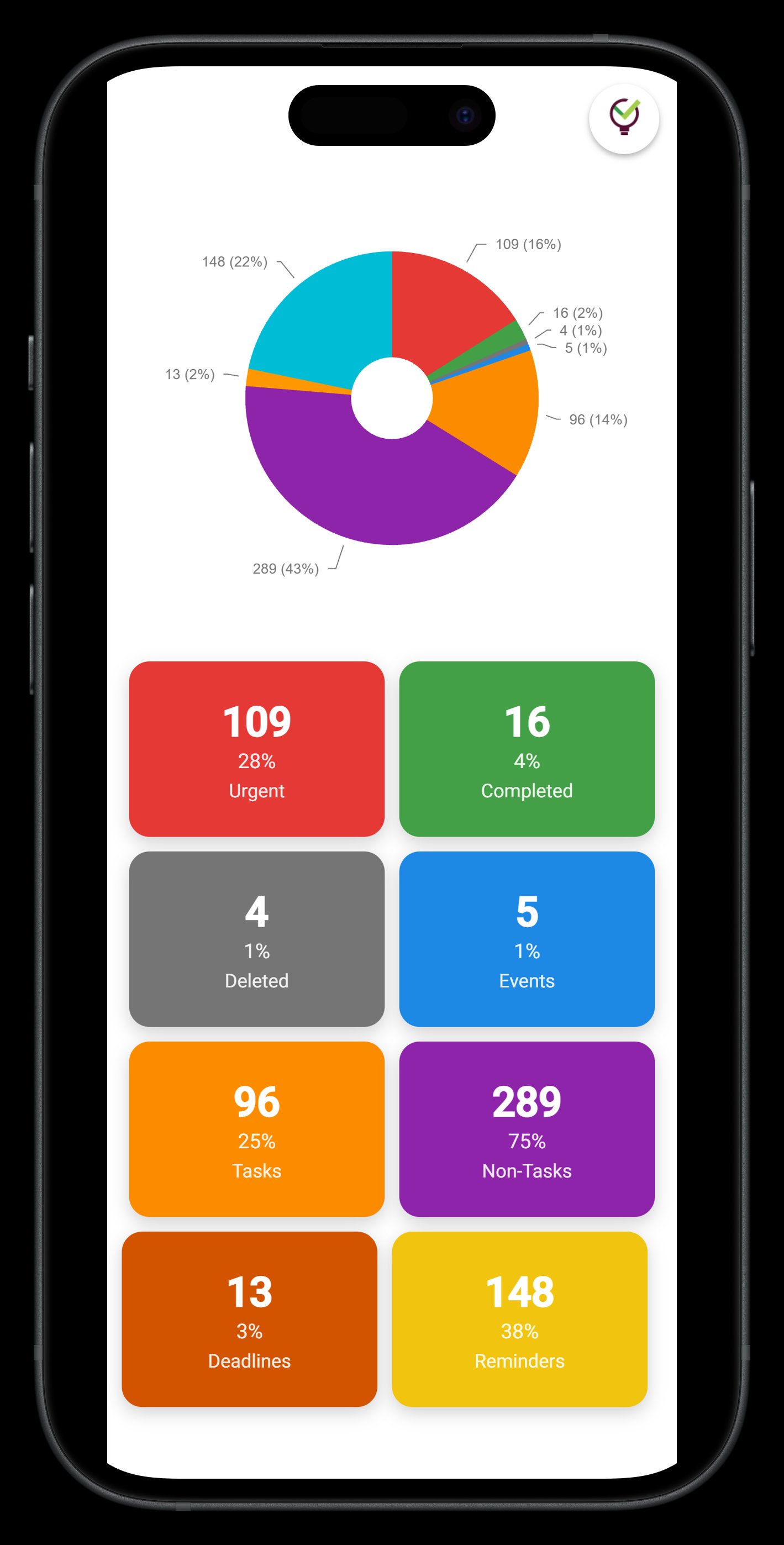
TaskLoco Premium is regularly $9.99/month per person. Right now, charter members can lock in 50% off the regular price — forever. That means $4.99/month per person today. And if our price ever goes up, you still pay half. Always.
Code CHARTER50 auto-applies at checkout. First 500 spots only — once they're gone, this offer is gone permanently. Act fast while spots last.
Every Premium subscription includes unlimited notes, 10GB file storage, reminders, calendar, and team sharing. Each team member requires a separate subscription. 7-day free trial — no charge until day 8. Cancel anytime.
Free Options: TaskLoco
TaskLoco Lite
- Native iPhone & Android app
- Completely anonymous — no sign-in
- Data stays on your device
- Up to 20 notes
- Free forever
TaskLoco Lite Plus+
- Web app + Chrome extension
- Sign in with Google
- Wall syncs across all devices
- Up to 30 notes
- Free forever
Lock In 50% Off — Forever
7-day free trial. No charge until day 8. CHARTER50 auto-applies at checkout.
🔒 Lock In My Charter SpotSee TaskLoco in Action
Frequently Asked Questions
What is the 1-3-5 rule for productivity?
The 1-3-5 rule is a daily planning framework that limits you to exactly nine tasks per day: one large task that requires deep focus, three medium tasks that are meaningful but bounded, and five small tasks that take 15 minutes or less. The constraint is the point — it forces you to prioritize before the day starts instead of reacting to whatever feels urgent in the moment.
Why is a visual layout better than a numbered list for 1-3-5?
A numbered list treats every item as equal — same font, same size, same visual weight. That makes it easy to lose your big task in the noise. A visual layout separates task tiers spatially: your one big task sits alone at the top, your medium tasks are grouped in the middle, your small tasks are clustered below. Your eye does the prioritization automatically, without having to re-read and re-decide all day long.
How do I set up a 1-3-5 board in TaskLoco?
Create a pinned template on your TaskLoco wall with one note for your big task, three for medium tasks, and five for small tasks. Each morning, clone the template, fill in today's commitments, and you're done — the layout is already built. TaskLoco Premium adds reminders (delivered as push notifications that deep-link back to the note), file attachments for context, and a calendar view so your plan matches your actual schedule.
What counts as a 'big task' in the 1-3-5 rule?
A big task is something that requires sustained, uninterrupted focus — typically 60 to 90 minutes or more of real cognitive work. Writing a strategy document, coding a feature, preparing a presentation, or having a difficult conversation are all big-task territory. If you can knock it out in 20 minutes, it's probably a medium or small task. The point is cognitive weight, not time on the clock.
What happens if I don't finish all nine tasks in a day?
That's information, not failure. If you consistently finish your big task but leave three small tasks undone, your small tasks may not actually be small — or they weren't real commitments. If you never touch your big task, you're letting urgent-feeling small tasks protect you from the harder work. The 1-3-5 rule surfaces those patterns so you can fix them. Incomplete tasks carry to the next day's planning session, not as guilt, but as data.
Can I use TaskLoco's free version for a 1-3-5 workflow?
TaskLoco Lite Plus+ (free, sign in with Google) syncs across all your devices and gives you up to 30 notes — enough to run a 1-3-5 board with room for a template and a few days of history. It doesn't include reminders, file attachments, or calendar view. TaskLoco Premium unlocks all of those, including push notification reminders that deep-link back to individual notes, which is the feature that makes the morning ritual actually self-enforcing. There's a 7-day free trial on Premium with no charge until day 8.
Does the 1-3-5 rule work for teams, or is it just for individuals?
It works for both, but the implementation differs. For individuals, it's a personal morning ritual. For teams, it becomes a shared accountability layer — each person runs their own 1-3-5, and a quick standup or shared note surfaces what each person's big thing is today. TaskLoco Premium's team sharing lets you share notes with teammates; recipients can clone the note and make it their own, so everyone maintains autonomy over their own plan while staying aligned on priorities.
Born in Brooklyn. Powered by AWS. Your data stays yours.
TaskLoco is available on iPhone, Android, Chrome, and every web browser.