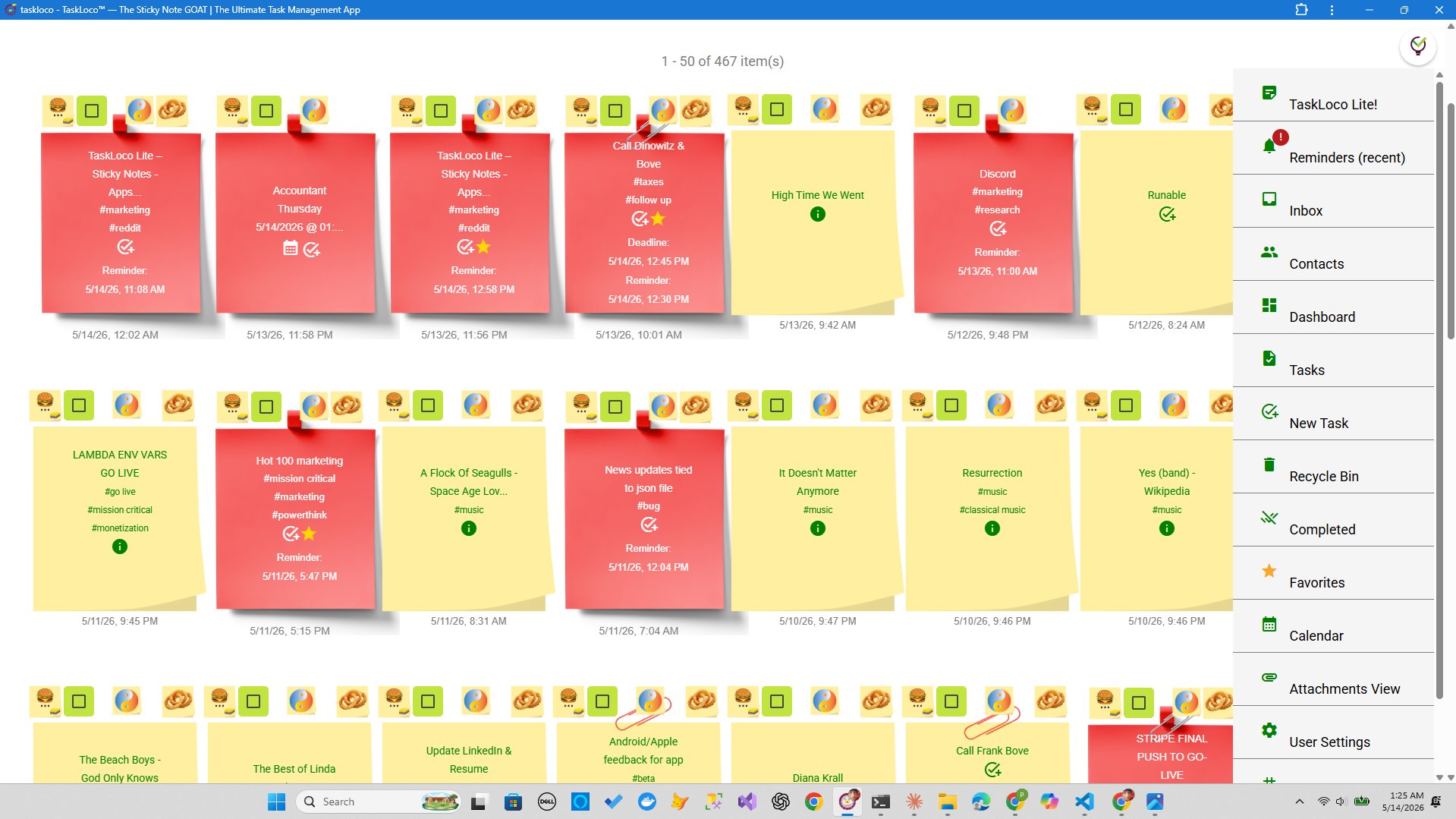
Most productivity systems are ruthlessly forward-looking. You add a task, complete it, and it vanishes — consumed by the list that never gets shorter. The problem isn't laziness. It's that the tool shows you only what's left, never what you've built. A visual done list flips that. It keeps your completed work visible, organized, and meaningful — so the act of finishing something actually feels like something.
This page breaks down what a visual done list is, why it works psychologically, what to look for when choosing one, and why TaskLoco's sticky-note wall approach has become one of the most intuitive ways to build that habit.
What to Look for in a Visual Done List
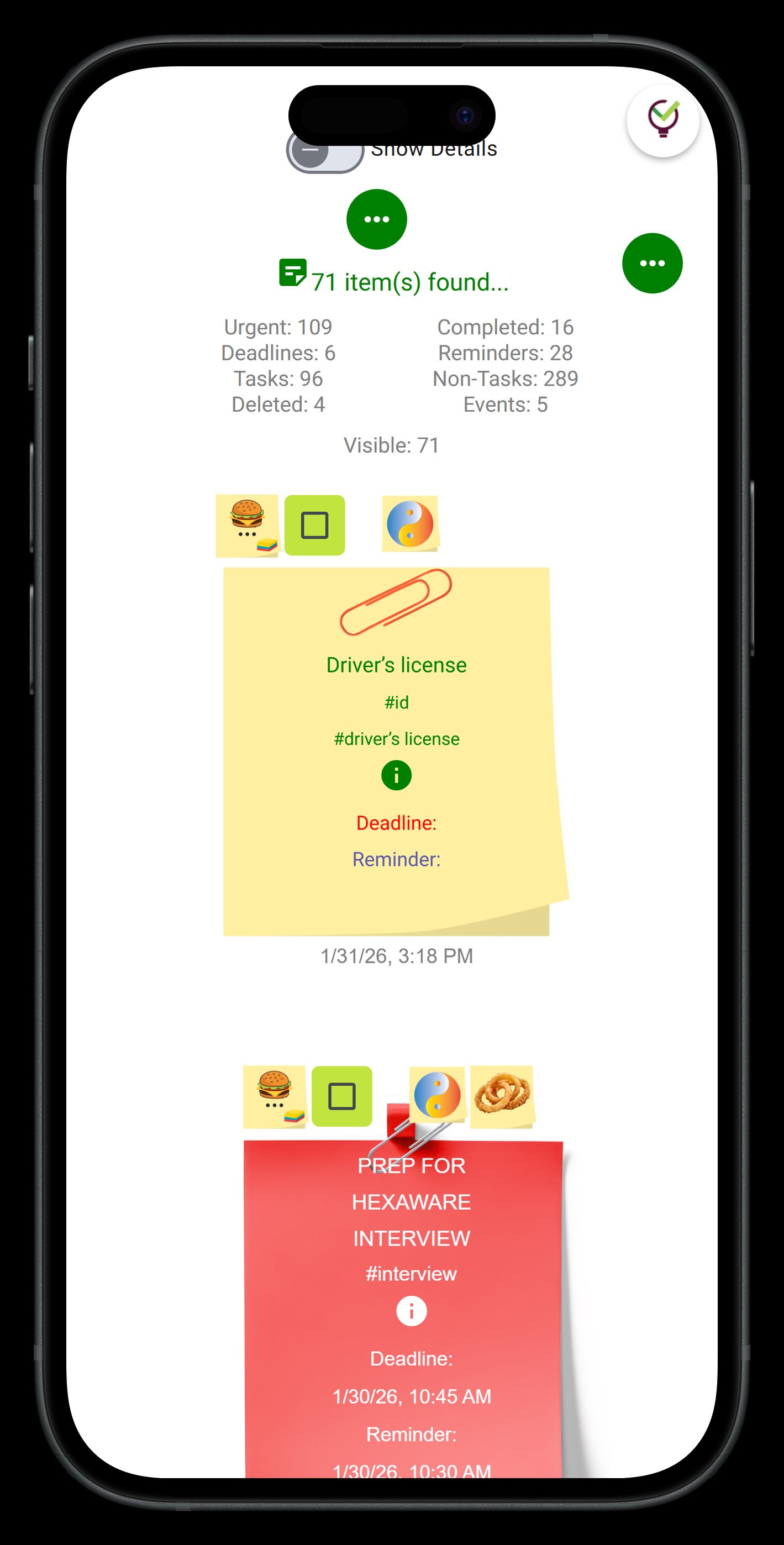
A visual done list isn't just a regular task list with a "completed" filter. The distinction matters: a filtered list hides your wins behind a tap or a toggle. A true visual done list keeps completed items in view — spatially present, readable at a glance, and arranged in a way that communicates progress rather than clutter.
Before picking any tool, evaluate it against these three criteria:
- Spatial permanence. Completed items should stay on the board or wall in a visible zone — not auto-archive, not disappear, not require a special view to find. If done tasks are out of sight by default, you don't have a done list, you have a history log. There's a difference.
- Visual hierarchy that separates done from doing. Color, position, opacity, or card style should make it instantly obvious what's finished versus in progress. You shouldn't have to read every note to understand the state of your board.
- Enough context per item. A title alone doesn't tell you what the task meant. The best done lists preserve the note — including any attachments, links, or descriptions — so completed work remains searchable and reference-worthy, not just a checkbox.
Two or three secondary criteria often separate good tools from great ones: the ability to add files or images to completed notes (so you can attach deliverables to the record of the work), reminders that link back to the original note rather than just firing a generic alert, and a calendar view that lets you see when things got done over time — not just that they did.
Why the Done List Works (and Why Most Apps Ignore It)
There's a well-documented psychological phenomenon sometimes called the "progress principle" — the finding that making progress on meaningful work is one of the most powerful daily motivators humans have. The catch: the progress has to be perceived. If your tool erases evidence of what you've done the moment you check it off, you lose the motivational signal entirely.
Traditional task managers are optimized for capture and completion, not for reflection. They want the list to be empty. Zero inbox. Clean slate. But for most people — especially anyone juggling multiple projects, clients, or creative work — the empty list feels like proof of nothing rather than proof of everything. You finished fifteen things today, and the app shows you a blank screen.
The sticky-note metaphor changes this fundamentally. Physical sticky notes on a wall don't vanish when the work is done. You move them to a "done" section, and they stay there. You can look across the wall at the end of a week and actually see the density of what you've accomplished. That spatial record is motivating in a way that a counter or a streak badge simply isn't.
Digital tools that replicate this spatially — rather than just adding a "completed" filter — tap into the same mechanism. The board becomes a story. The done column becomes evidence.
How TaskLoco Builds a Done List That Actually Works
TaskLoco is built around the sticky-note wall — a spatial canvas where notes live as cards you can move, arrange, and color. That architecture is exactly what a visual done list needs. When you finish something, you don't delete the note. You move it. It stays on the board, visible and searchable, in whatever "done" zone you've carved out for yourself.
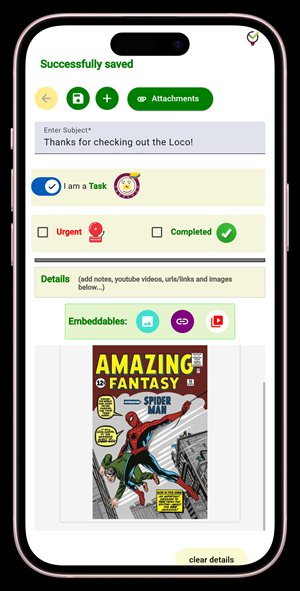
The richness of each note matters here. With TaskLoco Premium, a completed note isn't just a title with a checkmark. It can hold files (10GB of storage per person), embedded photos, and the full text of whatever you wrote when you created the task. Your done list becomes a record of the work, not just the task name.
Reminders in TaskLoco are delivered as push notifications directly to your phone and computer — and each one deep-links back to the original note. That means when a reminder fires, you land in context, not in a generic notifications panel. Optional email and SMS channels are available as well. And when a note is done, that context stays attached. You can search across all your notes — including completed ones — using full-text search.
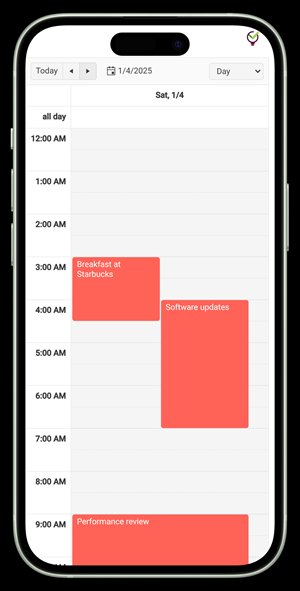
The calendar view adds a time dimension to the done list. Instead of just seeing a spatial arrangement of completed notes, you can look at when things got done across days and weeks. For anyone who wants to reflect on their output over time — reviewing a sprint, preparing for a weekly report, or just satisfying their own curiosity — this is genuinely useful, not decorative.
TaskLoco Premium also includes team sharing. Shared notes work like emails: a recipient can clone the note and make it their own, no permissions or access levels needed. For teams building a shared done list or passing work between members, this keeps the process frictionless.
Setting Up Your Visual Done List in TaskLoco
You don't need a complicated system. The wall view is where you'll spend most of your time, and setting up a done list is a matter of spatial convention — not a settings menu. Here's a practical approach that works well for most people:
- Divide your wall into three zones. Left column: incoming / to-do. Center: in progress. Right: done. This mirrors a physical kanban board but lives in your browser or on your phone.
- Color-code by completion state. Pick one note color for active tasks and a different color for done ones. When you finish something, change the color and move it right. The visual shift is satisfying and immediately legible.
- Use file attachments on done notes. When you finish a deliverable, attach the file directly to the note before you move it to done. Now your done list is also your work archive. Everything is in one place.
- Review on a schedule. The calendar view in Premium lets you set reminders to do a weekly review. When the push notification fires, it deep-links you straight back to the note — no hunting around.
- Don't purge too often. The whole point of a visual done list is that completed items stay visible. Let the done column build up across a week or two before you archive anything. The accumulation is the signal.
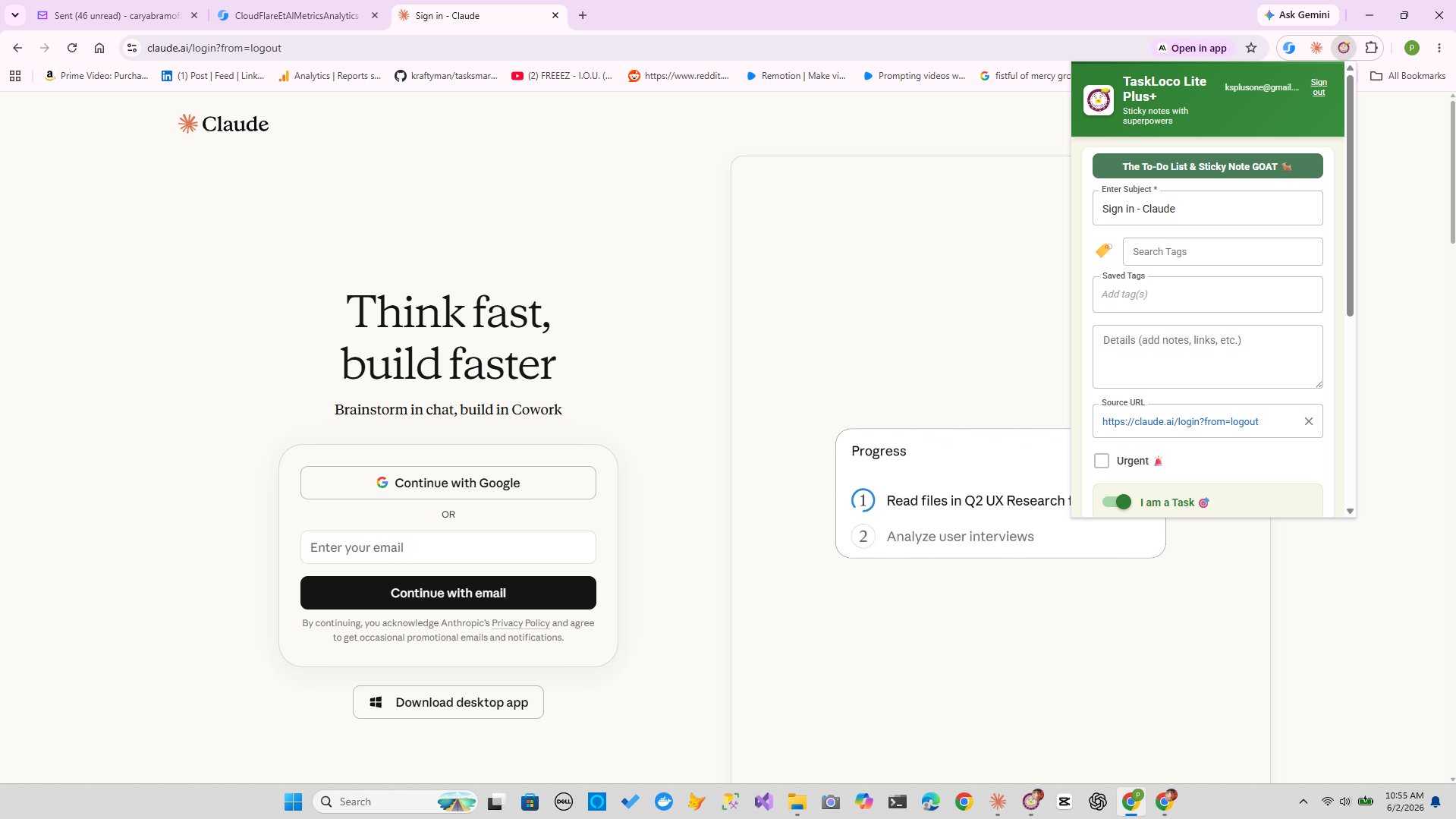
TaskLoco Lite Plus+ (free, web and Chrome extension) gives you 30 notes with cross-device sync — enough to try the done-list layout before committing to Premium. The Chrome extension lets you capture a webpage in one click and turn it into a note, which is useful when research tasks get completed: clip the source, mark it done, and it stays in your archive.
For anyone who wants reminders, file attachments, unlimited notes, and calendar view — the full done-list toolkit — that's TaskLoco Premium.
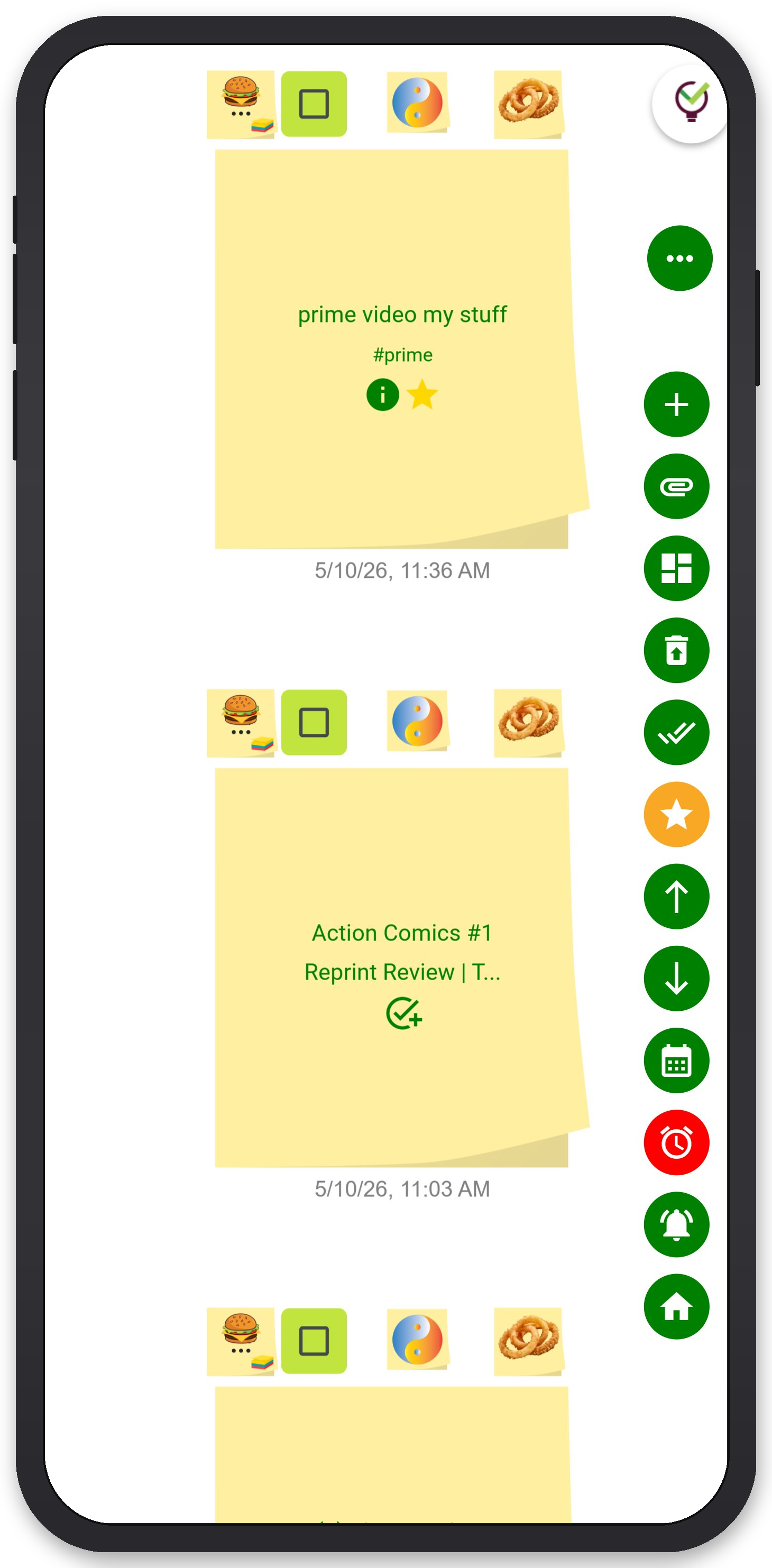
TaskLoco Premium is regularly $9.99/month per person. Right now, charter members can lock in 50% off the regular price — forever. That means $4.99/month per person today. And if our price ever goes up, you still pay half. Always.
Code CHARTER50 auto-applies at checkout. First 500 spots only — once they're gone, this offer is gone permanently. Act fast while spots last.
Every Premium subscription includes unlimited notes, 10GB file storage, reminders, calendar, and team sharing. Each team member requires a separate subscription. 7-day free trial — no charge until day 8. Cancel anytime.
Free Options: TaskLoco
TaskLoco Lite
- Native iPhone & Android app
- Completely anonymous — no sign-in
- Data stays on your device
- Up to 20 notes
- Free forever
TaskLoco Lite Plus+
- Web app + Chrome extension
- Sign in with Google
- Wall syncs across all devices
- Up to 30 notes
- Free forever
Lock In 50% Off — Forever
7-day free trial. No charge until day 8. CHARTER50 auto-applies at checkout.
🔒 Lock In My Charter SpotSee TaskLoco in Action
Frequently Asked Questions
What is a visual done list?
A visual done list is a space where completed tasks remain visible — displayed spatially on a board, wall, or canvas — rather than disappearing the moment you check them off. Unlike a filtered "completed items" view, a true visual done list keeps finished work in your line of sight by default, turning it into a record of momentum and accomplishment. The best ones preserve the full context of each task: notes, attachments, and any related files.
Why should completed tasks stay visible instead of being deleted?
Because completion is a signal, not just a state. When you can see what you've finished — spatially, at a glance — it reinforces the progress you've made and motivates the next task. Tools that delete or hide completed work the moment it's done remove that feedback loop entirely. A visual done list keeps the evidence in view, which is particularly valuable at the end of a day, week, or project when you want to reflect on output.
How does TaskLoco work as a visual done list?
TaskLoco's sticky-note wall is a spatial canvas where notes live as movable cards. You can create a "done" zone on the wall and move completed notes there — they stay visible, searchable, and rich with context (including any file attachments). The card-based layout makes the done column look and feel like a real accumulation of work rather than a database entry. With Premium, you also get calendar view to see when things got done over time, and full-text search across all notes including completed ones.
Can I attach files to completed notes in TaskLoco?
Yes — TaskLoco Premium includes 10GB of file storage per person. You can attach files, images, and documents directly to any note, including completed ones. That means your done list also functions as a work archive: finished tasks keep the deliverables attached, so everything related to that work stays in one searchable place.
Does TaskLoco have a free version I can try for building a done list?
Yes. TaskLoco Lite Plus+ is free — it runs as a web app and Chrome extension, syncs across all your devices, and gives you up to 30 notes. That's enough to try a done-list layout before upgrading. The Chrome extension lets you capture any webpage in one click, which is handy for clipping completed research. Lite Plus+ doesn't include reminders, file attachments, or unlimited notes — those are Premium features. There's also a native iPhone and Android app called TaskLoco Lite (free, no sign-in required) that stores up to 20 notes on your device — good for a quick feel of the interface, though it doesn't sync.
What's the difference between a done list and a completed tasks filter?
A completed tasks filter requires you to actively go looking for finished work — it's hidden by default and surfaced only when you toggle a view or run a search. A done list keeps completed items permanently visible in your main workspace. The spatial difference matters psychologically: done items in view read as progress, while done items behind a filter read as history you might never revisit. A visual done list treats finished work as a feature of your board, not a footnote.
How much does TaskLoco Premium cost?
$9.99/month per person (currently $4.99/month per person for first 500 charter members with code CHARTER50)
Born in Brooklyn. Powered by AWS. Your data stays yours.
TaskLoco is available on iPhone, Android, Chrome, and every web browser.