
Motivation is one of the most studied and most misunderstood concepts in psychology. Most people treat it like a fuel tank — either you have it or you don't. The science says something far more interesting: motivation is a dynamic system, shaped by how you interpret a situation, what you believe about yourself, and whether the goal connects to something you actually care about.
Decades of research across behavioral psychology, cognitive science, and neuroscience have produced a set of well-tested frameworks that explain why people start tasks, why they persist through difficulty, and — critically — why they stop. Understanding those frameworks is not just academic. It changes how you design your environment, how you set goals, and what you do when momentum disappears.
The Core Theories: Where the Science Comes From
Modern motivation psychology did not begin with self-help books. It began in the mid-twentieth century when researchers started questioning the dominant behaviorist view — that behavior is simply a response to external reward and punishment.
Maslow's Hierarchy of Needs (1943) proposed that human needs form a pyramid: physiological survival at the base, then safety, belonging, esteem, and finally self-actualization. The popular takeaway — that higher needs only emerge once lower ones are fully met — is actually an oversimplification. Maslow himself acknowledged significant overlap and individual variation. What the framework does capture accurately is that motivation is not one-dimensional. A person working for a paycheck is operating on a different motivational register than one pursuing mastery of a craft.
Self-Determination Theory (Deci & Ryan, 1985) is arguably the most empirically supported framework in the field. SDT distinguishes between intrinsic motivation (doing something because it is inherently satisfying) and extrinsic motivation (doing it for an external reward or to avoid a consequence). The critical finding: external rewards, when applied to tasks people already enjoy intrinsically, can undermine motivation over time — the overjustification effect. SDT also identifies three core psychological needs that must be met for sustained motivation: autonomy (feeling in control of your own actions), competence (feeling effective), and relatedness (feeling connected to others).
Expectancy Theory (Vroom, 1964) takes a more cognitive approach: motivation is a product of three beliefs — that effort will lead to performance, that performance will lead to a reward, and that the reward is actually worth having. Break any one of those links and motivation collapses, regardless of how much someone values the end goal in the abstract.
Goal-Setting Theory (Locke & Latham, 1990) adds precision to this picture. Specific, challenging goals consistently outperform vague or easy ones — but only when the person accepts the goal and receives feedback on progress. A goal with no feedback loop is a wish, not a motivational structure.
Intrinsic vs. Extrinsic: The Distinction That Changes Everything
The intrinsic/extrinsic distinction is not just conceptual — it has measurable consequences for the quality of work, persistence, and long-term engagement.
Intrinsically motivated behavior is driven by curiosity, interest, or the satisfaction of the activity itself. A developer who loses track of time solving a hard bug, a writer who edits a paragraph for the fifth time not because anyone asked but because it isn't right yet — these are intrinsic states. The research on intrinsic motivation consistently shows higher creativity, deeper learning, and greater persistence in the face of obstacles.
Extrinsic motivation is not inherently bad. SDT researchers introduced the concept of internalization — the process by which external values become personally meaningful. A person who starts exercising because a doctor told them to can, over time, come to genuinely value their health and exercise intrinsically. The motivational quality shifts from controlled to autonomous even though the behavior looks the same from the outside.
The problem arises when extrinsic motivators — particularly surveillance, evaluation, and contingent rewards — are applied to tasks that require autonomous engagement. Classic studies by Deci and colleagues showed that paying people to solve puzzles they previously enjoyed led to less engagement with those puzzles after the payment stopped. The reward reframed the activity from "something I choose to do" to "something I do for money" — and when the money disappeared, so did the motivation.
The practical implication is not to abandon external incentives — they work for activating behavior and meeting basic needs. The goal is to pair them with conditions that support autonomy and competence, so that external scaffolding gradually gives way to internal drive.

Where Motivation Breaks Down: The Real Failure Modes
Understanding motivation theory is not enough if you cannot recognize the specific points where it collapses. There are four well-documented failure modes worth knowing.
1. The intention-action gap. People routinely overestimate how much their future intention will translate into action. The gap between "I plan to" and "I did" is one of the most consistent findings in behavioral psychology. Implementation intentions — the "when X happens, I will do Y" format studied extensively by Peter Gollwitzer — close this gap by linking behavior to a specific cue rather than leaving it as an open-ended commitment.
2. Ego depletion (contested but instructive). The original research by Roy Baumeister proposed that willpower is a finite resource that depletes with use. Subsequent replication attempts have produced mixed results, and the strong version of the theory is no longer widely accepted. What does hold up: decision fatigue is real, and cognitive load impairs self-regulation. The lesson is not that willpower is a muscle you drain — it is that decision-heavy environments make deliberate behavior harder, which argues for reducing the number of decisions required to act.
3. Goal conflict. Most people carry multiple goals simultaneously — professional, relational, health-related, financial. These goals compete for attention, time, and energy. When goals conflict without an explicit hierarchy, paralysis or avoidance often follows. Research on goal systems theory (Kruglanski) shows that progress on one goal can paradoxically reduce motivation for a related goal, because the underlying need feels partially addressed.
4. Learned helplessness. Martin Seligman's foundational work showed that repeated exposure to uncontrollable outcomes — situations where effort produces no reliable result — causes organisms to stop trying even when the situation changes and effort would now succeed. In humans, this translates into persistent disengagement, passivity, and a belief that action is futile. It is not a character flaw; it is a rational adaptation to a previously unresponsive environment.

TaskLoco and the Motivation Loop: One Honest Connection
TaskLoco is not a motivation system. No app is. But the research above points to a few structural conditions that make follow-through more likely: specific, visible goals; feedback on progress; and reduced friction between intention and action.
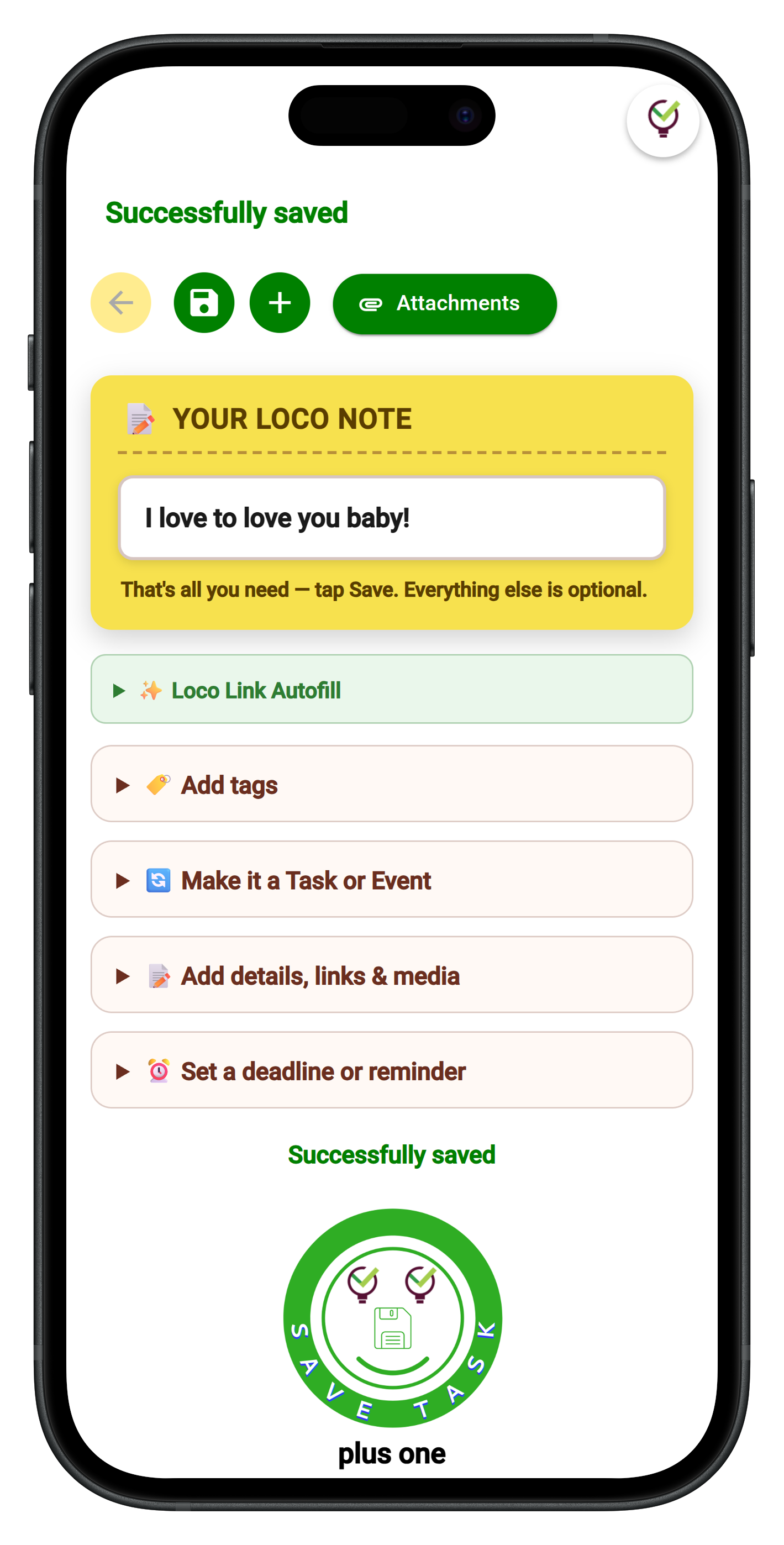
The sticky-note model TaskLoco is built around maps surprisingly well onto implementation intention research. A note is not just a reminder — it is a commitment device. Writing something down, giving it a deadline, and attaching it to a context (a project, a date, a person) converts a vague intention into a structured plan. That is exactly the format Gollwitzer's research identifies as most effective for closing the intention-action gap.
TaskLoco Premium adds push notification reminders that deep-link directly back to the original note — so when a reminder fires, you land inside the context of the task, not in a generic inbox. That framing matters: it reduces the cognitive cost of re-engaging with a task, which is one of the small friction points that cumulatively explain why good intentions fail.
The team sharing feature is relevant to the relatedness component of SDT — sharing a note with a collaborator makes a goal social, which research consistently shows increases commitment. Not because anyone is watching, but because articulating a goal to another person makes it more real.



TaskLoco Premium is regularly $9.99/month per person. Right now, charter members can lock in 50% off the regular price — forever. That means $4.99/month per person today. And if our price ever goes up, you still pay half. Always.
Code CHARTER50 auto-applies at checkout. First 500 spots only — once they're gone, this offer is gone permanently. Act fast while spots last.
Every Premium subscription includes unlimited notes, 10GB file storage, reminders, calendar, and team sharing. Each team member requires a separate subscription. 7-day free trial — no charge until day 8. Cancel anytime.
Free Options: TaskLoco
TaskLoco Lite
- Native iPhone & Android app
- Completely anonymous — no sign-in
- Data stays on your device
- Up to 20 notes
- Free forever
TaskLoco Lite Plus+
- Web app + Chrome extension
- Sign in with Google
- Wall syncs across all devices
- Up to 30 notes
- Free forever
Lock In 50% Off — Forever
7-day free trial. No charge until day 8. CHARTER50 auto-applies at checkout.
🔒 Lock In My Charter SpotSee TaskLoco in Action
Frequently Asked Questions
What is the psychology of motivation in simple terms?
Motivation is the internal process that gets behavior started, keeps it going, and determines how much effort a person puts in. Psychologists distinguish between intrinsic motivation (driven by genuine interest or satisfaction) and extrinsic motivation (driven by reward or consequence). Modern research — particularly Self-Determination Theory — shows that the quality of motivation matters as much as its intensity: autonomous motivation produces more persistence, creativity, and well-being than controlled motivation.
What are the main theories of motivation in psychology?
The most influential frameworks are: Maslow's Hierarchy of Needs (1943), which organizes human needs from survival to self-actualization; Self-Determination Theory (Deci & Ryan, 1985), which identifies autonomy, competence, and relatedness as the core psychological needs underlying intrinsic motivation; Expectancy Theory (Vroom, 1964), which frames motivation as a function of effort-performance-reward beliefs; and Goal-Setting Theory (Locke & Latham, 1990), which shows that specific, challenging goals with feedback consistently outperform vague or easy ones.
What is the difference between intrinsic and extrinsic motivation?
Intrinsic motivation comes from within — you do something because it is genuinely interesting, enjoyable, or meaningful to you. Extrinsic motivation comes from outside — a reward, a grade, a salary, avoiding punishment. The key research finding is the overjustification effect: adding external rewards to activities people already find intrinsically motivating can reduce their internal drive over time, because the activity becomes reframed as something done for the reward rather than for its own sake.
Why do people lose motivation even for goals they care about?
Several well-documented mechanisms explain this. Goal conflict — competing priorities without a clear hierarchy — causes paralysis or avoidance. The intention-action gap means good intentions rarely convert to action without a specific plan linking the behavior to a trigger or context. Learned helplessness, developed through repeated experiences of effort not producing results, leads to persistent disengagement. And cognitive overload from decision-heavy environments impairs self-regulation. In most cases, motivation loss reflects a system problem, not a character flaw.
What is learned helplessness and how does it affect motivation?
Learned helplessness, first described by Martin Seligman, is the tendency to stop trying after repeated experiences where effort had no effect on outcomes. It develops as a rational response to an uncontrollable environment. The damaging part is that it persists even after the environment changes — the person continues to behave as if their actions are futile. In motivational terms, it breaks the effort-to-performance link that Expectancy Theory identifies as essential for sustained engagement.
How does goal-setting affect motivation?
Locke and Latham's Goal-Setting Theory, supported by decades of research, shows that specific and challenging goals produce significantly higher performance than vague or easy goals — but only under two conditions: the person must genuinely accept the goal, and they must receive meaningful feedback on their progress. Without feedback, even a well-formed goal loses its motivational force because there is no signal indicating whether effort is producing results.
How can understanding motivation psychology help with productivity?
The most actionable insight from motivation research is structural: motivation is a response to conditions, not a fixed trait. This means you can engineer conditions that make follow-through more likely. Implementation intentions ("when X happens, I will do Y") close the intention-action gap. Reducing decision friction lowers the cognitive cost of starting. Making goals visible and specific engages the competence need. Sharing commitments with others activates the relatedness need. Tools that support these conditions — clear task capture, reminders tied to context, shared notes — align with how motivation actually works rather than relying on willpower alone.
Born in Brooklyn. Powered by AWS. Your data stays yours.
TaskLoco is available on iPhone, Android, Chrome, and every web browser.