You wrote the goal down. You felt the momentum. Then three weeks later it's still sitting in a notebook while real life took over. That's not laziness — that's what happens when a goal hasn't been translated into something you can act on today. A goal is a destination. Without a route, you're just hoping.
The fix isn't more motivation or a bigger vision board. It's engineering. Specifically: breaking the goal into milestones, milestones into tasks, and tasks into something you'll actually see and do each day. This guide walks through exactly that process — and shows how to set up a simple daily system that doesn't collapse the moment things get busy.
What Actually Makes a Goal-to-Task System Work
Before any tool enters the picture, it's worth understanding what separates systems that work from systems that get abandoned after two weeks. There are three things that genuinely matter:
- Specificity at the task level. "Work on the business plan" is not a task. "Write the market analysis section, 300 words" is a task. The more concrete the action, the less friction between intention and execution. If you have to figure out what to do when you sit down, you've already lost half the battle.
- Visible daily commitment. Your daily tasks need to be somewhere you can't avoid them — not buried three menus deep in an app you open once a week. The system has to surface what matters today without requiring you to go looking for it.
- A clear line from task back to goal. Motivation erodes fastest when daily tasks feel disconnected from anything meaningful. Every task you do needs a traceable line back to a milestone, and every milestone back to the goal. That connection is what turns tedious into purposeful.
A good goal-breakdown system doesn't need to be complex. It needs to be honest about what the next action actually is, and it needs to put that action somewhere unavoidable. Everything else is optional.
The Three-Layer Breakdown: Goal → Milestone → Daily Task
Every big goal can be decomposed into three layers. Skip a layer and the system breaks down. Here's how to do it cleanly:
Layer 1 — Define the goal with a deadline and a measurable outcome. Not "get fit" but "run a 10K in under 55 minutes by the end of the quarter." Not "grow revenue" but "close five new clients by the end of month three." The goal has to be testable — either you hit it or you didn't. Ambiguity here infects every layer below it.
Layer 2 — Break the goal into 3–6 milestones. Milestones are checkpoints roughly evenly spaced across your timeline. For the 10K goal: run 5K without stopping by week 3 / hit 7K by week 6 / complete a full 10K by week 9 / hit the target pace by week 12. Each milestone is a mini-finish line that tells you you're on track. If you hit a milestone late, you know immediately — and you can adjust before the whole goal is at risk.
Layer 3 — Turn each milestone into specific daily or weekly tasks. This is where most people underthink it. For "run 5K without stopping by week 3" the tasks are: run 2K Monday, 2.5K Wednesday, 3K Friday, rest on weekends. Exact distances, exact days. No room for interpretation when you sit down to act.
Write each layer down separately. Don't collapse milestones and tasks into the same list — they answer different questions. Milestones answer "am I on track?" Tasks answer "what do I do right now?"
How to Build This System Inside TaskLoco
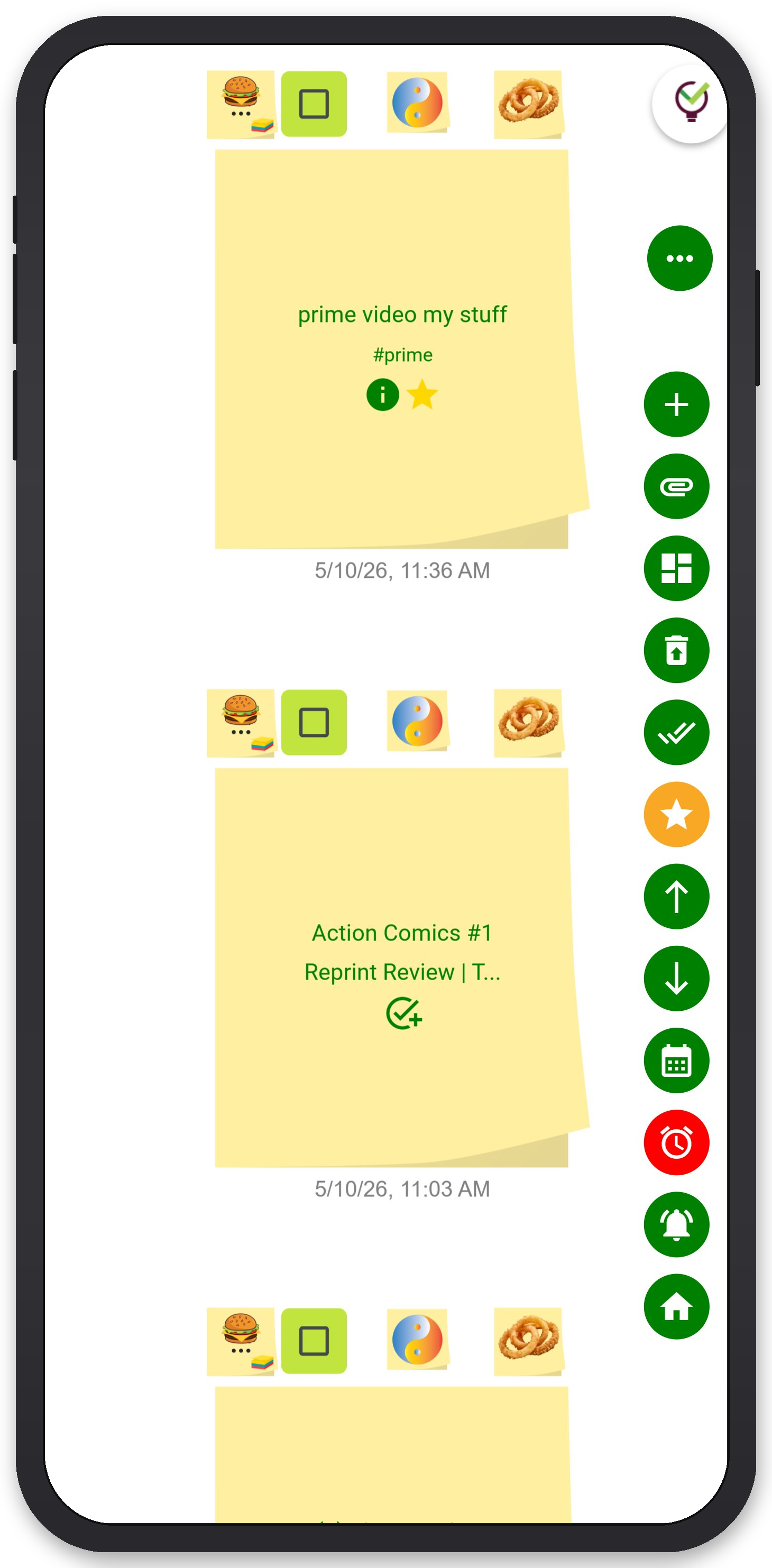
TaskLoco is built around sticky notes, and that turns out to be a surprisingly natural fit for goal decomposition. Here's a practical setup that maps directly onto the three-layer model above.
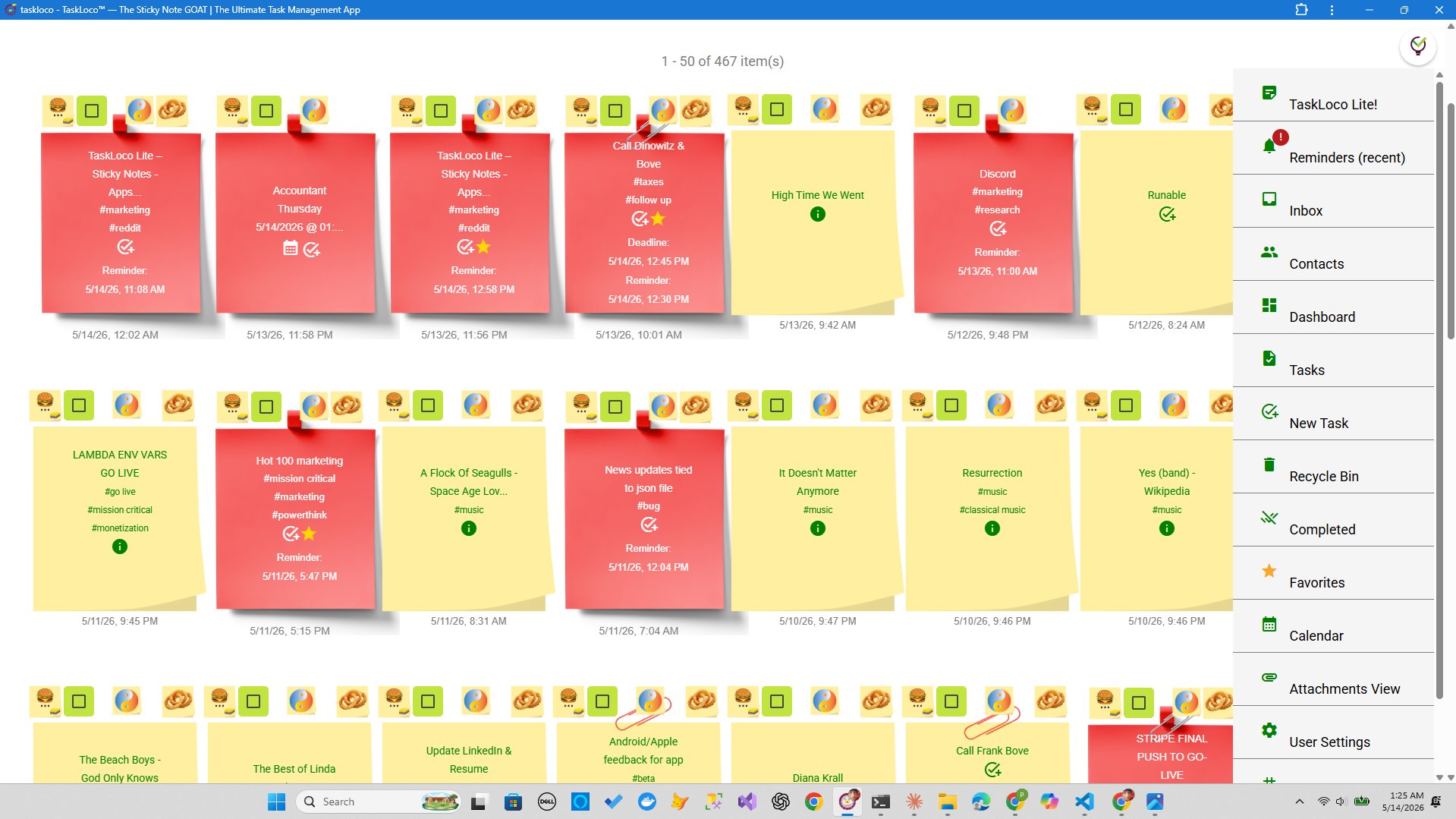
One note per milestone. Create a note for each milestone. Give it a clear title ("Milestone 2 — 7K by week 6") and write the specific tasks inside it as a checklist. Color-code by status: active milestone gets one color, completed milestones another, future milestones a third. Your wall view becomes a live map of where you are in the goal.
A daily task note you actually see. Keep one note — call it "Today" — pinned at the top of your wall. Each morning, copy the day's tasks from the relevant milestone note into "Today." This is your only job list for the day. Nothing else exists until these are done. The act of manually copying forces a moment of intentional commitment that auto-populating systems skip entirely.
Reminders that deep-link back to the note. For time-sensitive tasks, set a reminder directly on the note. When it fires, the push notification takes you straight back to that note — not to a generic app home screen. You see the task in context, next to everything else that belongs to it. That context is what separates a reminder that gets acted on from one that gets dismissed.
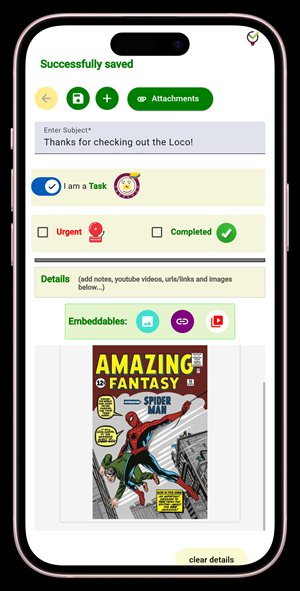
Attach reference material where it belongs. Research documents, inspiration images, draft files — attach them directly to the milestone note they support. With 10GB of file storage on Premium, you're not shuffling between apps to find the brief or the template. Everything lives with the task it informs.
If you're working toward a goal with a team — a product launch, a content calendar, a shared business objective — TaskLoco's team sharing works the way email does: share a note and the recipient can clone it and make it their own. No permissions to configure, no access levels to manage. Each person owns their piece of the plan.
Keeping the System Alive Past Week Two
The graveyard of productivity systems is full of setups that worked great on day one. Here's what separates the ones that last:
Weekly reviews are non-negotiable. Set aside 15 minutes every Sunday (or whatever your week-start day is) to do three things: mark milestones complete or in progress, update task lists for the coming week based on what actually happened last week, and check whether your timeline still makes sense. Goals don't fail because the system broke — they fail because the system was never updated after reality diverged from the plan.
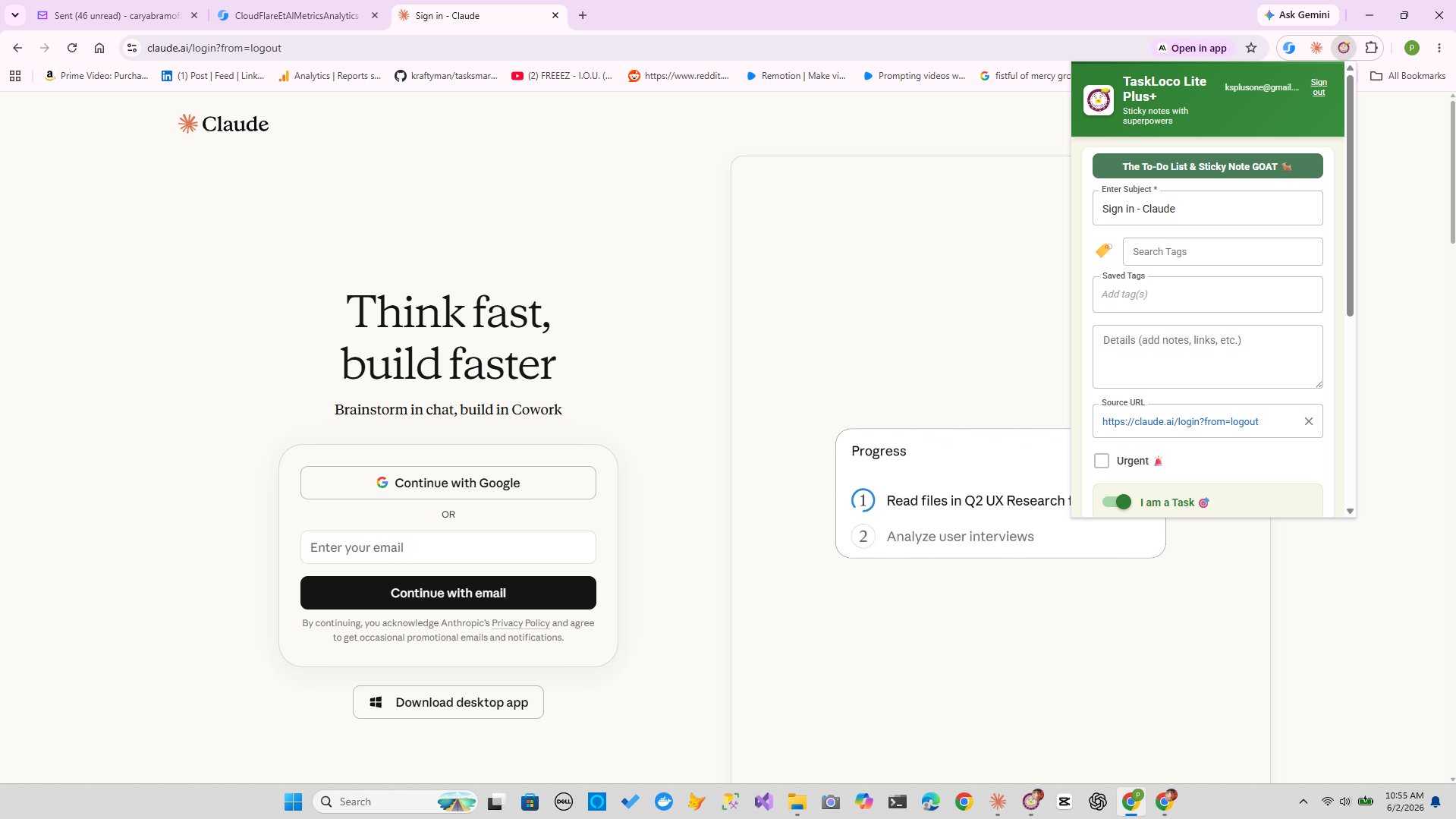
Reduce friction at every step. If opening your task list takes more than two seconds, you'll stop opening it. TaskLoco's Chrome extension lets you capture a webpage, article, or reference link into a note with one click — so the moment you find something relevant to a goal, it's saved before you forget it. The web app works on any browser including mobile, so your notes are with you wherever you are.
Make the goal visible, not just the tasks. Keep a dedicated note at the top of your wall with just the goal and the finish line written in plain language. You'll see it every time you open the app. That 10-second reminder of why you're doing all this is worth more than any motivational podcast.
Don't let perfect be the enemy of done. Miss a task? Move it to tomorrow. Miss a week? Adjust the milestone date. The system isn't a contract — it's a map. Maps get updated when the road changes. The only real failure is throwing out the map entirely because one road was closed.
TaskLoco Premium is regularly $9.99/month per person. Right now, charter members can lock in 50% off the regular price — forever. That means $4.99/month per person today. And if our price ever goes up, you still pay half. Always.
Code CHARTER50 auto-applies at checkout. First 500 spots only — once they're gone, this offer is gone permanently. Act fast while spots last.
Every Premium subscription includes unlimited notes, 10GB file storage, reminders, calendar, and team sharing. Each team member requires a separate subscription. 7-day free trial — no charge until day 8. Cancel anytime.
Free Options: TaskLoco
TaskLoco Lite
- Native iPhone & Android app
- Completely anonymous — no sign-in
- Data stays on your device
- Up to 20 notes
- Free forever
TaskLoco Lite Plus+
- Web app + Chrome extension
- Sign in with Google
- Wall syncs across all devices
- Up to 30 notes
- Free forever
Lock In 50% Off — Forever
7-day free trial. No charge until day 8. CHARTER50 auto-applies at checkout.
🔒 Lock In My Charter SpotSee TaskLoco in Action
Frequently Asked Questions
How do I break a big goal into smaller steps?
Start with three layers: the goal itself (specific, measurable, deadline-bound), 3–6 milestones that mark progress at regular intervals, and concrete daily or weekly tasks that belong to each milestone. Never collapse milestones and tasks into the same list — milestones tell you whether you're on track; tasks tell you what to do right now. Write each layer separately and connect them explicitly.
How many daily tasks should I have for one goal?
Most people overload their daily list and then feel like failures when they don't finish it. A better rule: pick one to three tasks per goal per day. If a single goal demands more than three daily actions to stay on track, that's a sign the goal either has too short a timeline or needs to be split into sub-goals. Three focused tasks done beats ten tasks half-done every single time.
What's the best way to keep daily tasks visible?
The system has to put your tasks somewhere unavoidable. A dedicated "Today" note pinned to the top of your TaskLoco wall works well — it's the first thing you see when you open the app, and it contains only what matters today. Reminders on TaskLoco Premium fire as push notifications to your phone and computer and deep-link straight back to the note, so even if you forget to open the app, the reminder brings you directly to the task in context.
What's a milestone versus a task?
A milestone is a checkpoint — a verifiable point where you can objectively say "yes, I'm on track" or "no, I've fallen behind." A task is a specific action you take on a specific day. The milestone "complete first draft by end of month" is made up of many tasks: "write chapter 1 outline Monday," "draft chapter 1 Tuesday–Wednesday," and so on. Milestones answer the question am I on track? Tasks answer what do I do today?
How do I stay motivated when working toward a long-term goal?
Motivation follows progress. The problem with long-term goals is that progress feels invisible until the very end. Milestones fix this by creating regular finish lines — completing a milestone gives you a genuine sense of achievement even when the main goal is still months away. Keeping your goal note visible every day also helps: a brief visual reminder of why the daily tasks matter is more effective than any motivational technique.
Can I use TaskLoco to track a goal with my team?
Yes. TaskLoco Premium includes full team sharing — share a note and the recipient can clone it and make it their own, no permissions or access levels to configure. Each team member maintains their own copy of their tasks. Reminders fire as push notifications to each person's devices individually, and the push notification deep-links straight back to the relevant note. Each team member requires their own separate Premium subscription. $9.99/month per person (currently $4.99/month per person for first 500 charter members with code CHARTER50)
What should I do when I fall behind on my goal?
Don't throw out the system — update it. Missing tasks or milestones is information, not failure. During your weekly review, assess what actually happened: was the task too big and needs to be broken down further? Was the timeline unrealistic? Adjust the milestone dates, reschedule the missed tasks, and keep going. The only real failure is abandoning the map because one road was closed. Rebuilt plans succeed far more often than abandoned ones.
Born in Brooklyn. Powered by AWS. Your data stays yours.
TaskLoco is available on iPhone, Android, Chrome, and every web browser.