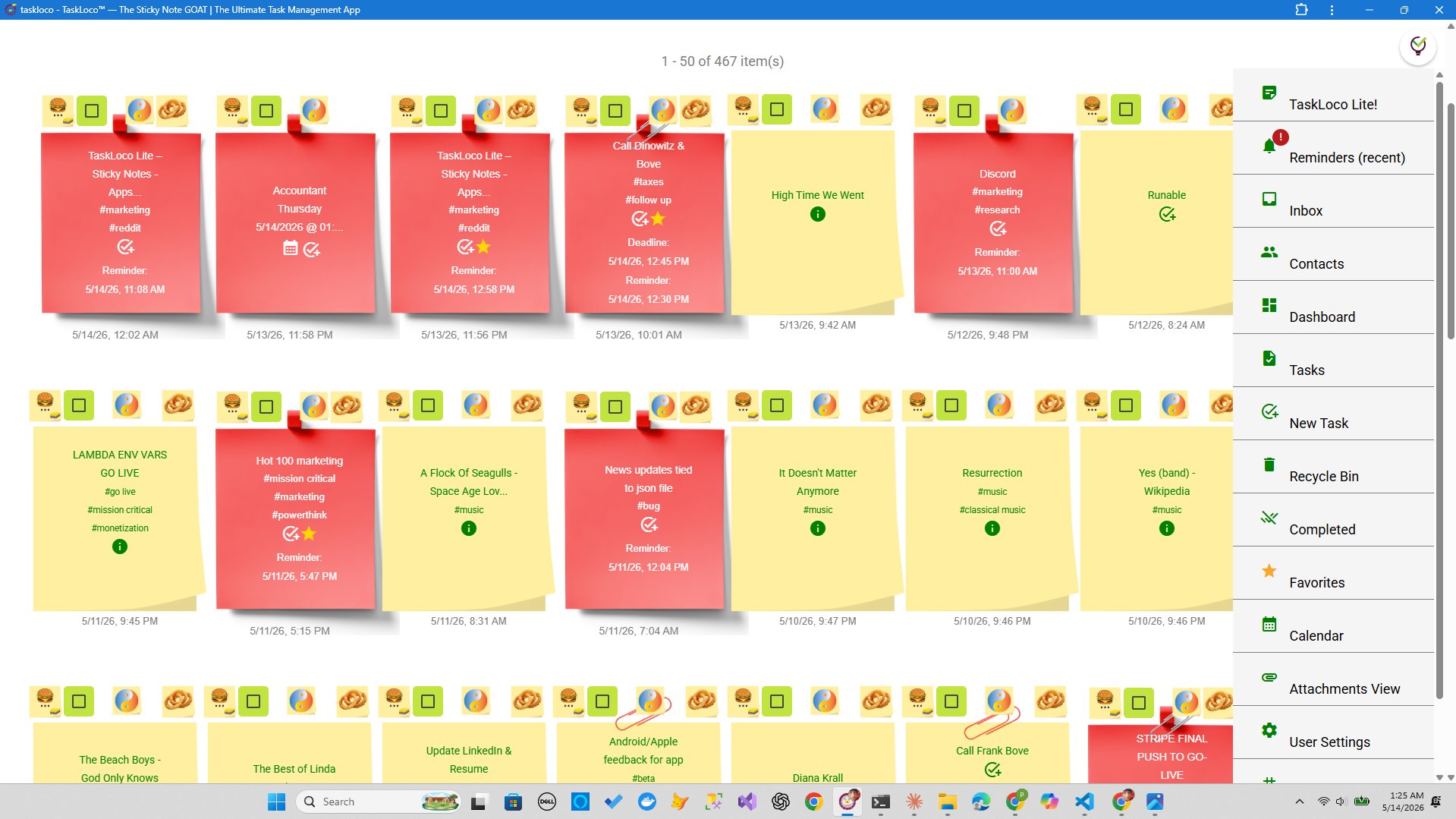
You read the article. You bought the book. You watched the YouTube breakdown of someone's five-hour morning routine. And somehow, instead of feeling energized, you closed the tab feeling like a failure before you'd even started. That's not a coincidence — that's a design flaw in how productivity advice is packaged and sold.
Most productivity content is aspirational fiction dressed up as practical advice. It tells you what high-output people do on their best days and frames it as a repeatable system for everyone. The gap between that and your actual Tuesday afternoon — inbox on fire, three half-finished projects, a headache — produces exactly one emotion: inadequacy. Understanding why this happens is the first step to finding something that actually works.
The Psychology Behind the Guilt Spiral
When you consume productivity advice, you're engaging in a form of mental simulation. Your brain imagines following the system, pictures the outcomes, and rewards you with a small hit of dopamine — before you've done a single thing. Researchers call this mental contrasting gone wrong: you get the emotional payoff of the goal without the behavioral commitment to reach it. The advice felt productive. The day wasn't.
There's a second mechanism at work too: social comparison. Productivity influencers are, almost by definition, people who selected for extreme output. They write 3,000 words before 7am and have a color-coded task system they've been refining for eight years. When their routine becomes the benchmark, everyone else is automatically underperforming. You're not comparing yourself to an average person — you're comparing yourself to someone at the 99th percentile of organized, motivated, and publicly self-documenting.
The third problem is system overload. Most popular frameworks — GTD, Zettelkasten, time-blocking, the 12-week year — are sophisticated enough to require ongoing maintenance. The system itself becomes a second job. When it slips for a few days, the cognitive dissonance between your self-image as someone who has their act together and the reality of 47 unprocessed inbox items creates a guilt response that's genuinely uncomfortable. So you avoid the system. Then you feel worse.
What Actually Works: The Research vs. The Content
The science of motivation and behavior change is fairly clear on a few things that popular productivity content tends to bury or ignore entirely.
Implementation intentions beat motivation. A 1999 study by Peter Gollwitzer found that people who specified exactly when, where, and how they would do a task were two to three times more likely to actually do it than people who simply intended to. The format is simple: 'When X happens, I will do Y.' This is not a morning routine. It is a single if-then sentence. It costs nothing to write and it works.
Smaller commitments outperform larger ones. BJ Fogg's research at Stanford on behavior change consistently shows that shrinking a habit down to something almost embarrassingly small — two push-ups, one sentence, open the app — removes the activation energy barrier. Productivity advice almost always goes the other direction: bigger routines, longer focus blocks, more elaborate systems. The neuroscience says smaller wins consistently.
External capture beats internal memory. Cognitive load theory tells us that working memory is limited and fragile. Every unwritten task or unresolved idea sitting in your head is using mental bandwidth that could go toward actual work. The single highest-return productivity action most people can take is writing things down — immediately, without filtering, without organizing — just to empty the mental buffer. The format almost doesn't matter.
Completion beats optimization. There's extensive research on the Zeigarnik effect: incomplete tasks occupy mental space in a way completed ones don't. Getting something done at 80% quality closes the loop and frees your brain. Endlessly optimizing your system to theoretically get to 100% never closes the loop — and the open loop tax compounds over time.
How to Build a System You Won't Abandon
The best productivity system is the one with the lowest barrier between having a thought and recording it. Everything else — categories, priorities, due dates, integrations — is downstream of that. Start there.
Step 1: Pick one capture surface and stick to it. The reason people lose notes, forget tasks, and feel scattered is not that they're disorganized — it's that they're using seven different places to write things down and no one place feels authoritative. Pick one. It could be a physical notebook, a notes app, a voice memo. The format is less important than the consistency. When everything lands in one place, the mental friction of 'wait, where did I put that?' disappears.
Step 2: Write the next physical action, not the project.'Launch website' is not a task. 'Write first draft of homepage headline' is a task. When your capture surface fills up with projects rather than actions, the list becomes paralyzing. Every item should be something you can start in the next few minutes without making any more decisions. If it isn't, it needs to be broken down before it goes on the list.
Step 3: Review once a day, briefly. You don't need a weekly review. You need to look at your list every morning and answer one question: what are the two or three things that actually need to happen today? Everything else can wait. This review should take five minutes, not fifty. If it takes longer, your list is too long or too vague.
Step 4: Remove the system on bad days. When energy is low, motivation is gone, or circumstances are chaotic, a complex system becomes a source of shame rather than support. Give yourself explicit permission to reduce the system to its minimum: one sticky note with one thing on it. The goal on hard days is not to execute the full system. The goal is not to abandon it entirely. One note keeps the thread alive.
Step 5: Ignore advice that doesn't match your constraints. If you have three meetings before 10am, the 'deep work first thing' advice is irrelevant. If you work in a collaborative environment, solo focus blocks need different design. The most important filter for any productivity advice is: does this fit how my days actually run? If not, skip it without guilt.
Where TaskLoco Fits Into This
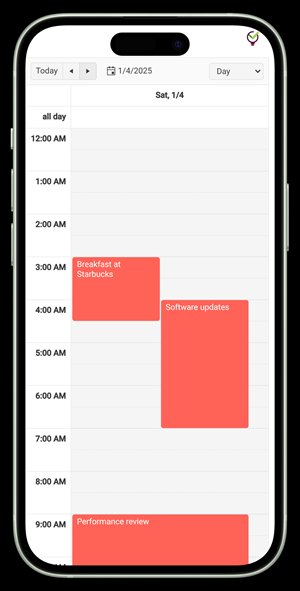
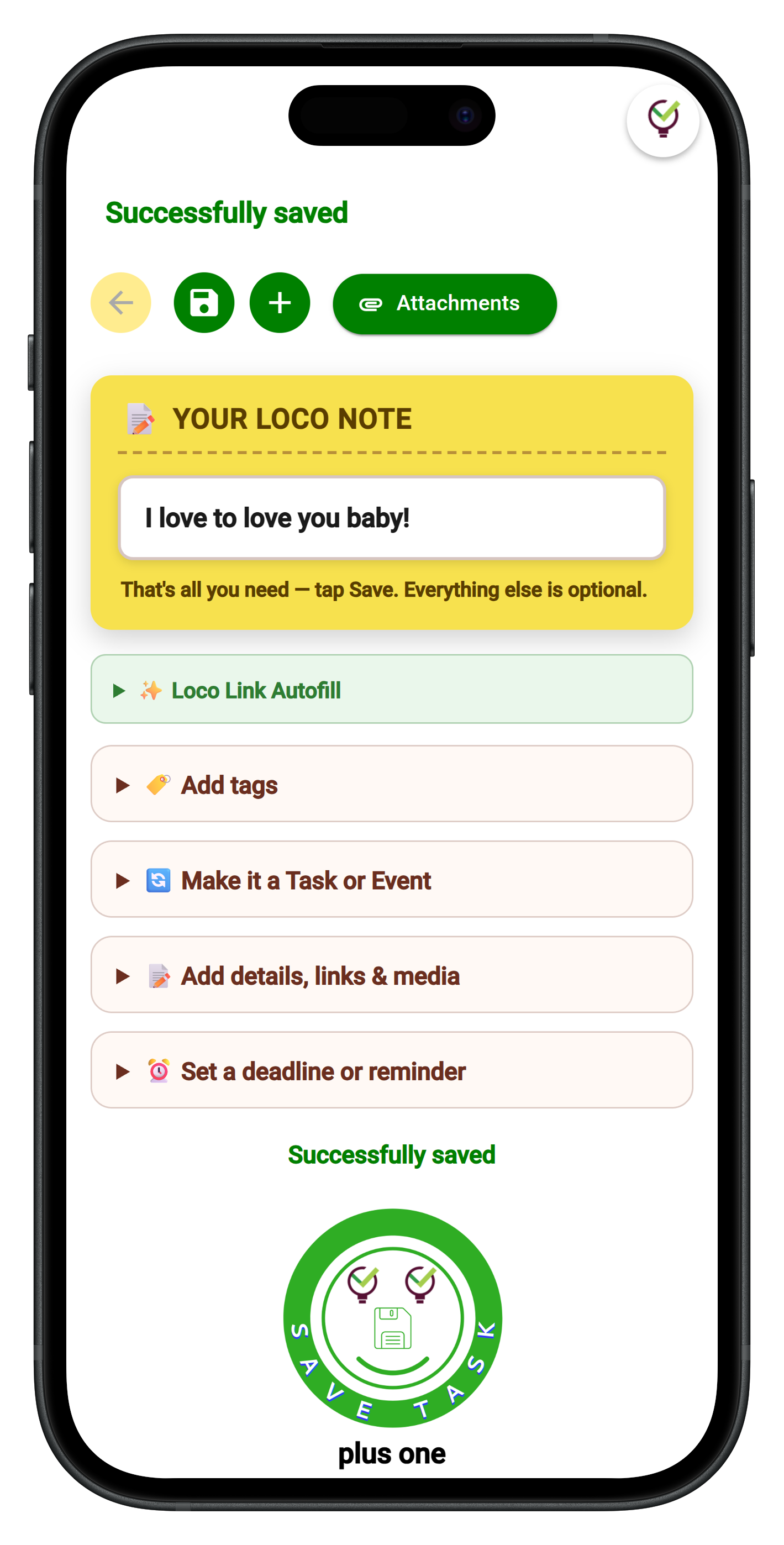
If you've landed on the idea that you want a single capture surface — fast to open, easy to write in, nothing to configure — TaskLoco is worth a look. It's built around sticky notes, which is deliberate. There's no elaborate hierarchy to maintain, no project structure to design upfront, no onboarding checklist that itself becomes a task you never finish.
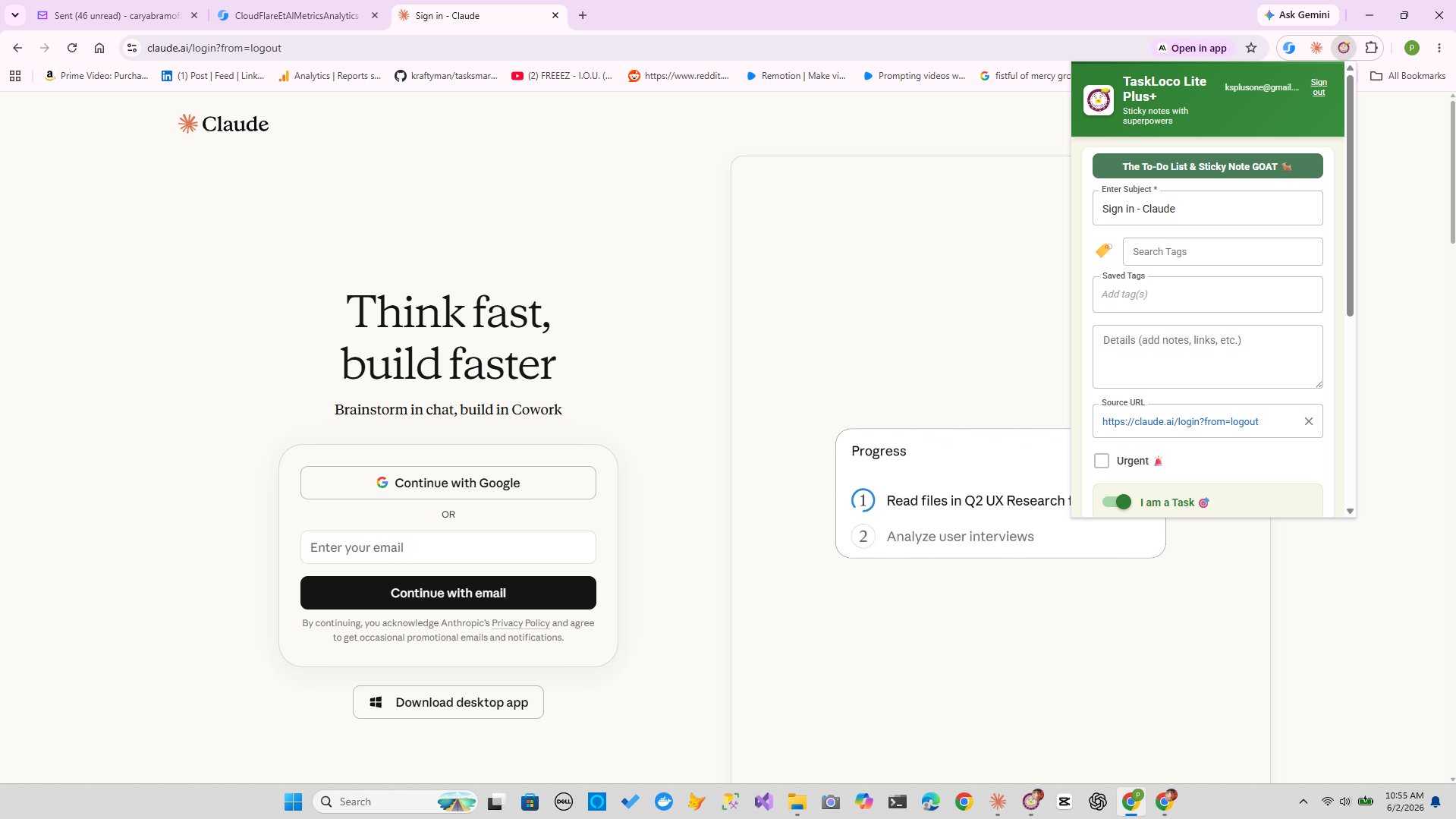
The free tiers are genuinely useful without commitment. TaskLoco Lite is a native iPhone and Android app — completely anonymous, no sign-in required, stores up to 20 notes on your device in a JSON file. It's as close to a digital sticky note as software gets. TaskLoco Lite Plus+ is the web app and Chrome extension — sign in with Google, get 30 notes synced across all your devices, and a one-click Chrome extension that captures any webpage directly into a note. Still free.
If you want the full picture — reminders that deep-link back to the original note and are delivered as push notifications to your phone and computer (with optional email and SMS channels), file attachments with 10GB of storage, unlimited notes, a calendar view, and team sharing — that's TaskLoco Premium. It's not trying to be a project management platform. It's trying to be the place where everything lands, and where nothing gets lost.
The Chrome extension is worth a specific mention for the productivity-advice-fatigue problem: when you're reading something useful online and don't want to lose it before you act on it, one click captures the page. It goes into your notes, not a read-later graveyard you never visit.
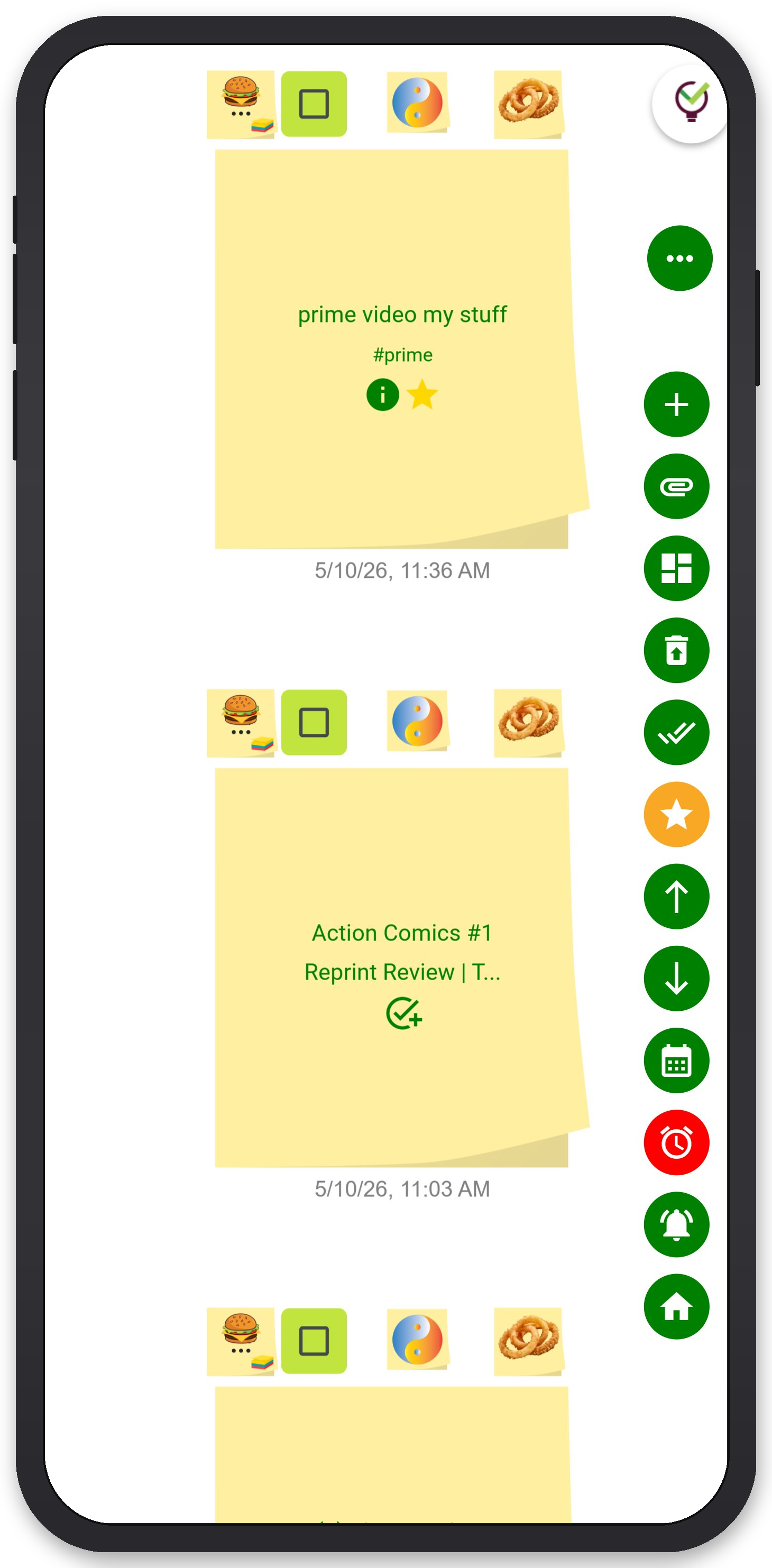
TaskLoco Premium is regularly $9.99/month per person. Right now, charter members can lock in 50% off the regular price — forever. That means $4.99/month per person today. And if our price ever goes up, you still pay half. Always.
Code CHARTER50 auto-applies at checkout. First 500 spots only — once they're gone, this offer is gone permanently. Act fast while spots last.
Every Premium subscription includes unlimited notes, 10GB file storage, reminders, calendar, and team sharing. Each team member requires a separate subscription. 7-day free trial — no charge until day 8. Cancel anytime.
Free Options: TaskLoco
TaskLoco Lite
- Native iPhone & Android app
- Completely anonymous — no sign-in
- Data stays on your device
- Up to 20 notes
- Free forever
TaskLoco Lite Plus+
- Web app + Chrome extension
- Sign in with Google
- Wall syncs across all devices
- Up to 30 notes
- Free forever
Lock In 50% Off — Forever
7-day free trial. No charge until day 8. CHARTER50 auto-applies at checkout.
🔒 Lock In My Charter SpotSee TaskLoco in Action
Frequently Asked Questions
Why does reading productivity advice make me feel unproductive?
Because most productivity content is written about best-case scenarios by people who selected for unusually high output, then packaged as universally applicable advice. The gap between the advice and your actual day produces inadequacy, not motivation. The advice isn't wrong — it's just written for someone else's constraints.
What's the simplest productivity system that actually works?
One capture surface, one review per day, and tasks written as next physical actions rather than project names. Implementation intentions (if X then I will do Y) outperform motivation in controlled research. Smaller commitments outperform larger routines. You don't need a sophisticated system — you need a consistent one with low friction.
Is there a productivity method backed by science?
Several. Implementation intentions (Gollwitzer, 1999) reliably increase follow-through. Behavior design research from Stanford shows that shrinking habits reduces activation energy and increases consistency. Cognitive load theory supports immediate external capture of tasks over relying on memory. The Zeigarnik effect explains why completing tasks — even imperfectly — frees mental bandwidth. None of these require a specific app or framework.
Why do I keep abandoning productivity apps?
Usually because the app's structure doesn't match how your days actually run, or because the system required more maintenance than you had bandwidth to give it. The fix is to choose the simplest tool that handles your most common use case — fast capture and daily review — and ignore features you don't need. A system you use inconsistently beats a perfect system you abandon.
How do I stop feeling guilty about not following my productivity system?
Build an explicit 'minimum viable mode' for hard days — a single note with one task. This keeps the thread alive without the full overhead of your normal system. Guilt comes from the gap between your self-image and your behavior. Closing that gap is easier by lowering the floor than by raising your effort. On bad days, one thing done beats zero things done inside a perfect system.
Can TaskLoco help with productivity without adding complexity?
That's the intent. TaskLoco is built around sticky notes — the fastest form of task capture that exists. The free Lite app requires no sign-in at all. Lite Plus+ syncs across devices and adds a Chrome extension for one-click webpage capture. Premium adds reminders (delivered as push notifications that deep-link back to the original note), file attachments, unlimited notes, a calendar, and team sharing. None of it requires a configuration session before you can use it. $9.99/month per person (currently $4.99/month per person for first 500 charter members with code CHARTER50)
What's the difference between a task list and a productivity system?
A task list records what needs doing. A productivity system is the full set of habits, tools, and routines around how you capture, organize, prioritize, and execute work. Most productivity advice sells systems. Most people need a better task list. If you find yourself spending significant time maintaining the system itself rather than working, that's a signal the system has grown past what your life actually requires.
Born in Brooklyn. Powered by AWS. Your data stays yours.
TaskLoco is available on iPhone, Android, Chrome, and every web browser.