The thought arrives. It's important. You know it's important. And then — because your brain is your brain — it's gone. This is the core ADHD productivity problem, and no amount of 'just write it down' advice fixes it when writing it down requires opening an app, choosing a folder, picking a category, and deciding whether this is a task, a note, or a reminder.
The 'throw it on the wall' method is the antidote. It borrows from brainstorming culture — the literal act of writing ideas on sticky notes and plastering them on a wall so nothing disappears into a drawer. For ADHD, this isn't just a productivity trick. It's a neurological match. Visible, low-friction, spatially organized thinking is how many ADHD minds actually work. The goal of this guide is to explain why the method works, what to look for in a tool that supports it, and how to build a capture habit that survives contact with a real, distracted day.
What to Look for in an ADHD Capture Tool
Before recommending anything, it's worth being honest about what actually makes a capture system work for an ADHD brain — because most productivity tools are designed for neurotypical workflows that reward consistent organization up front. ADHD capture needs something different.
Friction is the enemy. If capturing a thought takes more than two taps, an ADHD brain will either skip the capture entirely or lose the thought mid-process. The best capture tools have one job: get the thought out of your head and into a visible place in under five seconds. No required fields. No mandatory categories. No 'what project does this belong to?' dialogs.
Visibility beats organization. Filing systems feel productive but often kill ADHD capture because once a thought is filed, it's invisible. The wall metaphor works because notes stay in your field of view — spatially arranged by you, not alphabetically buried in a folder tree. Look for tools that show you everything at once, where you can glance and immediately orient yourself.
Capture and review must be separate actions. The number one mistake in ADHD productivity systems is trying to organize while capturing. These are two different cognitive modes. A great capture tool lets you dump everything without judgment first, then gives you a way to review and sort later — on your own terms, when you have the bandwidth for it.
Secondary things worth checking: cross-device sync (your thought doesn't wait for you to be at your desk), reminders that bring the note back to you rather than requiring you to remember to check it, and the ability to attach files or links so related context lives with the thought instead of in a separate tab you'll never find again.
Why 'Throw It On The Wall' Works for ADHD Brains
The phrase comes from improv and brainstorming culture — 'throw it at the wall and see what sticks.' In ADHD productivity, it gets reinterpreted as a capture philosophy: don't filter, don't evaluate, don't file. Just get the thought out and onto a surface where it can be seen later.
This works for several reasons that are specific to how ADHD affects thinking. First, ADHD is characterized by weak working memory. Thoughts that feel urgent and obvious in the moment evaporate quickly — not because you're careless, but because the brain's holding mechanism is unreliable. Externalizing thoughts to a physical or digital surface bypasses working memory entirely. The wall holds it. You don't have to.
Second, spatial memory is often stronger than categorical memory in ADHD brains. You might not remember 'I put that note under Project X,' but you might remember 'it was the yellow note in the top-left corner.' A visual wall of sticky notes plays to this strength. A nested folder system fights it.
The dopamine factor matters too. Throwing a thought onto a wall is satisfying in a low-stakes, immediate way. There's a small but real reward in the physical (or digital) act of slapping a note somewhere. That tiny dopamine hit is what keeps the habit going when willpower runs out — which it always does.
The review step — sorting, prioritizing, archiving — comes later, when you're in a different cognitive mode. Some people do this daily. Some weekly. Some only when the wall gets too chaotic to read. All of these are valid. The capture still happened, and that's the point.
How TaskLoco Brings the Wall Method Into Your Digital Life
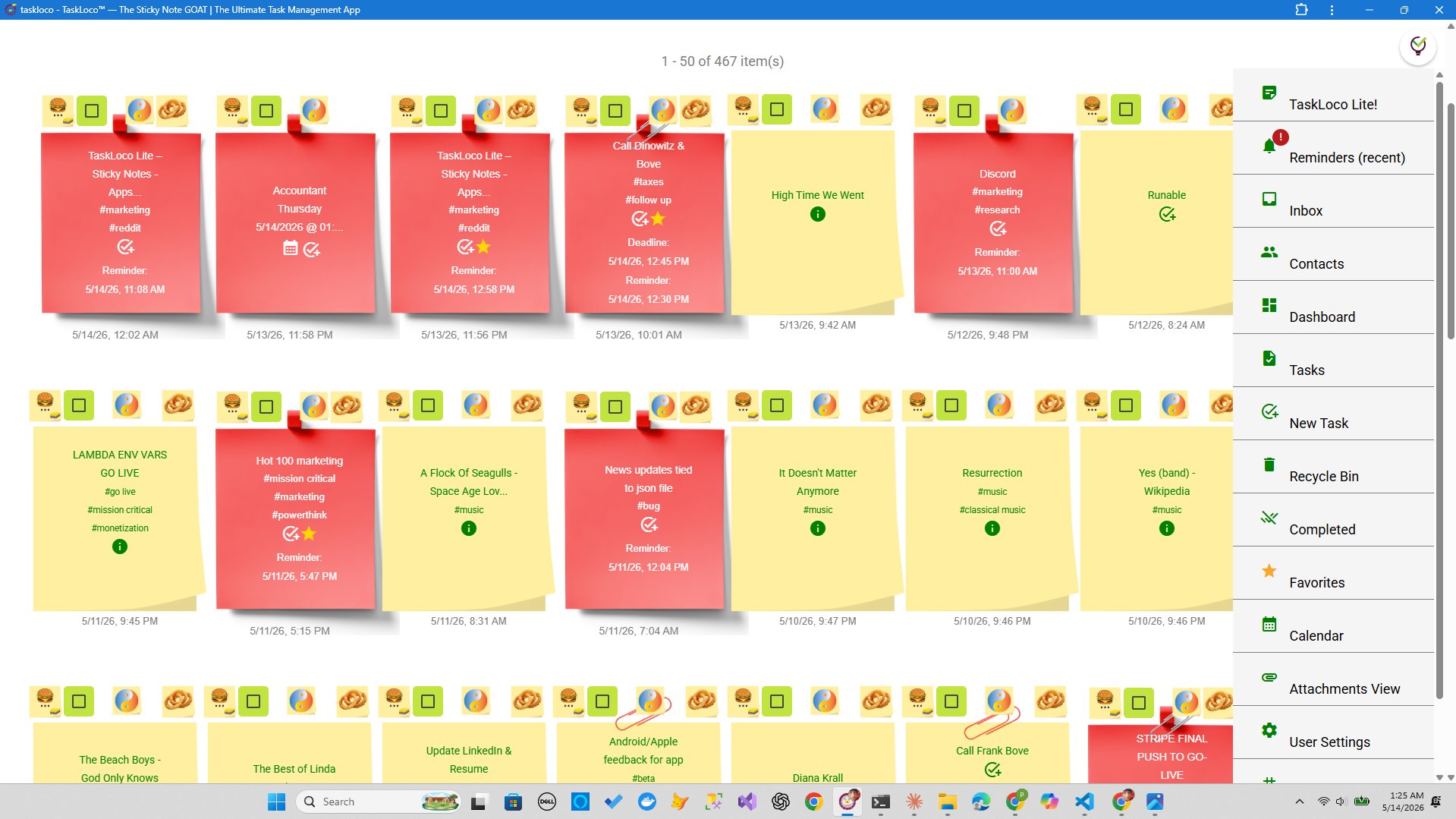
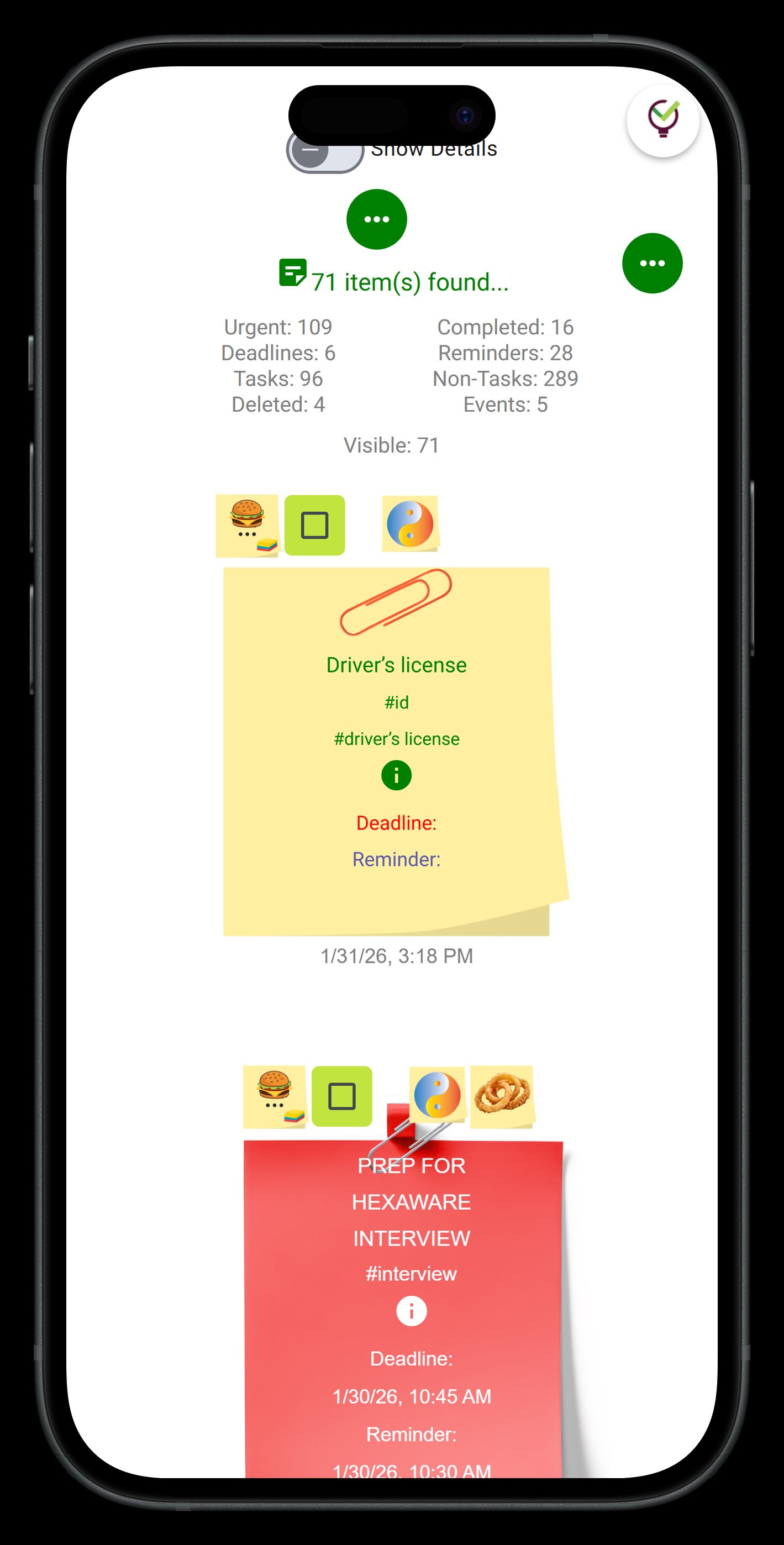
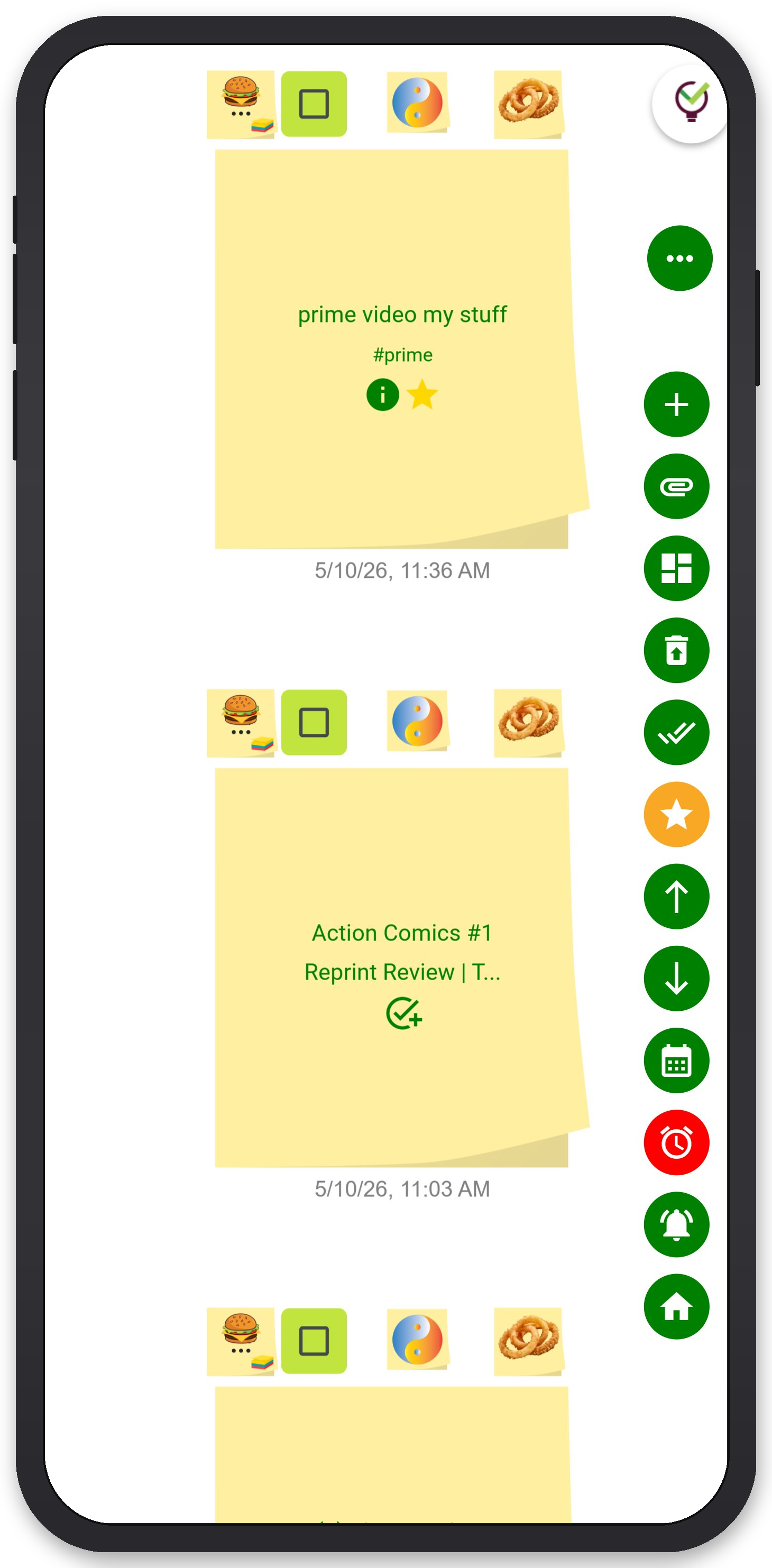
TaskLoco was built around a literal wall of sticky notes — not as a metaphor layered onto a traditional task manager, but as the actual core interface. When you open TaskLoco Premium, you see a spatial wall. You add a note and it goes on the wall. You can arrange notes visually, color-code them, and see everything at a glance without clicking into folders or switching views.
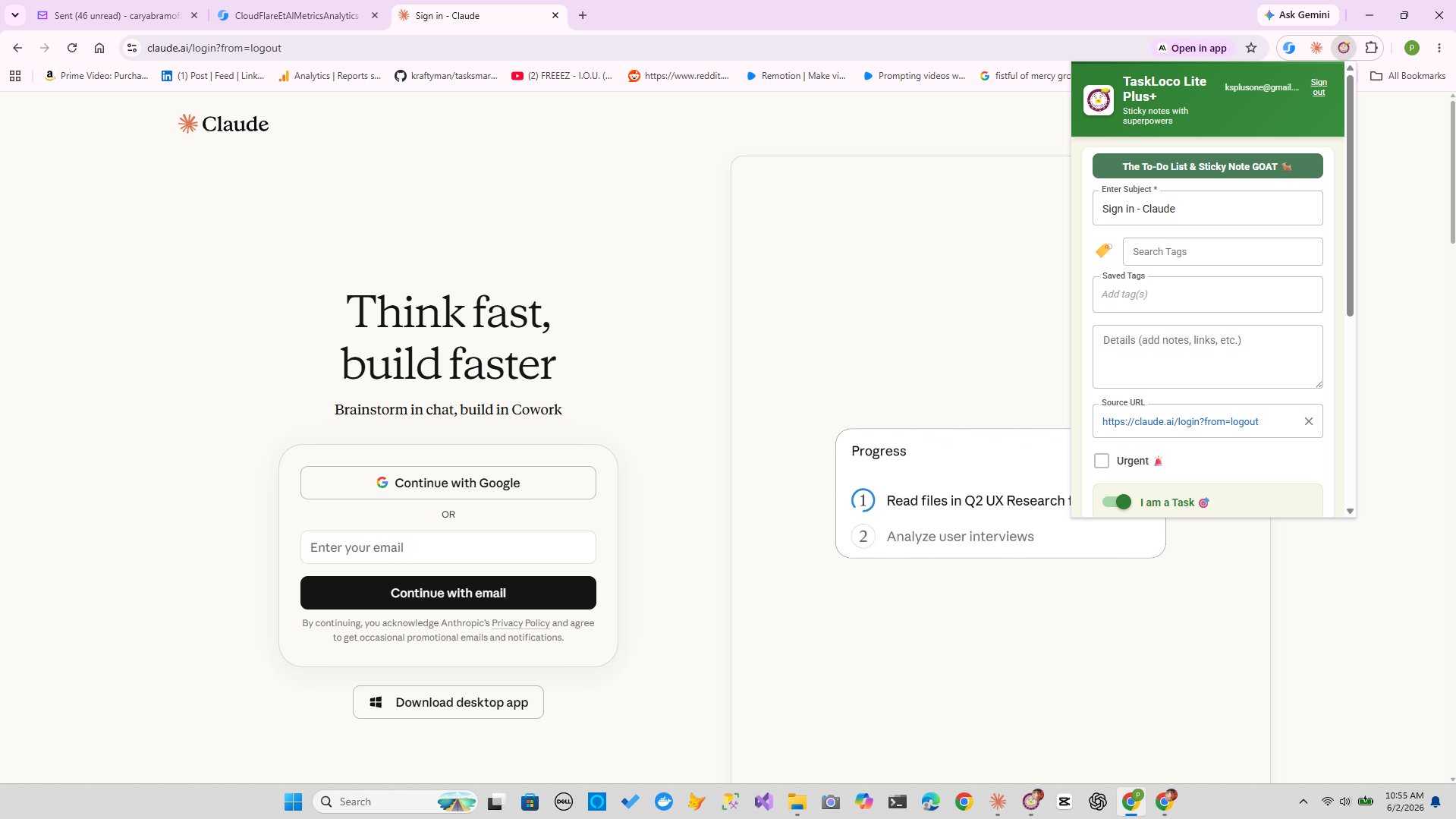
For ADHD capture specifically, a few things make TaskLoco unusually well-suited. The Chrome extension lets you clip any webpage to a note in one click — so when you're reading something and think 'I need to remember this,' you don't have to copy, switch apps, paste, and title a document. One click and it's on your wall. The thought survives the distraction.
Reminders in TaskLoco work as push notifications delivered directly to your phone and computer, and they deep-link back to the original note. This is the part that matters for ADHD: when the reminder fires, you don't just get an alert that says 'do the thing' — you get taken directly back to the note with all the context you captured. No hunting for what you were supposed to do or why it mattered. Optional email and SMS notifications are available as additional channels if you want extra coverage.
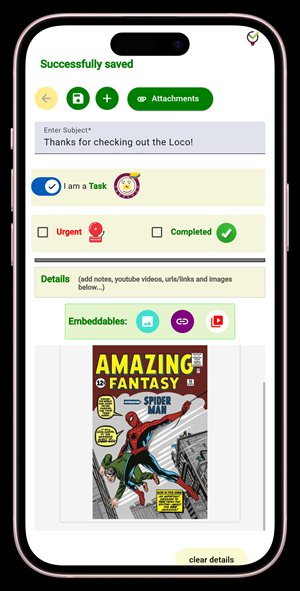
File attachments mean you can throw a screenshot, a document, or a photo directly onto a note — up to 10GB of storage included with Premium. When you come back to a note later, the context is already there. You're not trying to remember which email had the attachment or which folder you saved the file to.
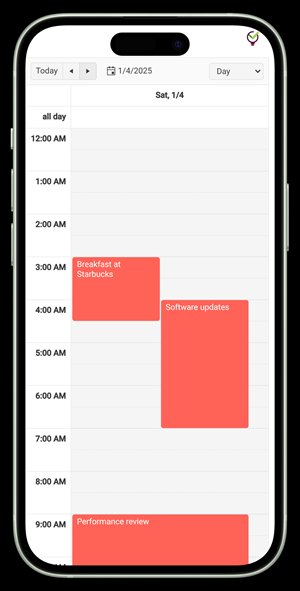
The calendar view gives you a time-based lens when you need one — useful for review sessions when you want to see what's due, what's overdue, and what needs to move. Team sharing works the way email works: share a note with a teammate and they get their own clone to work from, no permissions or access levels needed. The thought travels intact.
Building an ADHD Capture Habit That Actually Survives
Having the right tool is necessary but not sufficient. The capture habit itself needs to be almost automatic — because when ADHD executive function is depleted, 'I'll try to remember to use the app' is not a strategy.
The most durable ADHD capture habits share a few common traits. They happen in one place. Splitting capture between a notes app, a to-do list, voice memos, and Post-it notes on the monitor sounds flexible but creates review anxiety — you never know where to look. Consolidating to a single wall eliminates that. One place. Everything goes there.
They use the path of least resistance. Pin the app. Put the Chrome extension in your toolbar. If the tool requires three steps to get to, you will not use it when you most need it. TaskLoco Lite Plus+ is a free web app with the Chrome extension — no sign-in friction after the first time, synced across every device you use, available on mobile through your phone's browser. For unlimited notes, reminders, and file attachments, TaskLoco Premium is the step up that serious capture needs.
They separate capture from processing. Schedule a review time — even 10 minutes — when you look at the wall and decide what stays, what becomes a task with a reminder, and what can go. Don't try to do this during capture. The wall is a holding pen, not a filing system. That's the point.
They use reminders as retrieval mechanisms, not just alerts. An ADHD-friendly reminder doesn't just say 'hey, something exists.' It brings you back to the exact note with full context. That's why TaskLoco's push notification reminders deep-link directly to the note — so the retrieval is automatic, not another task for your working memory to manage.
TaskLoco Premium is regularly $9.99/month per person. Right now, charter members can lock in 50% off the regular price — forever. That means $4.99/month per person today. And if our price ever goes up, you still pay half. Always.
Code CHARTER50 auto-applies at checkout. First 500 spots only — once they're gone, this offer is gone permanently. Act fast while spots last.
Every Premium subscription includes unlimited notes, 10GB file storage, reminders, calendar, and team sharing. Each team member requires a separate subscription. 7-day free trial — no charge until day 8. Cancel anytime.
Free Options: TaskLoco
TaskLoco Lite
- Native iPhone & Android app
- Completely anonymous — no sign-in
- Data stays on your device
- Up to 20 notes
- Free forever
TaskLoco Lite Plus+
- Web app + Chrome extension
- Sign in with Google
- Wall syncs across all devices
- Up to 30 notes
- Free forever
Lock In 50% Off — Forever
7-day free trial. No charge until day 8. CHARTER50 auto-applies at checkout.
🔒 Lock In My Charter SpotSee TaskLoco in Action
Frequently Asked Questions
What is the 'throw it on the wall' method for ADHD?
It's a capture-first approach where you externalize every thought — tasks, ideas, reminders, random observations — onto a visible surface without stopping to organize or prioritize. The wall holds the thought so your working memory doesn't have to. Sorting happens later, in a separate review session. It works well for ADHD because it removes the organizational friction that kills capture habits.
Why do traditional to-do lists fail ADHD brains?
Most to-do lists require you to categorize, prioritize, and organize at the moment of capture — exactly when ADHD working memory is most taxed. They also bury tasks in lists that require scrolling to see, removing the spatial visibility that many ADHD minds rely on. A visual wall of notes that you can see all at once tends to match how ADHD thinking actually works better than a linear list.
Is TaskLoco free for ADHD capture?
TaskLoco has two free tiers. TaskLoco Lite is a native iPhone and Android app — completely anonymous, no sign-in required, stores up to 20 notes on your device. TaskLoco Lite Plus+ is a free web app with a Chrome extension that syncs up to 30 notes across all your devices after signing in with Google. For unlimited notes, reminders with push notifications, file attachments, and calendar view, TaskLoco Premium is the upgrade. $9.99/month per person (currently $4.99/month per person for first 500 charter members with code CHARTER50)
How does TaskLoco remind me about notes I've captured?
Reminders in TaskLoco are delivered as push notifications to your phone and computer. When the notification fires, it deep-links directly back to the original note — so you land in context, not just in the app. Optional email notifications are available as an additional channel, and optional SMS is available as an add-on.
Can I capture webpages and articles to my TaskLoco wall?
Yes. The TaskLoco Chrome extension captures any webpage to a sticky note in one click. For ADHD capture this is significant — the moment you read something interesting, one click puts it on your wall with the source link. You don't have to switch apps, copy URLs, or remember to save it later. It's already there when you're ready to review.
What's the difference between TaskLoco Lite and TaskLoco Premium for ADHD use?
TaskLoco Lite (the native app) is great for anonymous, frictionless capture on your phone — no account, no sign-in, up to 20 notes stored on the device. It has no reminders, no file attachments, and no sync. TaskLoco Lite Plus+ adds device sync and a Chrome extension for free, with up to 30 notes. For a full ADHD capture system — with unlimited notes, push notification reminders that deep-link back to your notes, file attachments, and calendar view — TaskLoco Premium is what you need. $9.99/month per person (currently $4.99/month per person for first 500 charter members with code CHARTER50)
How do I review my wall without getting overwhelmed?
Keep capture and review as separate, scheduled activities. During capture, throw everything on the wall without judgment. During review (even 10 minutes works), use the calendar view to spot time-sensitive items, set push notification reminders on anything that needs follow-through, and archive or delete what's no longer relevant. The goal of review isn't a clean wall — it's knowing what needs a reminder and what can wait. Let the wall be messy between reviews. That's what it's for.
Born in Brooklyn. Powered by AWS. Your data stays yours.
TaskLoco is available on iPhone, Android, Chrome, and every web browser.