If you've ever walked into a room and forgotten why you're there, written something on your hand so you wouldn't forget it, or watched a critical task vanish from your mind mid-sentence — you already understand working memory failure. For people with ADHD, that isn't occasional. It's the default state. Working memory, the brain's ability to hold and manipulate information in the short term, is one of the core executive functions most affected by ADHD. When it's unreliable, everything from daily tasks to long-term goals becomes genuinely hard to track.
That's why so many ADHD brains are drawn to sticky notes. Not because they're cute or retro — but because they work. A sticky note doesn't require you to remember. It just sits there, visible, in your space, holding the thought until you're ready for it. This guide explains the science behind that instinct, what to look for in a sticky note system that actually helps ADHD working memory, and how digital tools like TaskLoco push the concept further without adding cognitive overhead.
What Makes a Sticky Note System Work for ADHD Working Memory
Before recommending any specific tool, it's worth being precise about what ADHD working memory problems actually look like — and what a sticky note system needs to do to help. Working memory isn't just short-term memory. It's the active mental workspace where you juggle information while doing something with it: holding a phone number while you dial, keeping a deadline in mind while writing an email, remembering step three while you're on step two. ADHD disrupts this process consistently and often severely.
Sticky notes help because they offload that cognitive burden onto the environment itself. Psychologists call this environmental scaffolding — using the physical (or digital) world to do the remembering your brain struggles to do alone. But not every sticky note approach is equally effective for ADHD. Here are the three criteria that actually matter:
- Instant, frictionless capture. If capturing a thought takes more than a few seconds or requires navigating menus, the thought is gone before it's saved. The system must get out of the way.
- Persistent visibility. A note buried in a folder or hidden behind a click doesn't help. ADHD working memory needs cues that are in the way — visually present without effort. A wall or board view where all notes are simultaneously visible is far more effective than a list you have to scroll through.
- Actionable reminders that bring you back. Capture and visibility solve the storage problem, but ADHD brains also struggle with time blindness — the future simply doesn't feel real until it's now. A reminder that fires at the right moment and takes you directly back to the relevant note closes the loop that working memory alone can't close.
Physical sticky notes score well on capture and visibility but fail on reminders — a Post-it on your monitor can't buzz your phone at 2pm. Digital systems reverse the problem: most are great at reminders but terrible at visual immediacy, hiding everything behind nested lists and project trees. The ideal system combines both.
Why Digital Sticky Notes Beat Physical Ones for ADHD
Physical sticky notes have one unbeatable advantage: zero friction to create. You grab a pen and write. That's it. But they have serious structural flaws for ADHD brains that compound over time. They don't travel. A note on your bathroom mirror can't follow you to a meeting. They don't alert you. If you forget to look at the note, the note fails. They get buried. Desks, monitors, and walls accumulate layers, and once a note is covered by another note, it effectively disappears. And they can't hold attachments, links, or anything richer than what fits in a few square inches of paper.
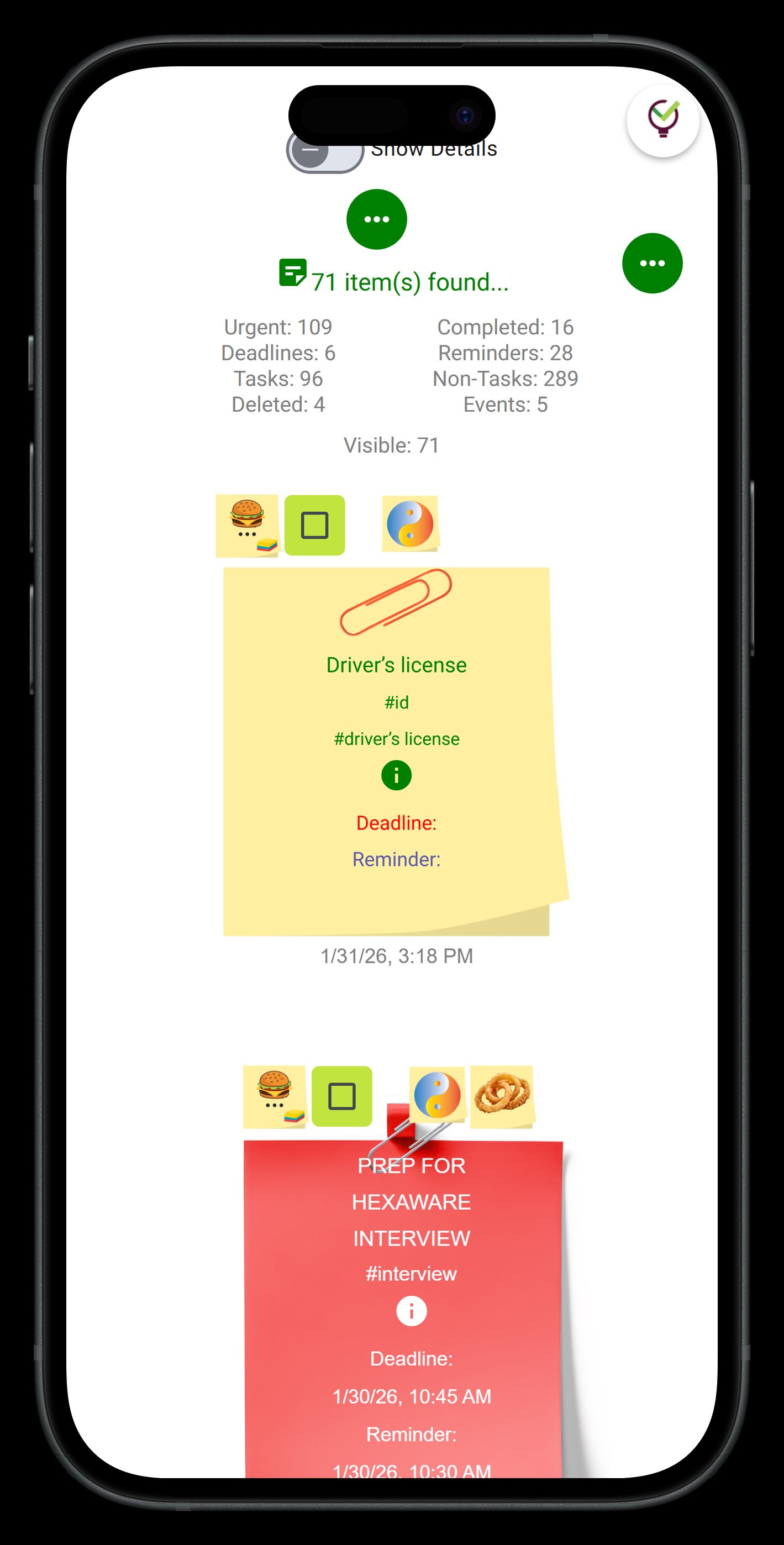
Digital sticky notes, done right, keep everything that makes a physical note work — the immediacy, the visual format, the low cognitive cost of reading one — while fixing every structural flaw. They sync across devices, so the note you made on your laptop appears on your phone. They can trigger reminders that find you rather than waiting for you to find them. They can hold images, files, and links alongside the text. And a well-designed digital wall view gives you the same spatial memory cues that a physical corkboard does, without the physical clutter.
The catch is implementation. Many digital tools claim to be note-taking apps but are really database tools or project managers wearing a note-taking costume. They impose structure — folders, tags, hierarchies, workspaces — that adds cognitive overhead instead of reducing it. For an ADHD brain that already struggles with organization and initiation, a tool that requires setup before it's useful is a tool that never gets used.
How TaskLoco Is Built Around Exactly This Problem
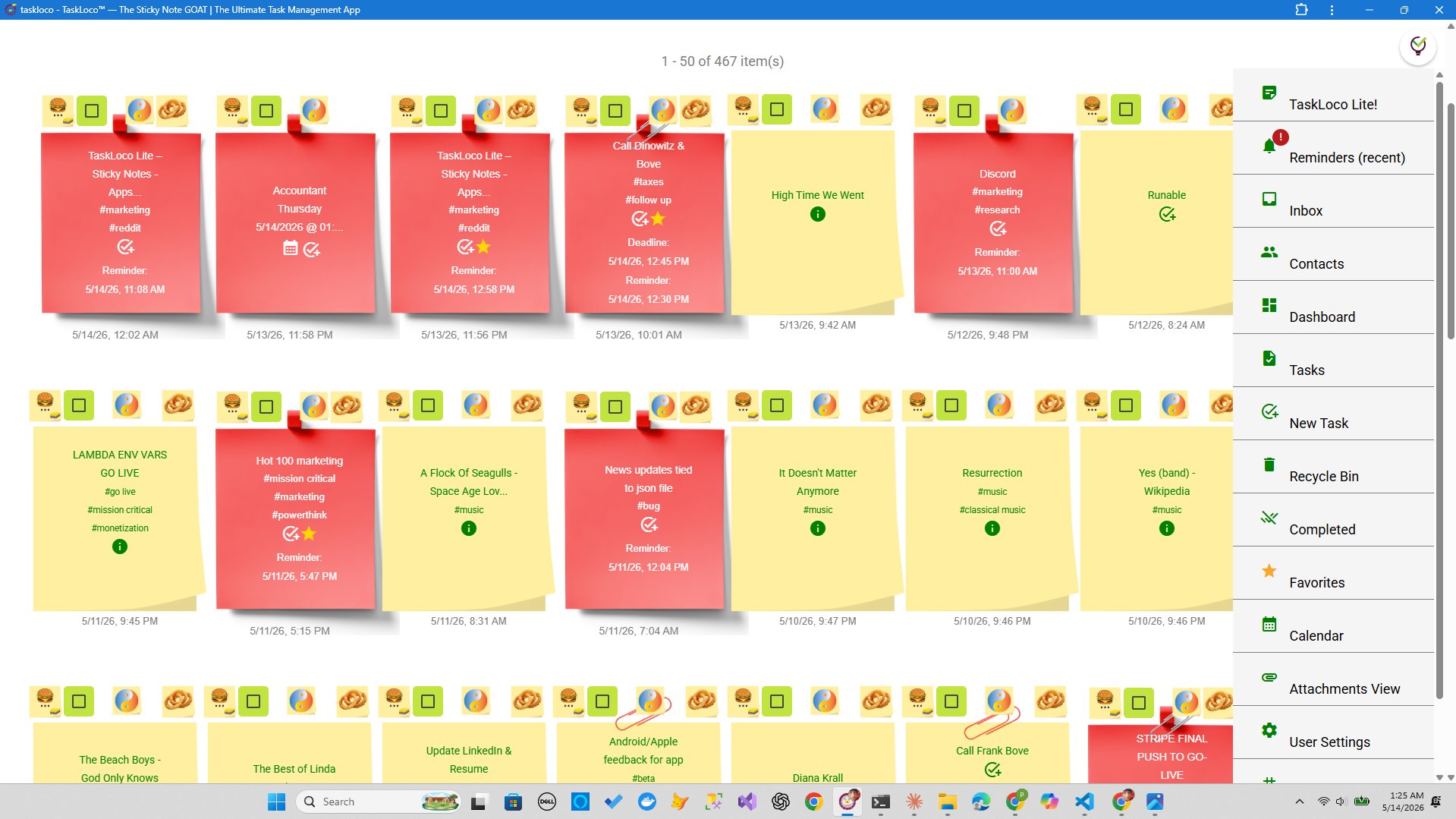
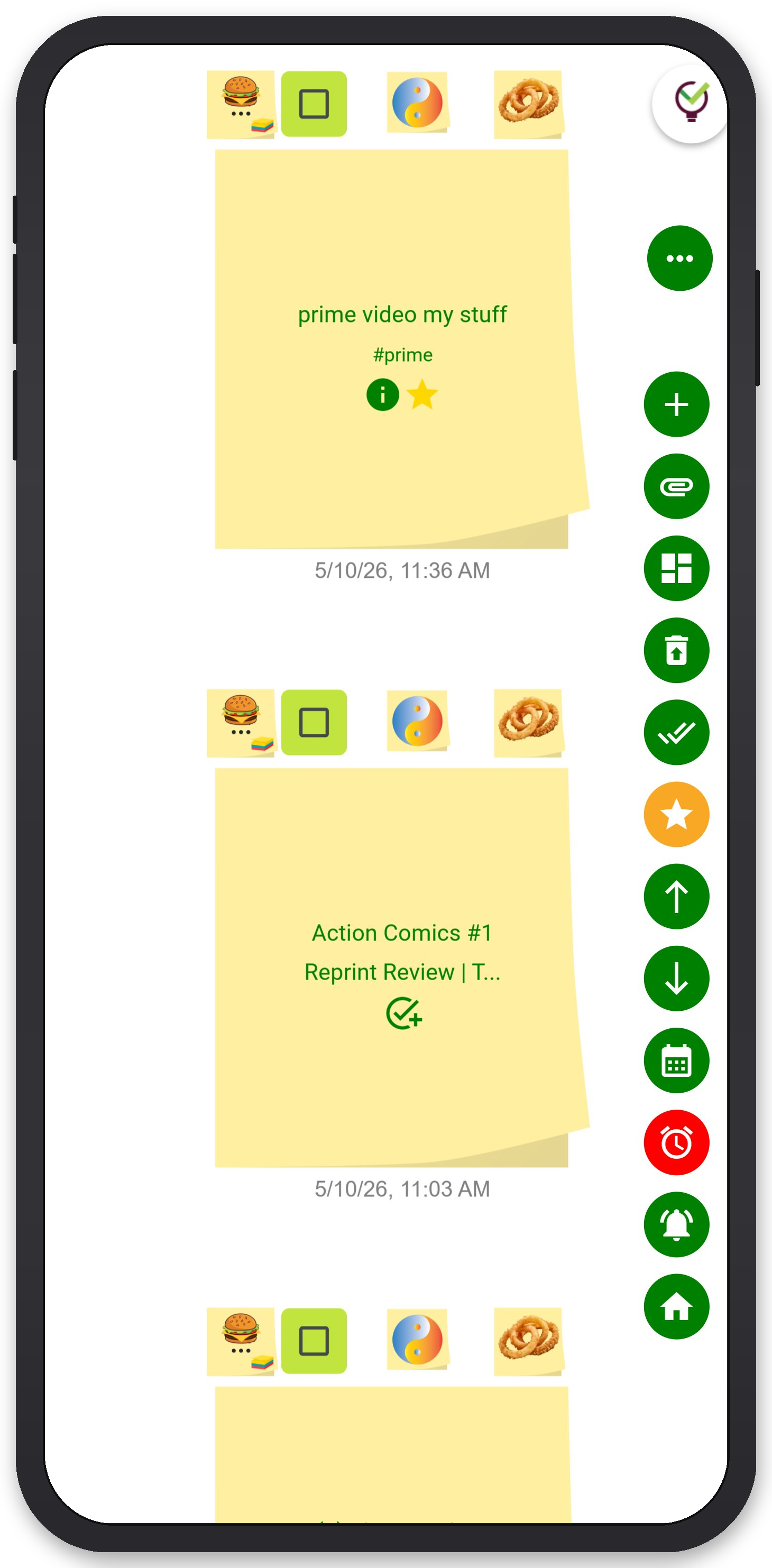
TaskLoco started as a sticky note app and that origin shows in how it works. The entire interface is organized around a wall view — a spatial canvas where your notes sit visually, all at once, without hiding behind tabs or requiring you to navigate to them. For ADHD working memory, this matters: when everything is visible simultaneously, you don't have to remember what you have. You just look.
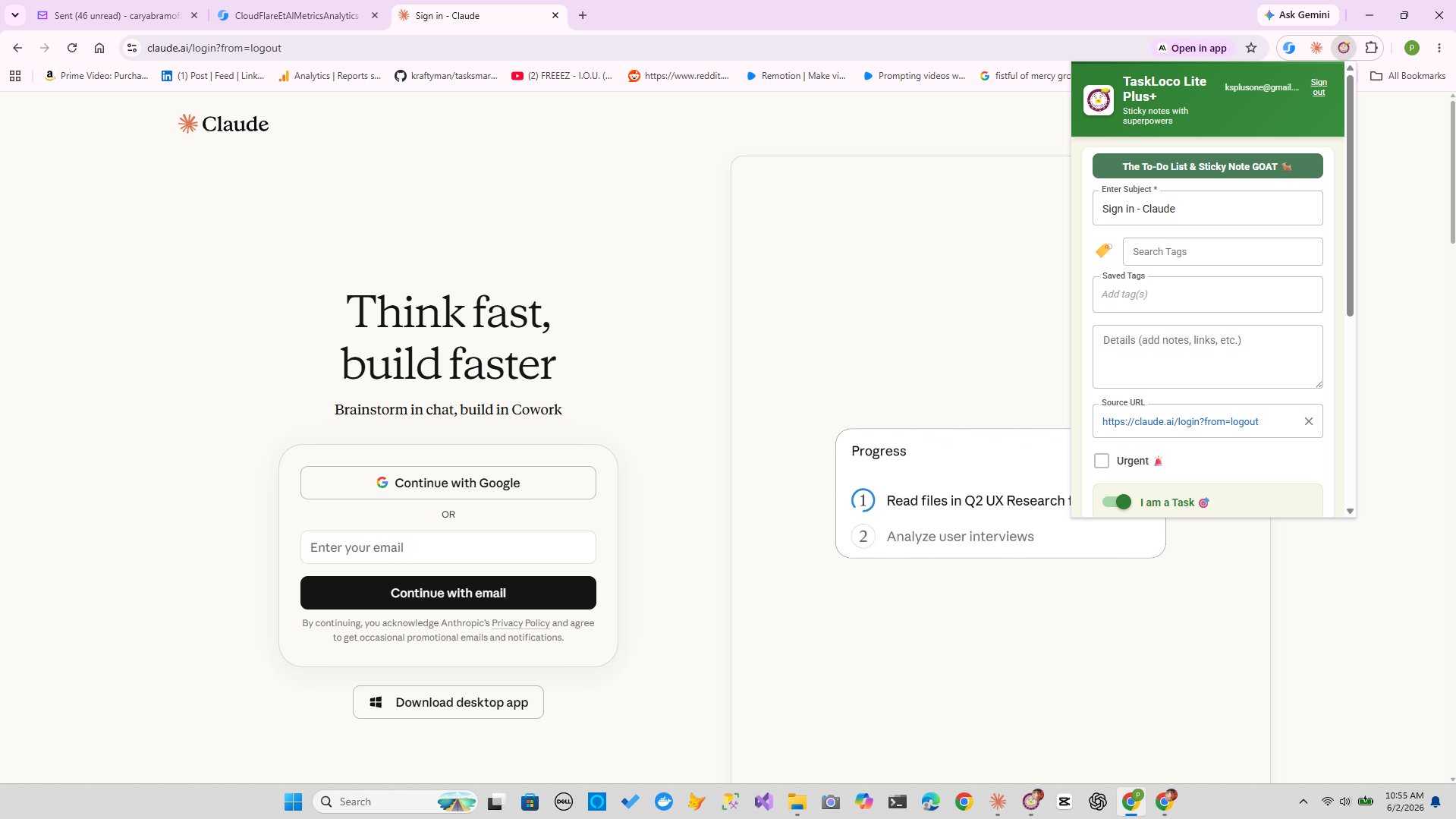
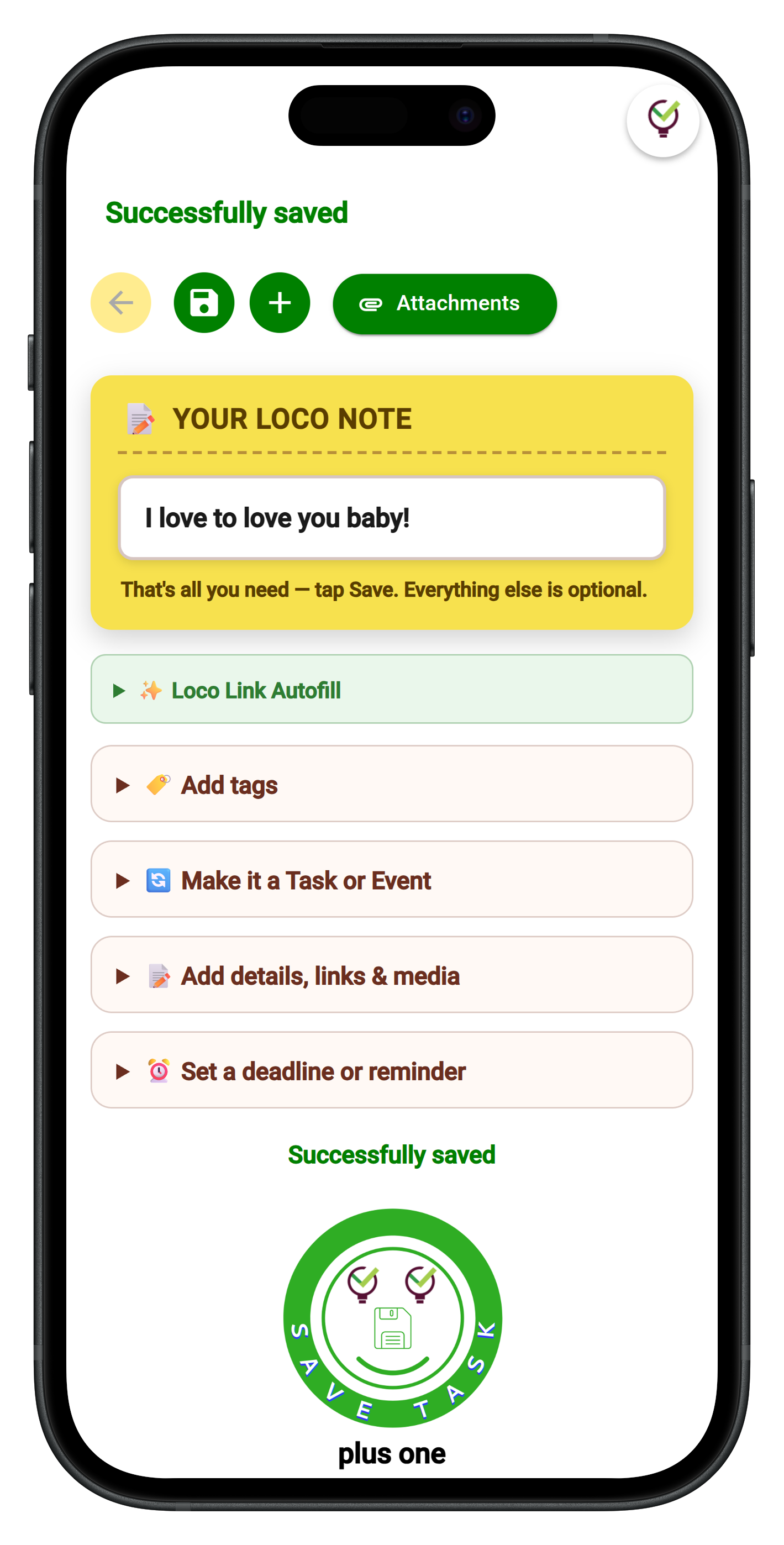
Capture is fast. Open the app, write the note, done. If you're on a laptop and come across a webpage you need to remember, the TaskLoco Chrome extension captures it in one click — no copying, no pasting, no switching apps. The note lands on your wall immediately.
Where TaskLoco moves beyond the sticky note metaphor is in its reminder system. A TaskLoco reminder fires as a push notification delivered to your phone and your computer. When you tap it, it deep-links directly back to the original note — not to an inbox, not to a dashboard, but to the exact note that contains the information you need. For time-blind ADHD brains, this is the difference between a reminder that says "you have something due" and a reminder that says "here is the thing, right now, act on it." Optional email and SMS notifications are available as additional channels if you want redundancy.
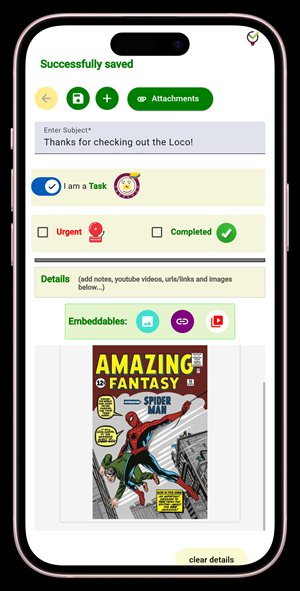
Notes in TaskLoco Premium can hold file attachments — up to 10GB of storage included — so a note about a doctor's appointment can also hold the insurance form, the intake paperwork, and the directions. Everything lives in one place. No hunting across apps and folders at the moment you need to act.
Team sharing works the way email does: you share a note, the recipient gets it and can clone it as their own. No permissions architecture to configure, no access levels to manage. For someone with ADHD who works with others — a partner, a coworker, a therapist — this means sharing a plan or a list is as easy as sending a message.
Building an ADHD-Friendly Sticky Note System That Actually Sticks
Tools are only as good as the habits around them, and habit-building with ADHD requires a system that meets you where you are, not where you wish you were. Here's how to build a digital sticky note practice that actually holds:
- Capture everything immediately, judge nothing. The worst thing for an ADHD brain is a capture step that involves deciding whether something is worth writing down. It is. Write everything. TaskLoco's unlimited notes mean you never need to filter at the capture stage — sort and archive later when you have energy for it.
- Use color to create visual priority without thinking. Color-coding notes by area of life (health, work, home, finances) gives your eye a fast sorting mechanism that doesn't require reading every note on the wall. Pattern recognition is fast; reading is slow.
- Set reminders at the moment of capture. Don't tell yourself you'll add the reminder later. You won't remember to. When you create the note, add the reminder in the same action. TaskLoco's reminder is built into the note, not a separate calendar step.
- Keep your wall as a working space, not an archive. Notes that are done get archived. A crowded wall stops being useful because everything competes for attention equally. Aim for a wall that shows only what's currently active.
- Use the Chrome extension as your capture net. When something on the web matters — a recipe, an article, a product, a form — capture it immediately into your wall. Don't bookmark it; bookmark tabs are a graveyard for ADHD intentions. A note on your wall is visible. A bookmark is not.
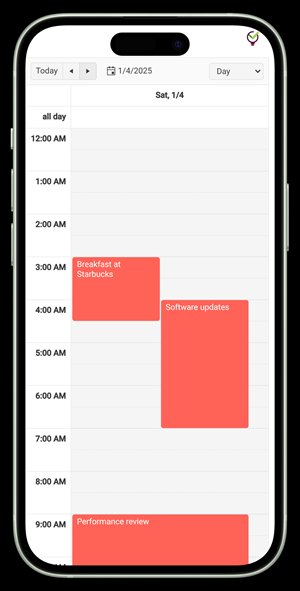
The goal isn't a perfect system. The goal is a system with enough friction-removal that you'll actually use it when your working memory is at its worst — which is exactly when you need it most. TaskLoco's free tiers let you start immediately with no commitment: TaskLoco Lite is a native iPhone and Android app, completely anonymous with no sign-in, storing up to 20 notes on your device. TaskLoco Lite Plus+ is the web app with Google sign-in, up to 30 notes synced across all your devices, plus the Chrome extension for one-click capture. When you're ready for reminders, file attachments, calendar view, unlimited notes, and team sharing, that's TaskLoco Premium.
TaskLoco Premium is regularly $9.99/month per person. Right now, charter members can lock in 50% off the regular price — forever. That means $4.99/month per person today. And if our price ever goes up, you still pay half. Always.
Code CHARTER50 auto-applies at checkout. First 500 spots only — once they're gone, this offer is gone permanently. Act fast while spots last.
Every Premium subscription includes unlimited notes, 10GB file storage, reminders, calendar, and team sharing. Each team member requires a separate subscription. 7-day free trial — no charge until day 8. Cancel anytime.
Free Options: TaskLoco
TaskLoco Lite
- Native iPhone & Android app
- Completely anonymous — no sign-in
- Data stays on your device
- Up to 20 notes
- Free forever
TaskLoco Lite Plus+
- Web app + Chrome extension
- Sign in with Google
- Wall syncs across all devices
- Up to 30 notes
- Free forever
Lock In 50% Off — Forever
7-day free trial. No charge until day 8. CHARTER50 auto-applies at checkout.
🔒 Lock In My Charter SpotSee TaskLoco in Action
Frequently Asked Questions
Why do sticky notes help ADHD working memory?
ADHD working memory is unreliable — it drops information between the thought and the action. Sticky notes work because they externalize memory into the environment. Instead of holding a thought in your head, the note holds it for you. A visual wall of notes means you don't have to remember what you have — you just look. Digital sticky notes like TaskLoco add push notification reminders that deep-link back to the original note, so the system finds you at the right moment rather than waiting for you to find it.
What's the difference between TaskLoco Lite, Lite Plus+, and Premium?
TaskLoco Lite is a free native iPhone and Android app — completely anonymous, no sign-in required, stores up to 20 notes on your device only, no sync. TaskLoco Lite Plus+ is the free web app (plus Chrome extension), sign in with Google, up to 30 notes synced across all your devices — no reminders, no file attachments. TaskLoco Premium adds unlimited notes, reminders delivered as push notifications with optional email and SMS, 10GB file storage, calendar view, and team sharing. Each team member needs their own Premium subscription. $9.99/month per person (currently $4.99/month per person for first 500 charter members with code CHARTER50)
Are digital sticky notes better than physical ones for ADHD?
Physical sticky notes win on zero-friction creation but fail on portability, reminders, and clutter over time. Digital sticky notes — when designed well — keep the visual immediacy of physical notes while adding sync across devices, push notification reminders that bring you back to the exact note, and the ability to attach files and links alongside the text. The failure mode of most digital tools is adding too much structure. The best digital sticky note apps feel like a sticky note, not a project management tool.
How do TaskLoco reminders work for ADHD time blindness?
TaskLoco reminders are delivered as push notifications directly to your phone and computer. When you tap the notification, it deep-links straight to the original note — not an inbox, not a dashboard, but the exact note containing the relevant information. This matters for ADHD time blindness because the reminder doesn't just tell you something is due; it puts the content in front of you immediately so you can act without hunting. Optional email notifications and an SMS add-on are available as additional channels.
Can I use TaskLoco without signing up or creating an account?
Yes. TaskLoco Lite is the free native app for iPhone and Android — completely anonymous, no sign-in, no account required. It stores up to 20 notes locally on your device in a JSON file. It never syncs to any server and requires no personal information at all. If you want cross-device sync and the Chrome extension, TaskLoco Lite Plus+ requires a Google sign-in and is also free. Reminders, file attachments, unlimited notes, and team sharing require Premium.
Does TaskLoco have a Chrome extension for capturing things from the web?
Yes. The TaskLoco Chrome extension is included free with Lite Plus+ and Premium. It captures any webpage in one click — the title, URL, and any highlighted text land directly on your note wall without switching apps, copying links, or navigating menus. For ADHD brains who know a bookmarked tab is effectively invisible, capturing directly to a visible note wall is a meaningful difference.
What's the best way to organize sticky notes for ADHD without getting overwhelmed?
Keep your active wall small and your archive ruthless. Use color to create visual categories so your eye can sort without reading. Capture everything at the moment of thought — never decide later. Add reminders at the moment of capture, not as a separate step. Archive any note that no longer needs action. TaskLoco's wall view, unlimited notes, and color-coding options support this approach without requiring you to build a taxonomy before you start. Start messy; clean up when you have the bandwidth.
Born in Brooklyn. Powered by AWS. Your data stays yours.
TaskLoco is available on iPhone, Android, Chrome, and every web browser.