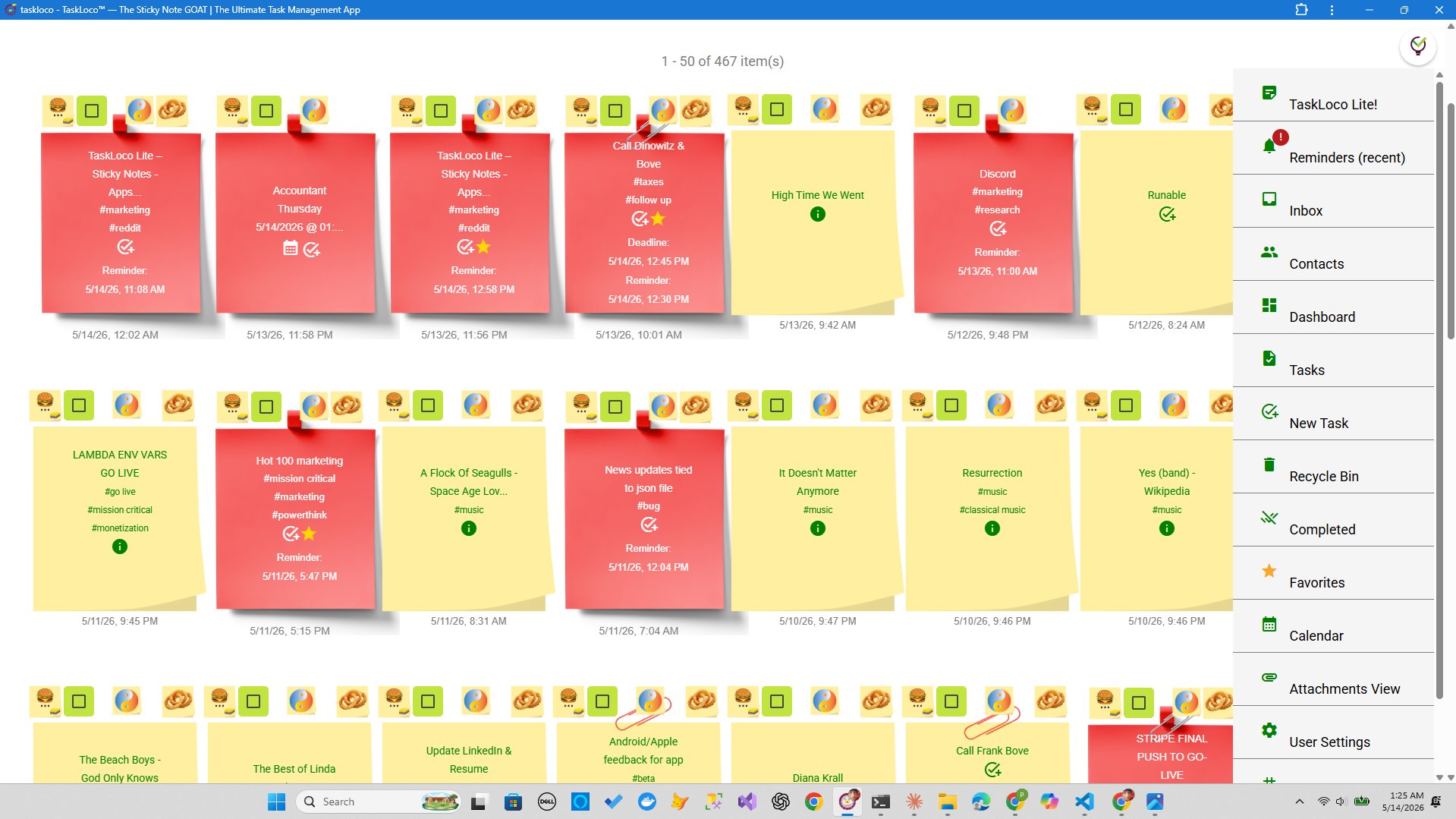
Your brain has forty tabs open and none of them are labeled. You know you're forgetting something important, but the harder you try to remember it, the faster it slips away. That's not a character flaw — that's ADHD working exactly as advertised. The sticky note brain dump exists specifically to solve this. Get everything out of your head and onto something you can see, move, and act on.
The method is deceptively simple: one thought per sticky note, no filtering, no organizing, no judgment — just dump. Then, once your head is clear, you sort. Digital sticky note apps have made this even more powerful because you never run out of wall space, you can search everything you've ever written, and a reminder can deep-link you right back to the exact note that matters. If you've tried journaling, planners, or elaborate task managers and found them exhausting, the sticky note brain dump might be the first productivity method that actually fits the way your brain works.
What to Look for in a Brain Dump Tool for ADHD
Before recommending any specific app, it's worth being honest about what actually makes a brain dump tool work for an ADHD brain — because most productivity apps are designed for neurotypical workflows and quietly fight against ADHD tendencies the whole time.
There are three things that matter most:
- Zero friction to capture. If opening the app takes more than two seconds or requires you to choose a project, a tag, a priority, and a due date before you can write anything, you will not use it when it counts. The capture step must be instant and unconditional. One tap, start typing, done. Organizing can come later — but only if capturing happened first.
- Visual spatial layout. ADHD brains respond to things they can see. A list buried in a sidebar is easy to forget. A wall of color-coded sticky notes spread across your screen is impossible to ignore. The spatial relationship between notes carries information — related ideas near each other, urgent things front and center. This is why physical sticky notes work, and why a digital version needs to replicate that spatial freedom rather than forcing everything into rows and columns.
- Search that actually works. Brain dumps generate volume. You will have hundreds of notes eventually. The tool must let you find anything instantly — by keyword, by color, by date — because your brain will not reliably remember where you filed something three weeks ago. Full-text search across every note and every attachment is not optional; it's the whole point of going digital over paper.
Reminders are also worth thinking about carefully. A reminder that fires as a push notification and deep-links you directly to the relevant note is infinitely more useful than a generic alarm that makes you go hunting for context. The note is the context — and getting back to it in one tap is the difference between actually doing the thing and just feeling vaguely stressed about it.
How to Actually Do a Sticky Note Brain Dump
The technique itself is not complicated, but there are a few specific moves that make it dramatically more effective for ADHD brains. Here's the process that works:
Step 1 — Set a timer for 10 minutes and go. Do not stop to think about whether something is important. Do not stop to organize. The only rule is: one thought per note. If your brain is throwing out a grocery list, a work task, a worry about something you said in 2019, and a song lyric — all of those get their own note. The act of setting a timer also helps with ADHD time-blindness; it creates a defined container for the activity so it doesn't feel like it will go on forever.
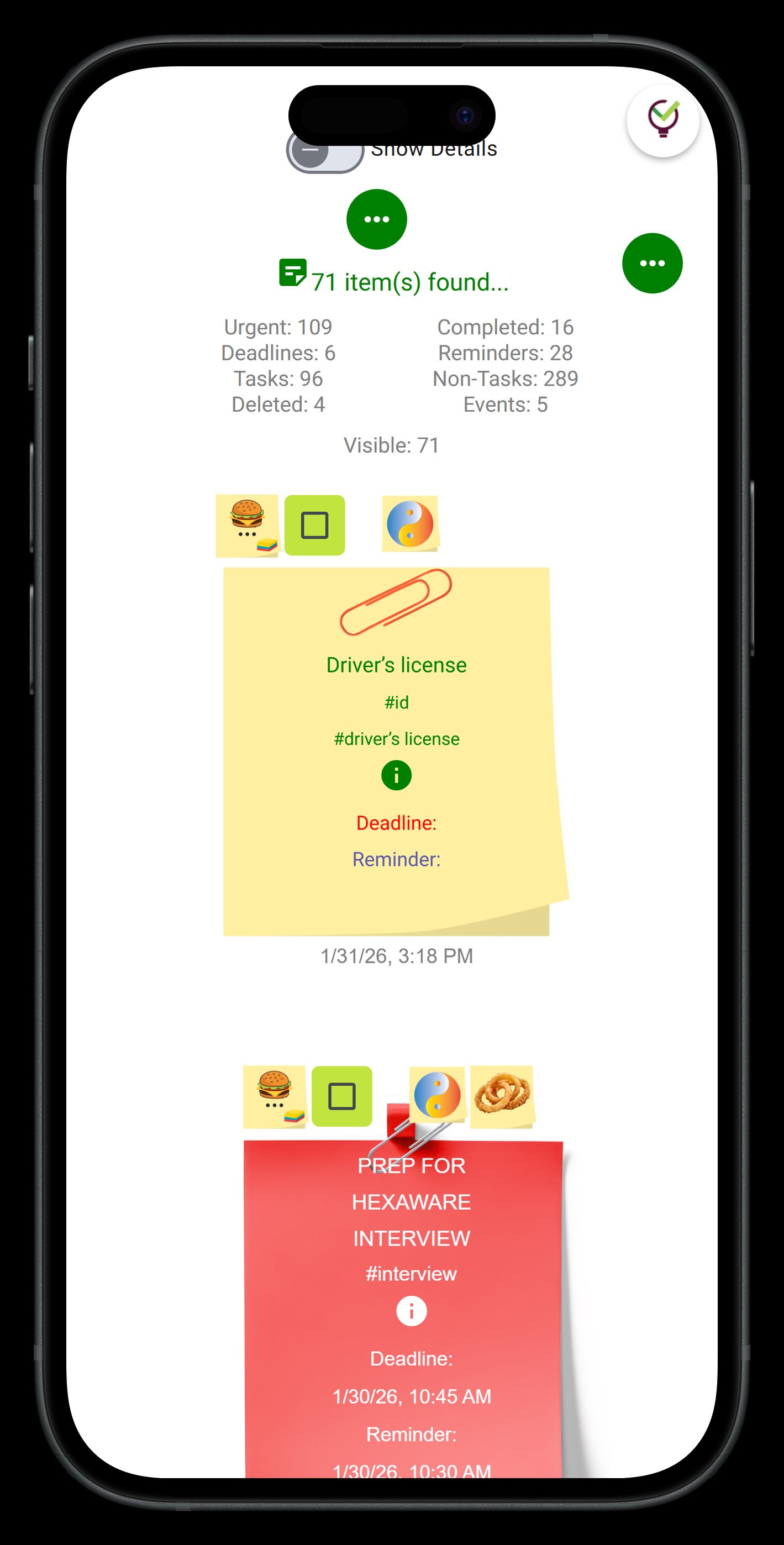
Step 2 — Use color, not categories. Trying to assign categories during a brain dump defeats the purpose. But a quick color code — red for urgent, yellow for personal, blue for work — takes one second and adds enormous value when you sort later. The color should be a reflex, not a decision.
Step 3 — Sort after, not during. Once the timer ends, take five minutes to move notes around on your wall. Group related things. Pull the urgent ones to the top. Archive the ones that turned out to be noise. This is when the spatial layout pays off — you can literally see your whole brain, rearrange it, and decide what actually matters today.
Step 4 — Set a reminder on exactly one note. The temptation is to set reminders on everything, which leads to notification blindness. Pick the single most important thing that needs to happen today, set a push notification reminder on that note, and let the reminder bring you back to the exact note when it fires. One tap, full context, no hunting.
For ADHD brains specifically, it helps to do a brain dump at the same time every day — usually first thing in the morning or right after lunch when attention tends to dip. Making it a ritual rather than a response to overwhelm prevents the backlog from building up in the first place.
Why TaskLoco Fits the ADHD Brain Dump Method
TaskLoco was designed around the sticky note as the fundamental unit of thought — not a task item, not a ticket, not a card in a column. A note. That distinction matters enormously for brain dumps because it means the app never asks you to classify something before you can write it down. Open a note, type, done. The wall view puts every note in front of you spatially, so your ADHD brain gets the visual map it needs rather than a nested list that disappears the moment you scroll past it.
Search in TaskLoco is full-text across every note and every file attachment you've stored. If you wrote something six months ago and can only remember one word from it, you'll find it. That's the kind of search that actually supports ADHD memory patterns — where you remember the content of a thought but have no idea when you had it or where you filed it.
Reminders in TaskLoco are delivered as push notifications to your phone and computer. When a reminder fires, it deep-links directly back to the note that triggered it. You tap the notification, you're inside the note, full context, zero hunting. Optional email notifications are available as an additional channel, and an SMS add-on is also available if you want another layer. But the push notification deep-link is the core, and for ADHD users it's the feature that bridges the gap between remembering something exists and actually doing it.
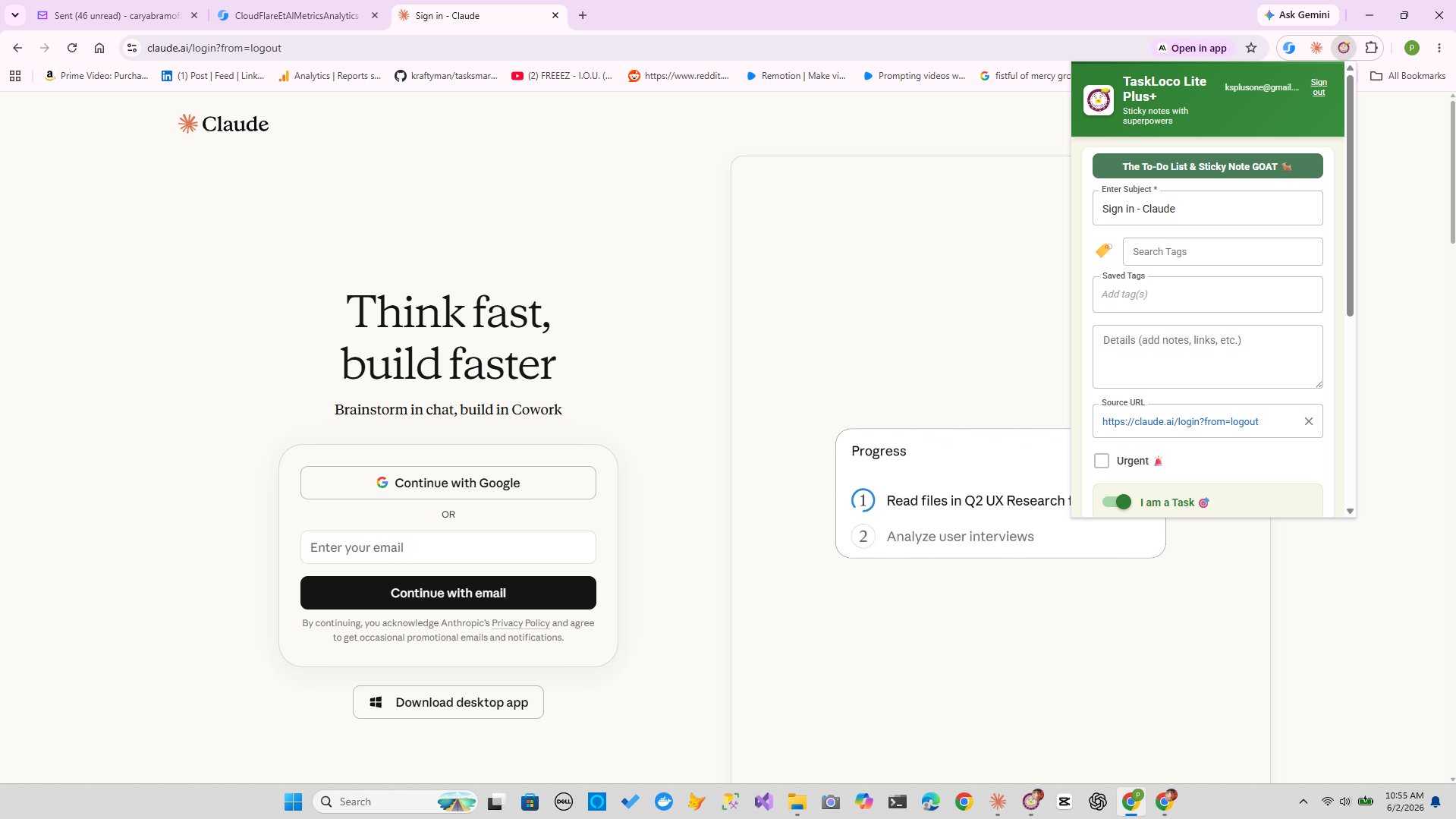
For capturing thoughts that hit while you're browsing the web, the Chrome extension lets you grab any webpage in one click — the page title, URL, and any text you highlight lands in a new note instantly. That's the difference between "I'll remember to come back to this" (you won't) and having it in your brain dump wall the moment the thought happens.
The free TaskLoco Lite Plus+ tier — available as a web app — lets you sync up to 30 notes across all your devices and use the Chrome extension for one-click capture. It's a genuine starting point, not a stripped-down demo. When you're ready for reminders, unlimited notes, file attachments, and calendar view, Premium is where those live. If you just want to try the capture experience on your phone with no sign-in required, the native TaskLoco Lite app on iPhone and Android stores up to 20 notes locally — completely anonymous, no account needed.
File Attachments, Calendar View, and the ADHD Context Problem
One of the most underappreciated ADHD challenges is the context-switching cost. Every time you have to leave a task to find a related file, email, or reference — and then find your way back — you pay a cognitive tax that neurotypical brains barely notice and ADHD brains find genuinely exhausting. Keeping the context attached to the note is the fix.
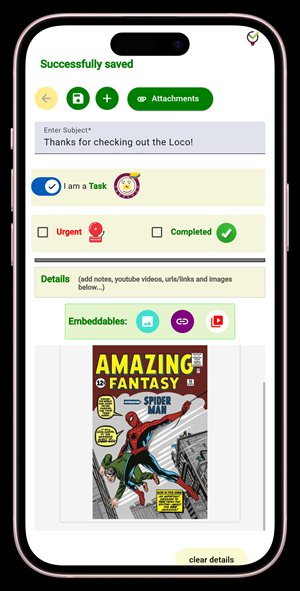
TaskLoco Premium gives you 10GB of file storage built in, so you can attach the PDF, the screenshot, the voice memo, the photo of the whiteboard — whatever the context is — directly to the note it belongs with. When you come back to that note later (or when a reminder brings you back), everything you need is already there. No tab switching, no searching your Downloads folder, no "wait, where did I save that."
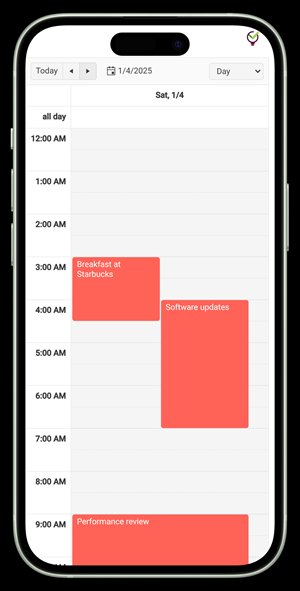
Calendar view takes your notes and tasks with dates and renders them as a visual calendar — another spatial layout that ADHD brains can read intuitively. Seeing that Tuesday is overloaded and Thursday has nothing on it is a different kind of information than reading a date field in a list, and it leads to better decisions about when to actually schedule things.
If you're using TaskLoco with other people — a partner, a coworker, anyone — team sharing works the way you'd want it to. You share a note the way you'd share an email. The recipient can clone it and make it their own. No permissions to configure, no access levels to manage, no IT ticket to open. It just works.
TaskLoco Premium is regularly $9.99/month per person. Right now, charter members can lock in 50% off the regular price — forever. That means $4.99/month per person today. And if our price ever goes up, you still pay half. Always.
Code CHARTER50 auto-applies at checkout. First 500 spots only — once they're gone, this offer is gone permanently. Act fast while spots last.
Every Premium subscription includes unlimited notes, 10GB file storage, reminders, calendar, and team sharing. Each team member requires a separate subscription. 7-day free trial — no charge until day 8. Cancel anytime.
Free Options: TaskLoco
TaskLoco Lite
- Native iPhone & Android app
- Completely anonymous — no sign-in
- Data stays on your device
- Up to 20 notes
- Free forever
TaskLoco Lite Plus+
- Web app + Chrome extension
- Sign in with Google
- Wall syncs across all devices
- Up to 30 notes
- Free forever
Lock In 50% Off — Forever
7-day free trial. No charge until day 8. CHARTER50 auto-applies at checkout.
🔒 Lock In My Charter SpotSee TaskLoco in Action
Frequently Asked Questions
Why do sticky notes work so well for ADHD brains?
Sticky notes work because they impose a constraint that matches ADHD thinking: one idea per note. There's no pressure to write a full sentence or organize your thoughts before you've had them. The spatial, visual layout of a note wall also means your brain can see everything at once rather than scanning a linear list — which is genuinely easier to process for many ADHD minds. The act of externalizing thoughts reduces the cognitive load of trying to hold everything in working memory.
What is a brain dump and how do I start one?
A brain dump is exactly what it sounds like: you empty everything out of your head onto something external — paper, sticky notes, a digital wall — without filtering or organizing. Set a timer for 10 minutes, open your sticky note app, and write one thought per note as fast as it comes. No judgment, no prioritization yet. When the timer ends, you sort. The brain dump separates capture from organization, which is critical for ADHD because trying to do both at once creates enough friction that neither happens.
Is TaskLoco free for ADHD brain dumps?
Yes — TaskLoco has two free tiers. TaskLoco Lite is a native iPhone and Android app: completely anonymous, no sign-in, stores up to 20 notes on your device. TaskLoco Lite Plus+ is a web app (and Chrome extension) that signs in with Google, syncs up to 30 notes across all your devices, and includes one-click webpage capture. Both are genuinely free. TaskLoco Premium adds unlimited notes, push notification reminders that deep-link back to the original note, 10GB file attachments, and calendar view. $9.99/month per person (currently $4.99/month per person for first 500 charter members with code CHARTER50)
How do reminders help with ADHD task management in TaskLoco?
TaskLoco reminders are delivered as push notifications to your phone and computer. The key feature for ADHD users is that tapping the notification takes you directly back to the original note — full context, one tap, no hunting. Optional email notifications are available as an extra channel, and an SMS add-on is also available. That deep-link from notification to note is the bridge between remembering something exists and actually doing it.
Can I use TaskLoco on my phone?
Yes. TaskLoco Lite is available as a native app on the iPhone App Store and Google Play Store — it's anonymous, requires no sign-in, and stores up to 20 notes locally on your device. TaskLoco Lite Plus+ and TaskLoco Premium are web apps that run in your phone's browser and sync across all your devices. The Chrome extension is available on desktop for one-click webpage capture.
How many notes can I have in a brain dump before I need to delete old ones?
TaskLoco Lite (the native app) holds up to 20 notes on your device — you'd delete one to make room for another. TaskLoco Lite Plus+ holds up to 30 notes synced across devices. TaskLoco Premium has unlimited notes, so your brain dump archive can grow indefinitely. For ADHD users who benefit from being able to search old thoughts and see patterns over time, unlimited notes is a significant practical advantage.
What's the difference between a brain dump and a to-do list?
A to-do list is already organized — it implies priority, sequence, and commitment. A brain dump has none of that. The goal of a brain dump is to get everything out of your head as fast as possible, with zero filtering. You are not deciding what's important; you're just evacuating. The to-do list, if you want one, comes after — built from whatever the brain dump revealed as actually urgent. For ADHD brains, this separation of capture and organization is crucial because combining them creates enough friction to stop the whole process.
Born in Brooklyn. Powered by AWS. Your data stays yours.
TaskLoco is available on iPhone, Android, Chrome, and every web browser.