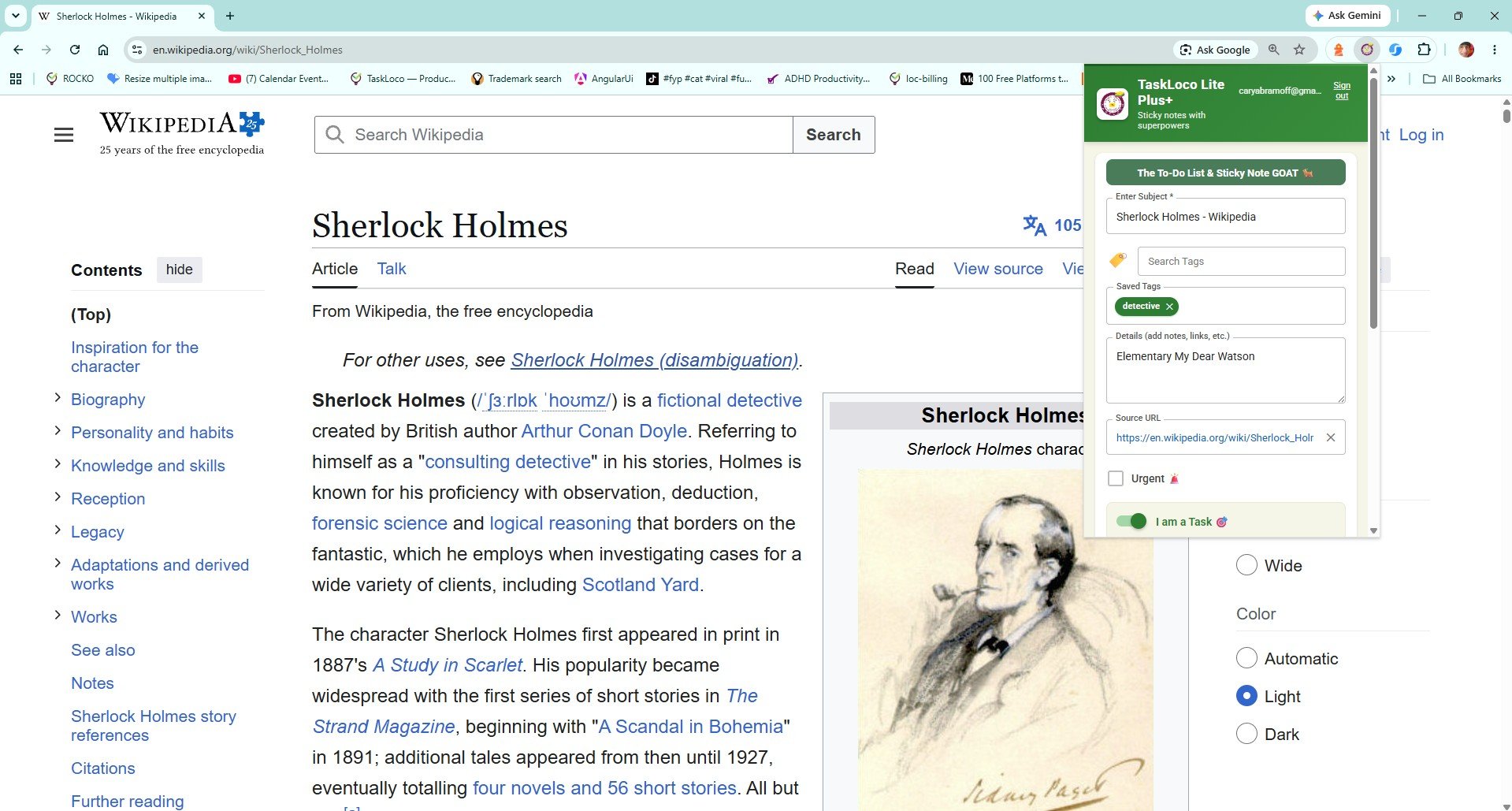
You're halfway through a Wikipedia rabbit hole on the Byzantine Empire or CRISPR gene editing, and you know you'll want to come back. So you either leave the tab open indefinitely, bookmark it into the void, or frantically copy-paste the URL somewhere. None of those feel like a real solution — and they aren't.
Saving a Wikipedia article as an actual note is different. A note has context: the title is visible, you can add your own thoughts, and you can find it again without remembering which folder you buried it in. This article covers every practical method — from zero-tool options to one-click clippers — so you can pick what fits how you actually research.
Method 1: The Manual Approach (No Tools Required)
If you want to save a Wikipedia article without any extension or account, the most straightforward method is to copy the page URL and paste it into whatever note-taking app you already use — Apple Notes, Google Keep, Notion, a plain text file, anything. This works, and it costs nothing.
Here's how to do it properly so the note is actually useful later:
- Copy the full URL from the address bar — not a search result link, but the actual Wikipedia page URL (e.g. en.wikipedia.org/wiki/Byzantine_Empire).
- Paste it with a label. Just a raw URL is nearly useless in two weeks. Add the article title above it, and a one-line note on why you saved it: "Byzantine Empire — background for essay on medieval trade routes."
- Use a dedicated section or notebook in your notes app. Dumping Wikipedia links into your general notes is how they disappear. A folder called "Research Sources" or "To Read" keeps things retrievable.
- Consider saving a quote too. If there's a specific passage you need, copy it alongside the URL. Wikipedia articles get edited; the exact wording you saw today may not be there next month.
Method 2: Using Browser Bookmarks (and Why They Fall Short)
Every browser has a built-in bookmark system, and it's the default way most people save Wikipedia articles. Press Ctrl+D (or Cmd+D on Mac) and the page is saved. The title is usually auto-filled from the page. Simple.
The problem isn't saving — it's finding. Browser bookmarks have no visual layer. They're a flat list of titles and URLs. If you bookmark twenty Wikipedia articles over the course of a month, they all look identical in the bookmarks bar: a favicon and a title. There's no way to see at a glance what each one was about, which ones you've read, or which ones belong to which project.
Bookmarks also don't travel well. They're tied to a single browser profile unless you've deliberately set up sync. And they have no annotation layer — you can't add a quick note explaining why you saved something, which is often the most important piece of context.
- Bookmark folders help — creating folders like "History Research" or "Science Reading" makes bookmarks more retrievable. But it requires discipline every single time you save, and most people don't maintain it.
- Bookmark managers like Raindrop.io add a visual layer, but they're a separate app with their own learning curve.
Bookmarks are fine for saving sites you visit regularly (your bank, a tool you use daily). For Wikipedia articles you save for reference and research, they tend to become a graveyard.
Method 3: One-Click Save with the Sticky Note Web Clipper
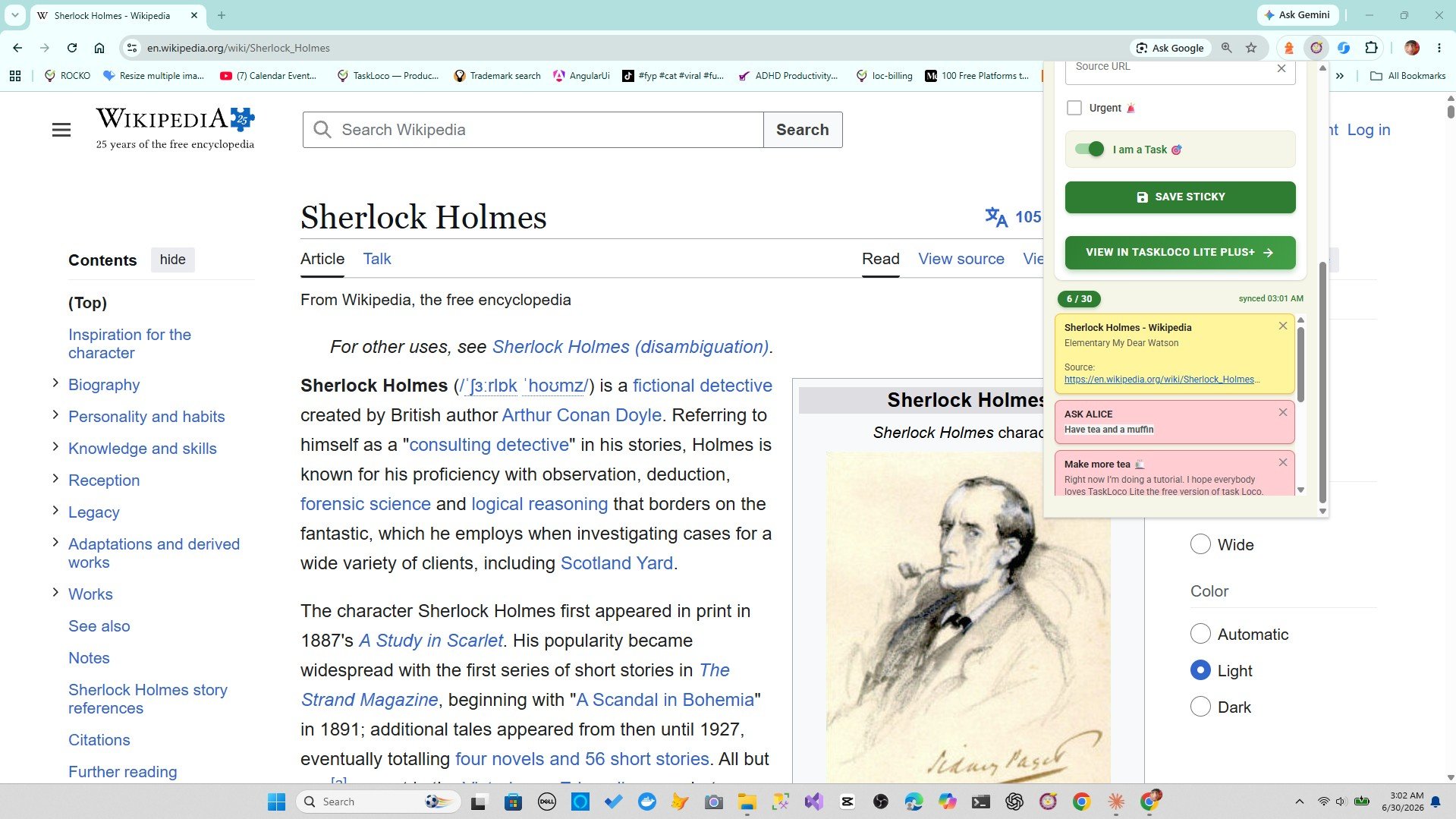
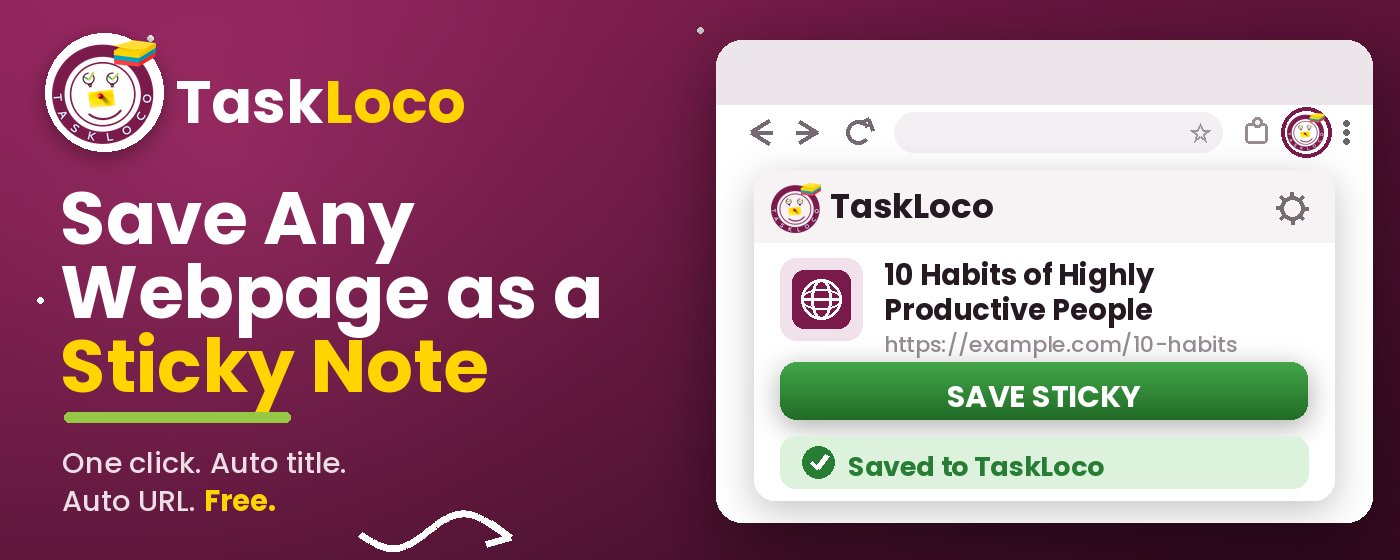
The Sticky Note Web Clipper is a free Chrome extension that turns any webpage — including any Wikipedia article — into a visual sticky note with one click. You don't switch apps, you don't paste anything, you don't label it manually. Click the toolbar icon, and the note is created with the Wikipedia article's title and URL already filled in.
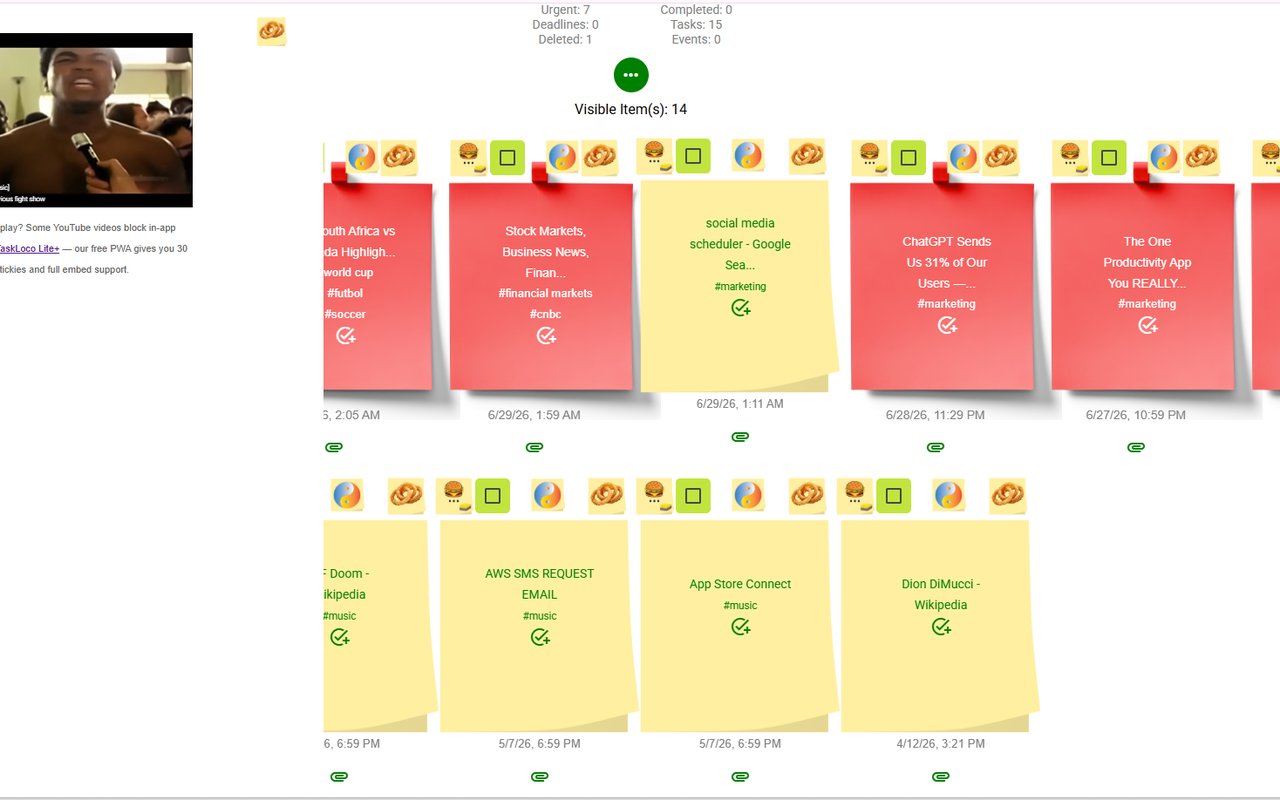
What you get is a sticky note that lives on a visual wall in TaskLoco. You can see all your saved Wikipedia articles at once, add your own annotation to any note (e.g., "Use the section on trade routes for Chapter 3"), and search across everything you've saved by keyword or tag. No folder discipline required.
The workflow looks like this:
- Open any Wikipedia article in Chrome.
- Click the Sticky Note Web Clipper icon in your browser toolbar.
- The note is created — title and URL auto-filled. Done.
- Optionally add a tag (e.g., #history, #science) or a quick note about why you saved it.
- Your saved articles sync to TaskLoco and are available on your phone or desktop whenever you need them.
If you're doing research across multiple Wikipedia articles for a paper, a project, or just personal curiosity, this is the method that actually keeps up with how fast you browse. You never slow down to organize — you clip and keep going.
How to Keep Your Saved Wikipedia Articles Organized
Saving is only half the equation. If you're clipping Wikipedia articles regularly, a little light organization goes a long way toward making them useful when you actually need them.
Use tags that match your projects, not broad categories. A tag like #byzantine-essay is more useful than #history because it's specific enough to pull up exactly what you need. Broad tags are better than nothing, but project-specific tags are what make search actually work.
Add a one-line annotation when the title isn't enough context. Wikipedia article titles are usually clear (Byzantine Empire), but sometimes the title isn't obvious about why you saved it. A quick note inside the sticky note — "See the Economics section" — takes five seconds and saves you a lot of re-reading later.
Review your saved notes the same day you do research. It sounds obvious, but the best time to annotate and organize what you saved is while the context is still fresh. Spend two minutes at the end of a research session tagging and annotating — not days later when you've forgotten why you saved half of it.
Don't over-save. The discipline isn't just in saving — it's in saving selectively. If a Wikipedia article is genuinely useful to your current work or something you'll want to reference later, clip it. If you're just mildly curious, let it go. A smaller, well-curated collection of notes is always more useful than a large, messy one.
The Sticky Note Web Clipper keeps your saved Wikipedia articles visible and searchable in TaskLoco, synced across Chrome, desktop, iPhone, and Android — so wherever you are when you need to pull up that source, it's there.
The Sticky Note Web Clipper is free. Install it from the Chrome Web Store, sign in with Google, and every page you clip becomes a sticky note you can find later.
Your clipped notes sync to TaskLoco across Chrome, desktop, iPhone, and Android — also free to start. No credit card to begin.
Get the Free Clipper
Sticky Note Web Clipper
- Free Chrome extension
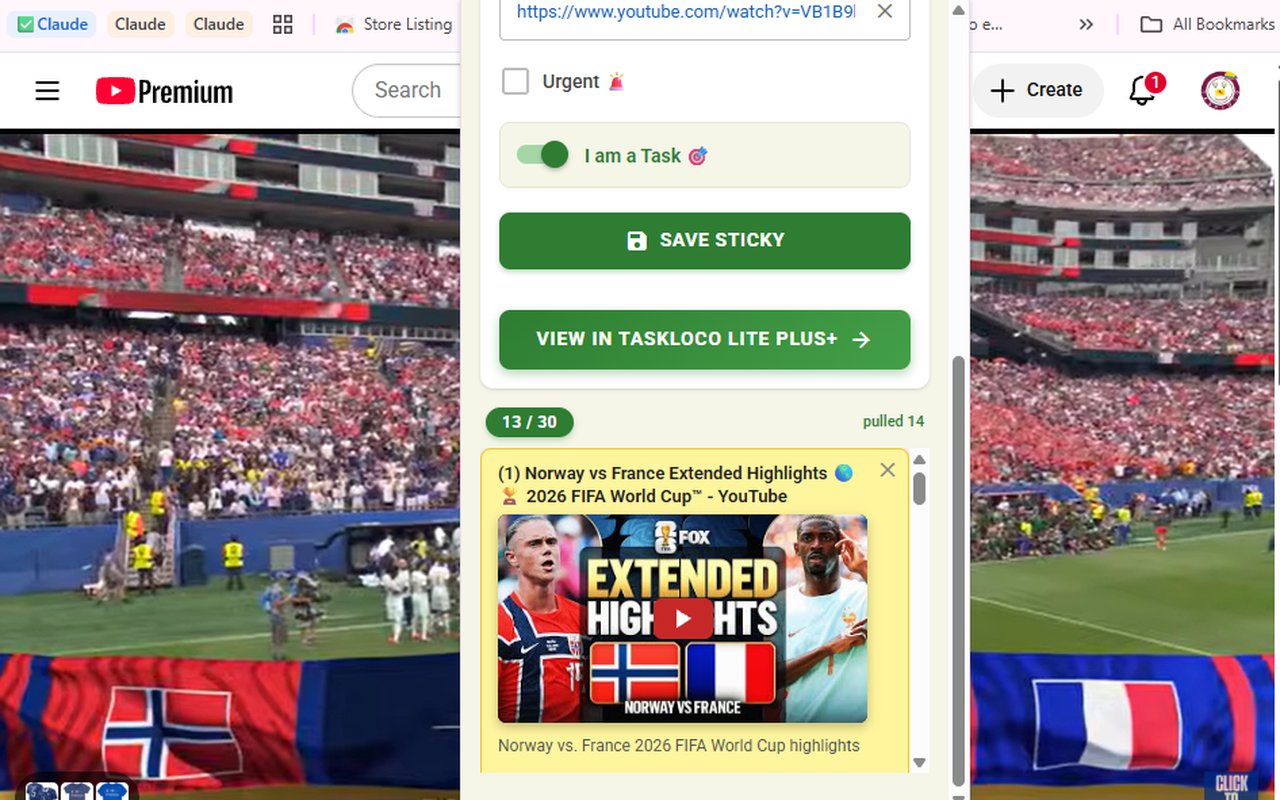
- One-click save — any page, article, or video
- Title & URL auto-filled
- Tags & search
- Free forever
Synced to TaskLoco
- Sign in free with Google
- Your wall on Chrome, desktop, iPhone, Android
- YouTube videos embed & play in notes
- Visual sticky-note wall
- Free to start
Add It to Chrome — Free
One click saves any page, article, or YouTube video as a sticky note. Title and URL auto-filled.
Add to Chrome — FreeSee TaskLoco in Action
Frequently Asked Questions
What's the fastest way to save a Wikipedia article for later?
The fastest method is the free Sticky Note Web Clipper extension for Chrome. Click the toolbar icon once while you're on any Wikipedia page, and it saves it as a sticky note with the title and URL already filled in — no copy-paste, no switching apps.
Can I add my own notes to a saved Wikipedia article?
Yes. When you clip a Wikipedia article with the Sticky Note Web Clipper, you get an editable sticky note. You can add your own annotations, tags, or context — anything that helps you remember why you saved it or where to look in the article.
Why are browser bookmarks not great for saving Wikipedia articles?
Bookmarks save the title and URL, but they give you no visual layout and no annotation layer. After saving a dozen Wikipedia articles, a bookmarks list looks identical from top to bottom — all titles, no context. They're hard to browse and easy to forget.
Does the Sticky Note Web Clipper work on Wikipedia specifically?
Yes. It works on any webpage in Chrome, including any Wikipedia article in any language. The article's title is auto-filled from the page, and the URL is captured automatically. You don't need to do anything beyond clicking the extension icon.
Can I access my saved Wikipedia articles on my phone?
Yes. Notes saved with the Sticky Note Web Clipper sync to TaskLoco, which is available on iPhone, Android, and desktop. Sign in with your Google account on any device and your saved articles are there.
Is the Sticky Note Web Clipper free?
Yes — the extension is completely free. TaskLoco also has a free tier. Install it from the Chrome Web Store, sign in with Google, and start clipping Wikipedia articles (or any other page) right away.
How do I find a Wikipedia article I saved a while ago?
In TaskLoco, you can search your saved notes by keyword — including words from the article title — or filter by any tags you added. Since notes are displayed visually on a wall rather than as a plain list, browsing through them is much faster than scanning a bookmarks folder.
Born in Brooklyn. Powered by AWS. Your data stays yours.
TaskLoco is available on iPhone, Android, Chrome, and every web browser.