Dwight D. Eisenhower, Supreme Commander of Allied Forces in World War II and later the 34th President of the United States, was famously blunt about the difference between urgent and important work. A quote often attributed to him — though the precise origin is debated — captures the idea perfectly: "I have two kinds of problems, the urgent and the important. The urgent are not important, and the important are never urgent." That tension is the entire engine behind what we now call the Eisenhower Matrix.
Stephen Covey popularized the framework for a general audience in The 7 Habits of Highly Effective People (1989), calling it the "Time Management Matrix" and placing it at the heart of Habit 3: Put First Things First. Since then, the model has become one of the most-cited prioritization frameworks in personal productivity, project management, and executive coaching — not because it is complicated, but because it makes a hard cognitive problem visual and therefore tractable.
How the Matrix Works: The Four Quadrants Explained
The Eisenhower Matrix is a two-by-two grid. The vertical axis represents importance — does this task move you toward a meaningful goal, or does it primarily serve someone else's agenda? The horizontal axis represents urgency — does this task demand attention right now, or does it have a longer time horizon? Every task you face can be placed somewhere on this grid, and where it lands tells you what to do with it.
- Quadrant 1 — Do (Urgent + Important): Crises, deadlines, emergencies. These tasks must be handled immediately. The goal is to minimize how much of your week lives here, because Q1 work is exhausting and largely reactive.
- Quadrant 2 — Schedule (Not Urgent + Important): Strategic planning, relationship building, learning, preventive maintenance. This is where Covey argued most high-performers should spend the bulk of their time. Q2 work rarely screams for attention, which is exactly why it gets ignored — and exactly why ignoring it is so costly.
- Quadrant 3 — Delegate (Urgent + Not Important): Interruptions, certain meetings, requests that feel pressing but do not advance your core goals. These should be handed off wherever possible. If you cannot delegate, time-box them aggressively.
- Quadrant 4 — Eliminate (Not Urgent + Not Important): Busywork, trivial distractions, low-value habits. The honest version of this quadrant is uncomfortable, because it often includes things that feel productive but are not.
Practitioners typically run a daily or weekly review: brain-dump every open task, then place each one in the appropriate quadrant before touching any of them. This separates the act of capturing from the act of deciding — a distinction that matters because deciding under pressure almost always inflates urgency artificially.
Why It Works — and Where It Breaks Down
The framework's power comes from two psychological mechanisms. First, it slows down the automatic reflex to treat every incoming request as urgent. Research in behavioral economics consistently shows that humans are loss-averse and respond to perceived urgency even when the stakes are low — what psychologist Robert Cialdini identified as the "scarcity" trigger. The matrix interrupts that reflex by forcing an explicit importance judgment before action.
Second, it makes the opportunity cost of neglecting Q2 visible. Most people intellectually understand that strategic work matters more than reactive busywork, but they cannot see the imbalance in their week. Mapping tasks to quadrants turns an abstract problem into a concrete picture. When you can see that 80% of your week is Q1 and Q3, the diagnosis is obvious.
That said, the model has real limitations that practitioners should understand honestly:
- Importance is subjective and context-dependent. What counts as "important" depends entirely on your goals, role, and values — which the matrix itself cannot supply. Two people looking at the same task can place it in different quadrants and both be right given their different contexts.
- It is static. The matrix gives you a snapshot. It does not account for tasks that shift quadrants as deadlines approach, or for cascading dependencies where a Q4 item suddenly becomes Q1 because of an upstream decision.
- It does not handle volume well. When you have 200 open tasks, individually quadrant-labeling each one becomes its own time sink. The matrix was designed for a pre-digital work environment. Applied at scale, it needs to be combined with a capture system (like GTD's inbox) to remain tractable.
- The Q1/Q2 boundary is easy to game. People under chronic stress tend to classify almost everything as Q1 to justify their reactivity. Without a deliberate check — ideally a weekly review rather than a daily one — the matrix gradually inflates toward false urgency.
Applying It in Practice: Common Adaptations
The textbook version of the Eisenhower Matrix — four equal quadrants drawn on paper — works well as a mental model but rarely survives contact with a real workweek without some adaptation. Here are the approaches that practitioners report actually sticking with:
Weekly batch sorting, not daily micro-sorting. Rather than re-quadrant every task every morning, many people do one longer weekly review — usually Sunday evening or Monday morning — where they categorize the full task list and set their Q2 commitments for the week. Daily check-ins then just handle new arrivals and Q1 fires. This reduces the cognitive load of the system significantly.
Using labels or tags instead of a drawn grid. Digital task systems let you apply Q1–Q4 labels (or equivalent tags like "this week," "schedule," "delegate," "someday") without drawing anything. The visual grid is a teaching aid; the underlying logic is just a two-attribute classification: urgent yes/no, important yes/no.
Combining with time blocking. The matrix tells you what category a task belongs to; it does not tell you when to do it. Pairing Q1 and Q2 identification with calendar time blocks for your most cognitively demanding tasks makes the system actionable rather than just diagnostic.
Limiting Q1 and Q2 to a fixed count. Some practitioners cap themselves at three Q1 items and three Q2 items per week. Anything above the cap either gets reclassified (honestly) or deferred. This constraint forces the prioritization judgment the matrix is meant to produce — without the constraint, lists expand to fill whatever space they are given.
Treating Q3 delegation as a skill, not just a category. Many people identify Q3 tasks correctly but never actually delegate them because they lack a system or a team. If delegation is not realistic in your context, Q3 items should be time-boxed strictly — given a defined slot and a hard stop — rather than allowed to interrupt freely throughout the day.
Using TaskLoco to Run Your Eisenhower Review
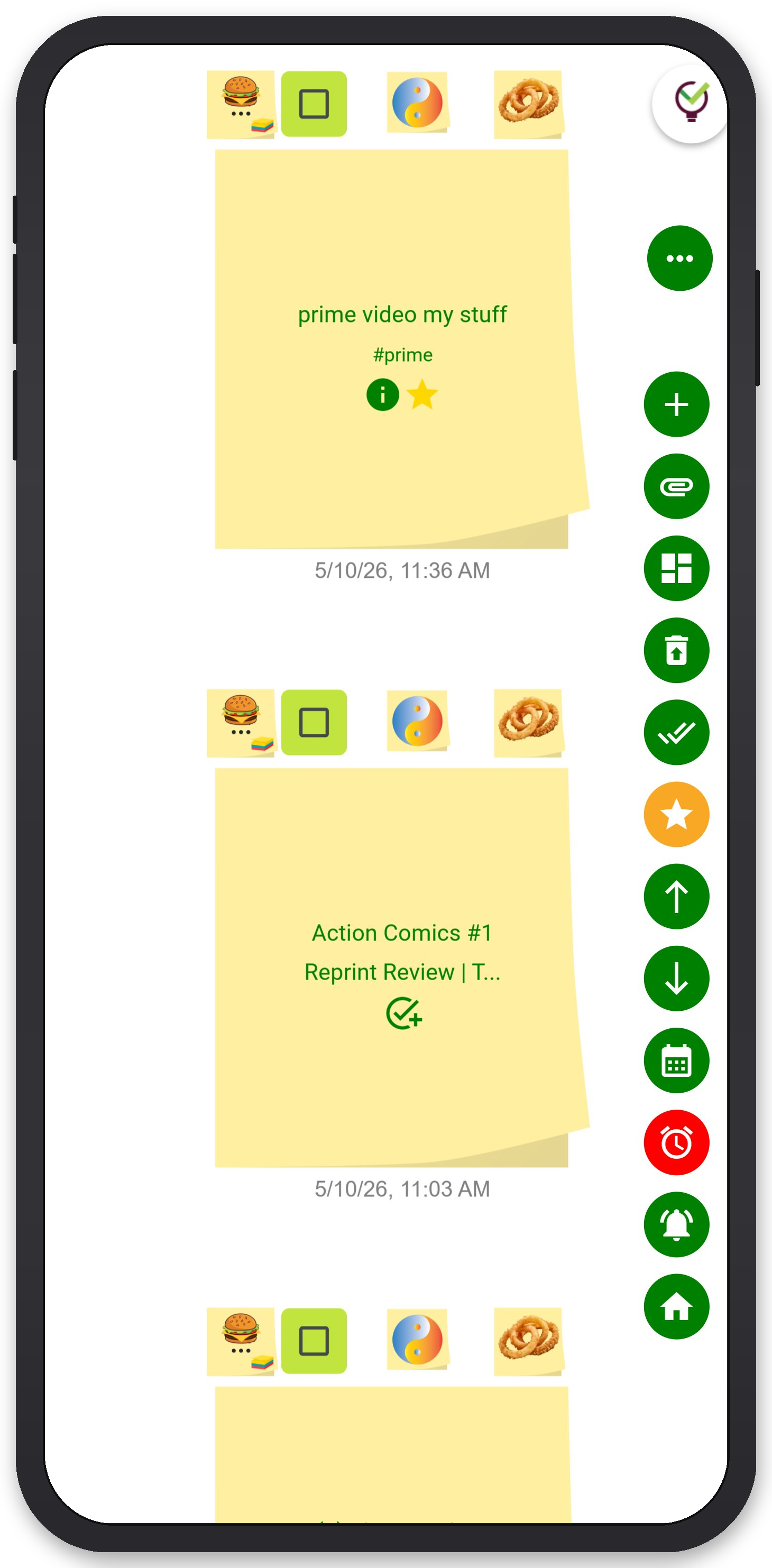
The Eisenhower Matrix is a mental model, not a software feature. Any system that lets you capture tasks and tag or group them can support the practice. TaskLoco's sticky-note-based layout happens to fit the quadrant workflow naturally: you can create four named groups on your wall — Do, Schedule, Delegate, Eliminate — and drag notes between them during your weekly review. Each note can carry a reminder (delivered as a push notification that deep-links straight back to that note), so your Q1 and scheduled Q2 items actually surface at the right time instead of getting buried in a list.
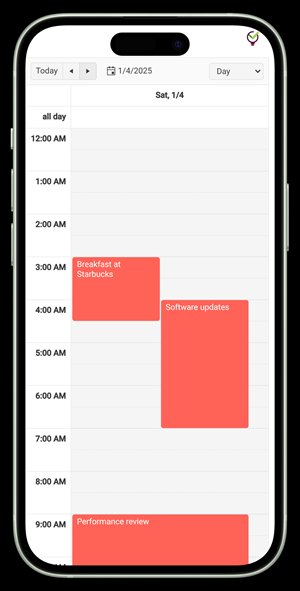
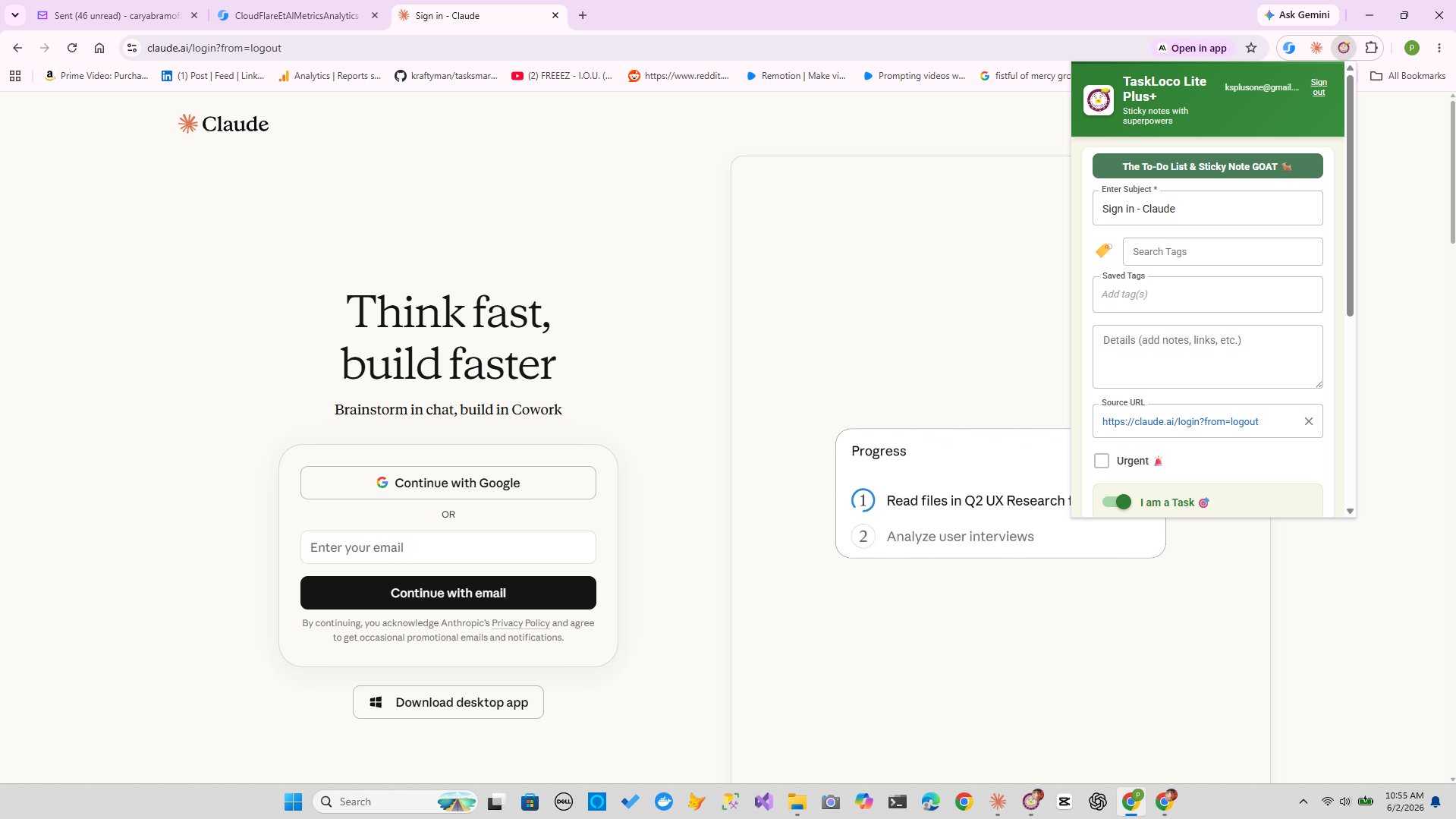
TaskLoco Premium also includes file attachments (10GB), a calendar view for time-blocking your Q2 commitments, and team sharing so Q3 delegation happens inside the same system rather than across a separate email thread. The Chrome extension lets you clip a webpage — a reference article, a stakeholder email, a spec doc — directly onto the relevant note in one click, which is useful when your Q2 planning involves research that needs to stay attached to the task context.
TaskLoco Lite — the native iPhone and Android app — stores up to 20 notes on your device with no sign-in required. It is useful for quick capture, but it does not sync and does not include reminders or sharing, so it works best as a companion for jotting tasks before your weekly review rather than as the review system itself.

TaskLoco Premium is regularly $9.99/month per person. Right now, charter members can lock in 50% off the regular price — forever. That means $4.99/month per person today. And if our price ever goes up, you still pay half. Always.
Code CHARTER50 auto-applies at checkout. First 500 spots only — once they're gone, this offer is gone permanently. Act fast while spots last.
Every Premium subscription includes unlimited notes, 10GB file storage, reminders, calendar, and team sharing. Each team member requires a separate subscription. 7-day free trial — no charge until day 8. Cancel anytime.
Free Options: TaskLoco
TaskLoco Lite
- Native iPhone & Android app
- Completely anonymous — no sign-in
- Data stays on your device
- Up to 20 notes
- Free forever
TaskLoco Lite Plus+
- Web app + Chrome extension
- Sign in with Google
- Wall syncs across all devices
- Up to 30 notes
- Free forever
Lock In 50% Off — Forever
7-day free trial. No charge until day 8. CHARTER50 auto-applies at checkout.
🔒 Lock In My Charter SpotSee TaskLoco in Action
Frequently Asked Questions
What is the Eisenhower Matrix in simple terms?
The Eisenhower Matrix is a way to sort tasks into four buckets based on two questions: Is this task urgent? Is this task important? Tasks that are both urgent and important get done now. Tasks that are important but not urgent get scheduled. Tasks that are urgent but not important get delegated. Tasks that are neither get eliminated. The goal is to spend more time in the "important but not urgent" bucket — that is where strategic, high-value work lives.
Did Eisenhower actually invent the Eisenhower Matrix?
Not exactly. The two-by-two urgency/importance grid was formalized and popularized by Stephen Covey in The 7 Habits of Highly Effective People (1989), where he called it the Time Management Matrix. Covey attributed the underlying insight to Eisenhower, citing a 1954 speech in which Eisenhower quoted a college president distinguishing between urgent and important problems. The visual grid format and the quadrant labels are Covey's contribution, not Eisenhower's.
What is the difference between urgent and important?
Urgent tasks demand immediate attention — they come with a deadline, a notification, or a social expectation of a quick response. Important tasks contribute meaningfully to your goals, values, or long-term outcomes. The critical distinction is that urgency is often externally imposed, while importance is a judgment you make relative to your own priorities. A ringing phone is urgent; whether answering it is important depends entirely on who is calling and why.
What should go in Quadrant 2 of the Eisenhower Matrix?
Quadrant 2 — Not Urgent, Important — is where Covey argued the most valuable work lives. Examples include strategic planning, skill development, relationship building, health maintenance, writing a business proposal before the deadline creates pressure, and fixing systems before they break. Q2 work never screams for attention, which is why it tends to get deferred in favor of whatever feels urgent today. Protecting dedicated time for Q2 tasks is the core discipline the matrix is designed to build.
How often should you update your Eisenhower Matrix?
Most practitioners find a weekly review more sustainable than a daily one. Once per week — typically at the start or end of the work week — you capture all open tasks, sort them into quadrants, and set your Q2 commitments for the coming days. During the week, you handle new arrivals by quickly asking "urgent? important?" and slotting them without rebuilding the whole matrix from scratch. The matrix is a planning tool, not a real-time dashboard.
What are the biggest criticisms of the Eisenhower Matrix?
The main criticisms are: (1) Importance is subjective — the matrix cannot tell you what matters, only sort what you already believe matters. (2) It is static — tasks change urgency as deadlines shift, but the matrix does not update itself. (3) It does not scale well — sorting hundreds of tasks into quadrants manually is its own time problem. (4) It is easy to rationalize: people under chronic stress tend to inflate Q1, which defeats the purpose. These are real limitations, not fatal flaws — but they explain why the matrix works best as a weekly habit combined with a separate capture system rather than as a standalone daily tool.
Can I use TaskLoco to organize tasks with the Eisenhower Matrix?
Yes. TaskLoco's wall view lets you create named groups — one for each quadrant — and move notes between them during your weekly review. TaskLoco Premium adds reminders (delivered as push notifications that deep-link back to the note), a calendar view for time-blocking Q2 work, file attachments, and team sharing for Q3 delegation. The free Lite Plus+ tier (web app, up to 30 notes, synced across devices) is enough to run a basic four-group Eisenhower board if your task volume is modest. $9.99/month per person (currently $4.99/month per person for first 500 charter members with code CHARTER50)
Born in Brooklyn. Powered by AWS. Your data stays yours.
TaskLoco is available on iPhone, Android, Chrome, and every web browser.