It's 2:47am. You're wide awake.
Not because of the thing you forgot. Because of the thing you might have forgotten, and there is no way to check without getting out of bed and opening four apps that will each show you a different piece of your own life.
You know the feeling. Everybody does. And everybody gets handed the same prescription for it: try harder, wake up earlier, buy the planner, build the system, download the app with the streaks. Nobody ever says the obvious thing out loud.
Nothing is wrong with your character. Something is wrong with the shape of the information. And the fix is so old, so cheap, and so unglamorous that a fifty billion dollar industry has spent fifteen years politely stepping around it.
Your brain is a room, not a list
Human memory is spatial. Not alphabetical. Not chronological. Certainly not a bulleted column. You can walk through a house you moved out of twenty years ago and say exactly which drawer the scissors were in. You cannot name item fourteen on Tuesday's to-do list, and you wrote that yourself. On Tuesday. Four days ago.
Give a thing a place, a color, and a size, and your brain stops hunting for it. Recall becomes free. That is the whole secret. It has been hanging on office walls and studio walls and war room walls for fifty years, and then software came along and quietly deleted it.
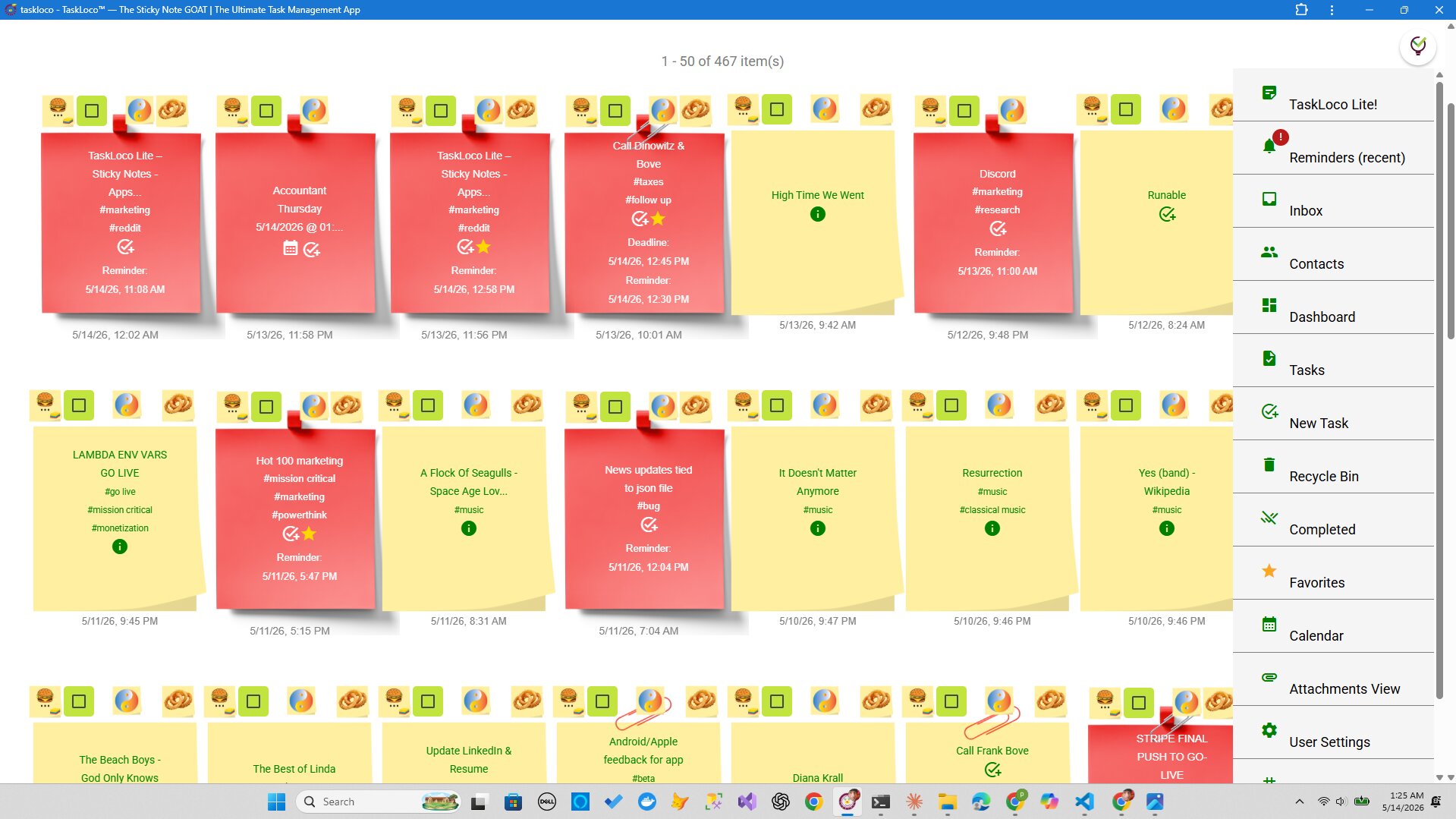
Now put those notes on one storyboard and watch what happens. Everything laid out at once. Nothing buried three taps deep. Nothing lost. You see your whole life the way you see a room, and rooms are the one interface your brain was actually built for.
What your to-do app did to you
Open it. Look at what it actually did to your day. A hospital appointment. A Costco run. A contract that decides whether you make payroll on Friday. A reminder to text your sister back.
Four wildly different weights in a human life, rendered as four identical gray rows. Nothing bigger. Nothing closer. Nothing louder. You handed a machine the one job your brain was already elite at, and it handed you back a spreadsheet.
So you stopped opening it. And then, because this is how these things go, you felt bad about that too. You added "get organized" to the list of things you are failing at, inside the app that caused it.
What a sticky note has that a row never will
- Position. Top left is on fire. Bottom right is someday. Nobody ever had to teach you that.
- Color. Green is money. Red is trouble. Yellow is everything else. One glance, zero reading.
- Presence. A note takes up room in the world. It flat out refuses to be scrolled past.
- A satisfying death. Finishing something makes it vanish off the wall. That reward loop is older than software and it still beats every streak counter ever shipped.
- Permission to be half-baked. A sticky feels low stakes, so the rough idea actually gets written down instead of dying in your head at a traffic light.
Paper has all five, and always did. What paper does not have is an alarm clock, a filing cabinet, or a copy of itself in your pocket. That gap is the whole story. And the man who closed it did it the hard way.
The man who gave away the patent
In 2010, Cary Abramoff built the first version of this under a different name. Lawyers told him the truth about the industry he was walking into: without a patent, somebody bigger would sue him out of existence and take it.
He did not have patent lawyer money. So he sat down and wrote the patent himself. In 2013 the United States Patent Office granted it. US8548992. His name on it.
In 2015 his company collapsed. The product went dark. That is usually where this kind of story ends, with a founder holding a piece of paper and a grudge.
Instead, in 2017, he did something almost nobody in software does. He let the patent expire on purpose and released the invention into the public domain. He gave it to everyone, including the people who could have used it against him.
"Locking up software ideas felt wrong. Good ideas should help everyone. TaskLoco belongs to the world, and now I'm bringing it back better than ever."
— Cary Abramoff, Creator of TaskLoco
Then in 2024 he quit his day job and rebuilt the entire thing from scratch. Two years of it. Out of Brooklyn, NY. No moat, no patent to hide behind, nothing to sell but whether the thing actually works.
It works.
So he kept the sticky note and gave it a brain
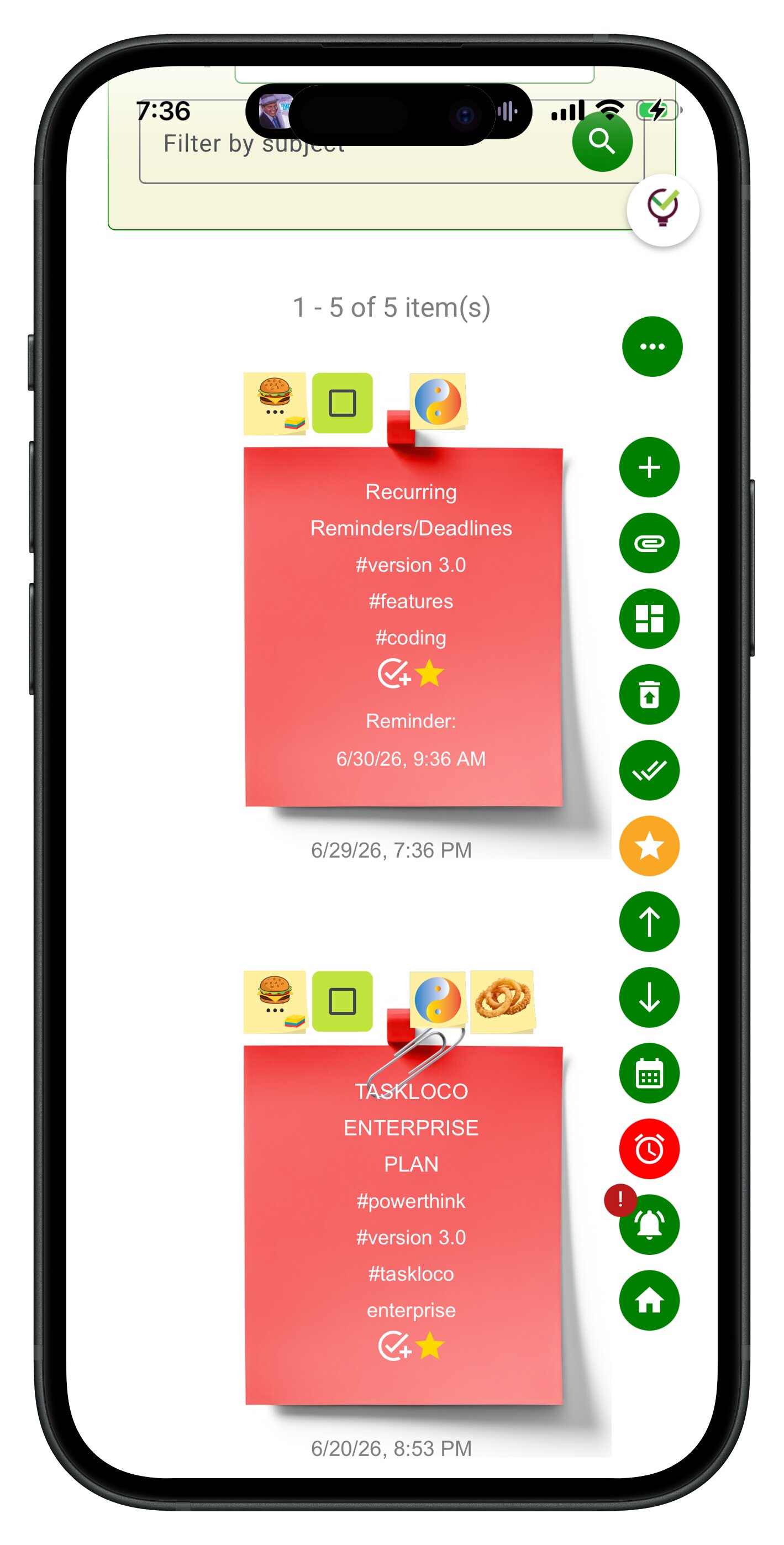
TaskLoco is what you get when somebody refuses to give up the wall. Real sticky notes on a real storyboard. Colors and positions that mean exactly what you decide they mean. And then everything paper never could do:
- It remembers so you don't have to. Recurring reminders by push, email and SMS. Daily, weekly, monthly, skip the weekends. The note tells you when. You are not the calendar anymore.
- It holds your stuff. The contract, the receipt photo, the lease, the lab result. The file lives on the note, not in a folder you will never find again at 2:47am.
- It follows you everywhere. Web, iPhone, Android, and the Chrome extension. Write it on the laptop, finish it at a red light. Same wall, every device, anywhere in the world.
- Every note is a mini web page. Embed a video, a photo, a link. Tag it and find it in one second. Send or clone it to one person without handing over your entire life.
- It gets out of your way. No projects to configure. No workspace to design. No onboarding tour, no certification, no productivity philosophy to adopt. You write a note and stick it on a wall, which you have known how to do since you were four years old.
This isn't a to-do list. It's a new category.
TaskLoco is not a to-do list. It is not a project manager. It is not a notes app. It is a cognitive workspace: a visual brain where tasks, ideas, files and reminders live in one place and speak one language.
"Your task list is your promise to yourself. TaskLoco makes that promise visible, intuitive, and impossible to lose."
— Cary Abramoff, Creator of TaskLoco
Who gets it in the first ten minutes
Visual thinkers. People with ADHD, who spent years being told they needed a better system when what they actually needed was a system that shows them everything at once. Students running six classes in parallel. Parents running a household that never came with a project manager. Founders holding a dozen threads where dropping one costs real money and real people.
And every single person who has ever grabbed an actual paper sticky note and slapped it on an actual monitor because the app was not working. That is most of us. The sticky note never lost. It just never got upgraded.
Ninety seconds is all it takes
Zero learning curve. Zero friction. Sign in with Google, type the thing that is sitting on your chest right now, hit save. Two taps. Under thirty seconds to your first loco note.
There is a moment, usually about ninety seconds in, when the wall stops being a screen and starts being your stuff. You move one note. You color another. You lean back. And the thing you have been carrying around in your head all week is suddenly sitting on a wall in front of you, where you can see all of it at once.
Lock In 50% Off — Forever
7-day free trial. No charge until day 8. CHARTER50 auto-applies at checkout.
🔒 Lock In My Charter SpotFrequently Asked Questions
What is the productivity breakthrough secret behind sticky notes?
Human memory is spatial. You recall where something sat far more reliably than what it was called. A storyboard of sticky notes gives every task a location, a color and a size, so your brain retrieves it without reading a single line.
Why do to-do list apps stop working after a week?
A list flattens everything into one vertical column of identical rows. Nothing is bigger, closer or louder than anything else, so the list stops meaning anything and you stop opening it.
Is TaskLoco free?
Yes. TaskLoco Lite is free on iPhone, Android and Chrome, and the full web app runs in any browser. Premium adds recurring reminders, file attachments, calendar and sharing, with a 7 day free trial.
Does TaskLoco work on iPhone and Android?
Yes. TaskLoco runs on the web, on iPhone, on Android and as a Chrome extension, and your notes sync across all of them when you are signed in.
How long does it take to get started?
Under thirty seconds. Sign in with Google, type your first loco note, save it. No card, no onboarding tour, no learning curve.
Who created TaskLoco?
Cary Abramoff, in Brooklyn, NY. He wrote and was granted US patent 8548992 in 2013, then let it expire into the public domain in 2017 rather than lock the idea up. He quit his day job in 2024 to rebuild TaskLoco from scratch.
Born in Brooklyn. Powered by AWS. Your data stays yours.
TaskLoco is available on iPhone, Android, Chrome, and every web browser.