Most tutorials on AI agents bury the interesting part under pages of theory. So here's the honest version: an AI agent is just a loop. Something perceives the world, something decides what to do next, something acts, and then it checks whether it's done. That's it. Everything else — memory, tool use, multi-agent coordination — is layered on top of that loop.
This guide is for builders who want to get their hands dirty. You'll learn what an agent actually is (not the marketing version), how to build a minimal working one in Python, and how to extend it with memory, tools, and real decision-making. By the end, you'll have something running — not just a vague sense of how agents work in theory.
What an AI Agent Actually Is (and Isn't)
The word "agent" gets applied to everything right now — chatbots, AutoGPT wrappers, multi-step API calls. That's confusing. A real AI agent has three properties that distinguish it from a simple script or a one-shot LLM call:
- Perception: The agent takes in information from its environment — a user prompt, a web page, a file, an API response, or all of the above.
- Decision-making: It chooses what action to take next based on what it perceives and what goal it's working toward. This is where LLMs shine — they can reason in natural language about ambiguous situations.
- Action: It does something — calls a function, writes a file, searches the web, sends a message — and then observes the result before deciding what to do next.
The key word is loop. A chatbot responds once and stops. An agent keeps going — observe, think, act, repeat — until it decides the goal is met or it hits a limit you've set. That autonomy is what makes agents powerful and also what makes them tricky to build correctly.
What an agent is not: a single prompt, a fine-tuned model, or a retrieval-augmented generation (RAG) pipeline. Those are components you might use inside an agent, but they don't constitute one on their own.
Building Your First Agent: Step-by-Step
You can build a working AI agent with nothing but Python, an OpenAI API key, and a clear goal. Here's a minimal, real example — a research agent that searches the web and summarizes what it finds.
Step 1: Define the goal and scope
Before writing a single line of code, write one sentence describing what the agent should accomplish. "Find the three most recent papers on RAG evaluation and summarize their methods" is a good goal. "Be helpful" is not. Agents without tight goals wander. Keep it concrete.
Step 2: Set up your environment
You need Python 3.10+, the openai package, and a tool library. For beginners, LangChain and LlamaIndex are the two most common frameworks. LangChain gives you pre-built agent executors and tool integrations. LlamaIndex is better if your agent needs to reason over large document collections. Start with LangChain for general-purpose agents.
- Install:
pip install langchain openai - Set your API key:
export OPENAI_API_KEY=your_key_here
Step 3: Define the tools
Tools are functions the agent can call. Each tool has a name, a description (the LLM reads this to decide when to use it), and code that actually does something. A minimal research agent might have two tools: a web search tool and a text summarizer.
In LangChain, a tool looks like this:
from langchain.tools import tool @tool
def search_web(query: str) -> str: """Search the web for current information on a topic.""" # Call a search API here (SerpAPI, Tavily, etc.) return results
The docstring is critical — the LLM uses it to decide when to call this tool versus another one. Write it as if you're explaining it to a smart intern, not a machine.
Step 4: Create the agent
Connect your tools to a model and an agent executor. The executor handles the loop — it calls the model, parses the output to see if a tool call is requested, runs the tool, feeds the result back in, and keeps going until the model outputs a final answer.
from langchain.agents import initialize_agent, AgentType
from langchain.chat_models import ChatOpenAI llm = ChatOpenAI(model="gpt-4o", temperature=0)
agent = initialize_agent( tools=[search_web], llm=llm, agent=AgentType.OPENAI_FUNCTIONS, verbose=True
)
agent.run("Find three recent papers on RAG evaluation and summarize their methods.")
Step 5: Test, inspect, and iterate
Run it with verbose=True and watch the chain of thought. You'll see exactly what the agent is deciding at each step. Agents almost never work perfectly on the first run. Common issues: the model picks the wrong tool because the description is vague, the agent loops more than it should because the stop condition isn't clear, or a tool throws an error the agent doesn't know how to handle. Fix these one at a time.
Memory, Tool Calling, and Making Agents Actually Useful
A minimal agent works for simple tasks. But most real use cases need two more things: memory (so the agent remembers what it's already done) and reliable tool calling (so it doesn't hallucinate actions that don't exist).
Short-term memory vs. long-term memory
Short-term memory is just the conversation history — everything the agent has said and done in the current session. Most frameworks handle this automatically. Long-term memory requires storing information somewhere external (a vector database like Chroma, Pinecone, or Weaviate) and retrieving relevant chunks at query time. For a research agent, long-term memory means it can pick up where it left off across sessions without re-reading everything.
For beginners, start with short-term memory only. Add a vector store when your agent's context window overflows or when you need to persist information between runs.
Structured tool calling
The biggest reliability improvement in modern agents is structured tool calling — instead of asking the LLM to write code or format a JSON blob, you define tool schemas and the model fills them in. OpenAI's function calling API, Anthropic's tool use API, and LangChain's OPENAI_FUNCTIONS agent type all do this. It's dramatically more reliable than asking the model to output structured text that you then parse.
Always define your tool parameters with Pydantic or JSON Schema so the model knows exactly what inputs are expected. Ambiguous schemas produce ambiguous calls.
Handling failures gracefully
Agents will fail. A search API returns nothing, a tool throws an exception, the model decides a task is done when it isn't. Build error handling into every tool — return a descriptive error string instead of raising an exception, so the agent can read the error and try a different approach. Set a maximum iteration count so the agent can't run forever. Log every action to a file so you can diagnose what went wrong.
Frameworks worth knowing
- LangChain / LangGraph: Most popular, most tutorials, large ecosystem. LangGraph adds graph-based control flow for complex multi-step agents.
- LlamaIndex: Excellent for document-heavy workflows; strong RAG integration.
- CrewAI: Built for multi-agent systems where specialized agents collaborate on a task.
- AutoGen (Microsoft): Research-oriented, great for experimenting with agent-to-agent conversation.
- Pydantic AI: New but fast-growing; very clean structured output and tool calling.
How TaskLoco Helps When You're Building Something Real
Building an AI agent isn't a one-sitting project. You'll accumulate research links, architecture decisions, debugging notes, API quirks, and half-finished ideas across days or weeks. That's a lot of context to carry in your head — and the fastest way to lose momentum is to forget why you made a decision you made three days ago.
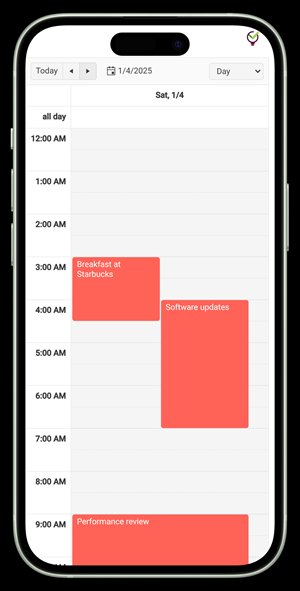
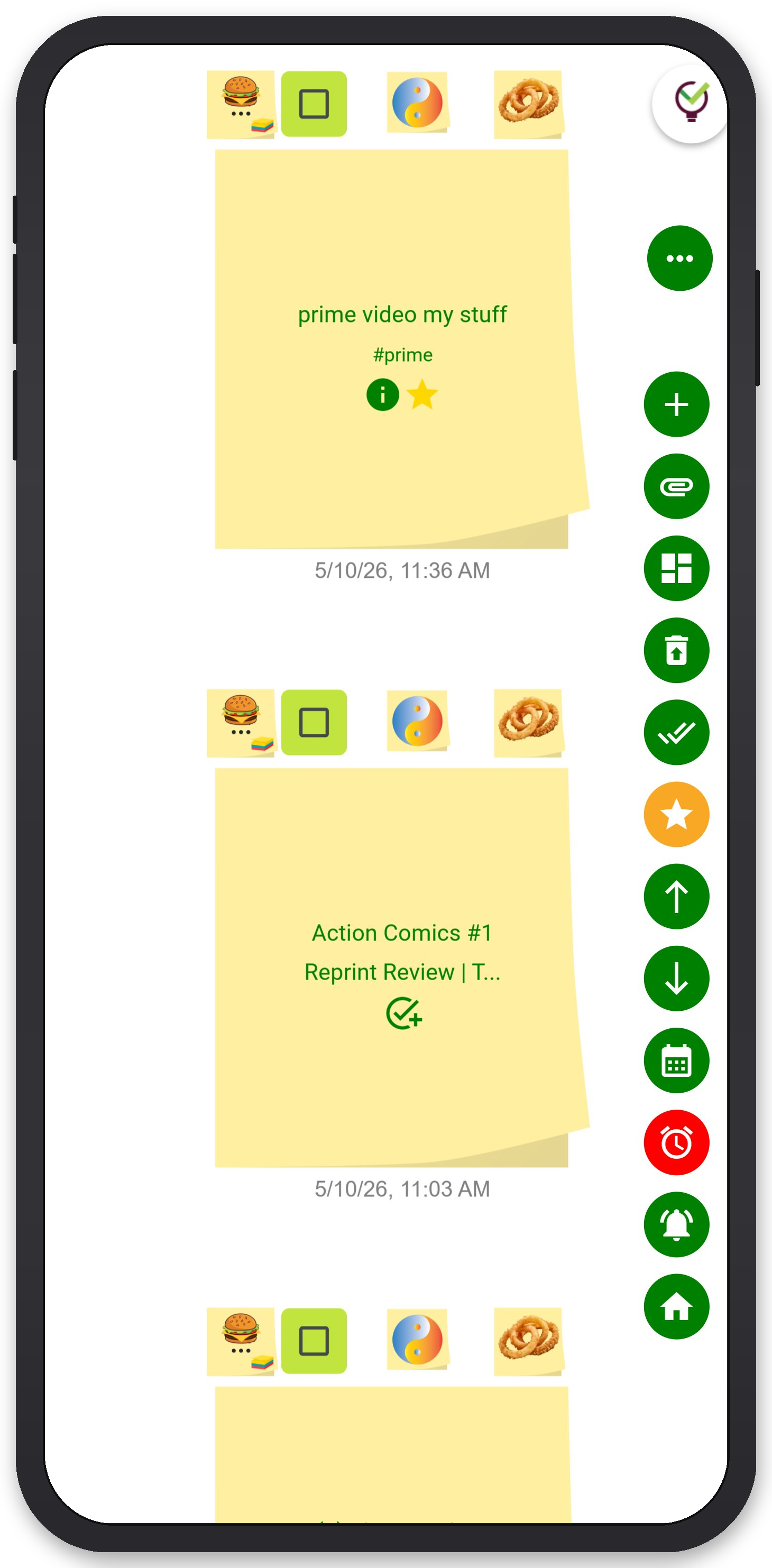
TaskLoco's sticky-note workspace is a surprisingly good fit for the way agent development actually works. Each note can hold a slice of your project: one for the agent's tool definitions, one for the prompts you're testing, one for error patterns you've seen and how you fixed them, one for the papers or docs you want to read. Notes stay visible on your wall so the big picture doesn't disappear while you're deep in a detail.
Premium users get reminders that fire as push notifications directly to your phone and computer — useful when you're waiting for an API approval or need to check on a long-running test. Each reminder deep-links straight back to the note it came from, so you land exactly where the context is, not in an inbox. File attachments (10GB included) let you keep architecture diagrams, exported logs, and reference PDFs alongside the notes that reference them. And when you're working with a collaborator — a co-founder, a colleague reviewing your agent design — team sharing lets them clone a shared note and make it their own, with no permissions maze to navigate.
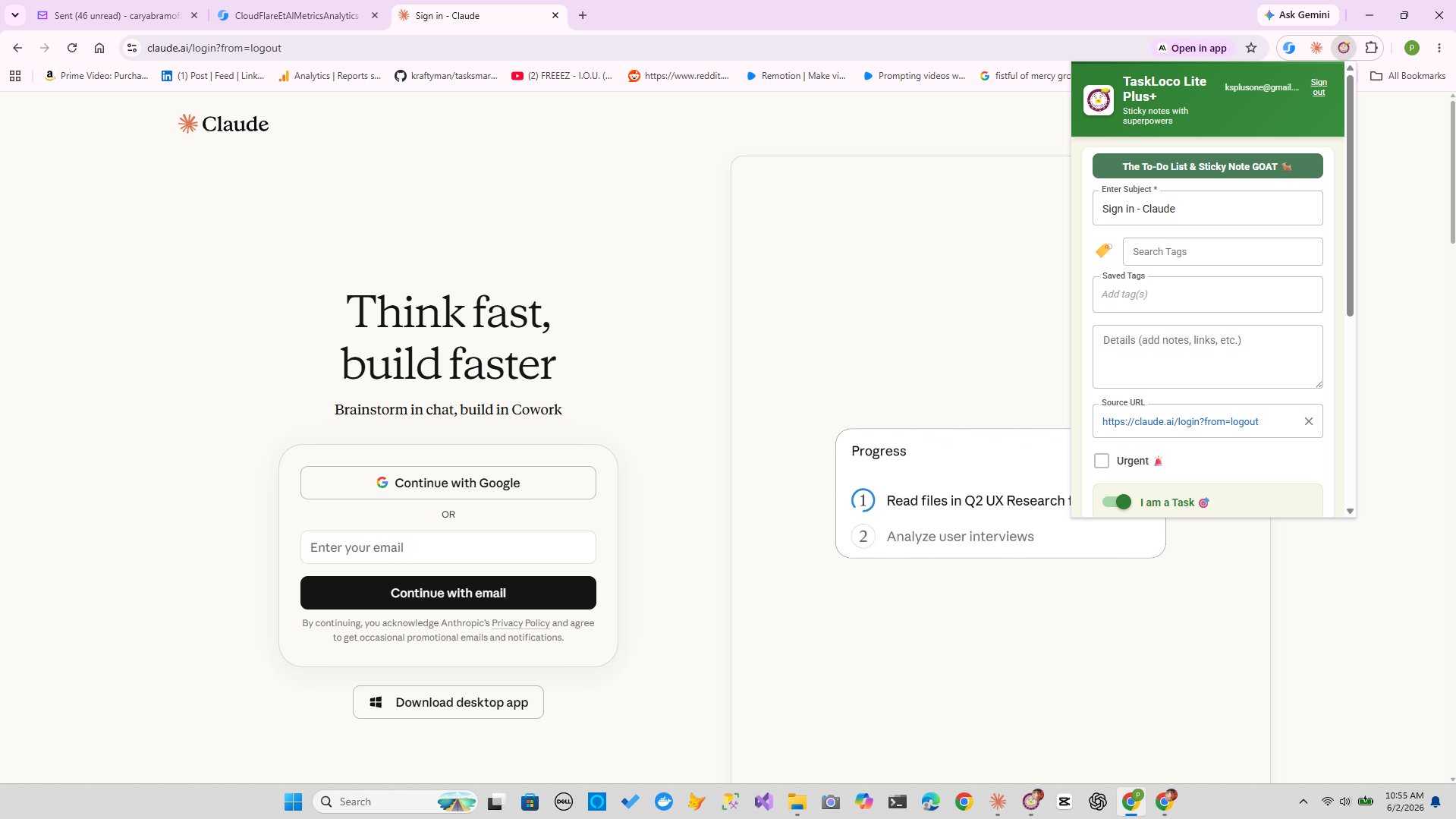
If you just want to jot a few things down without signing up for anything, TaskLoco Lite is a free native app on iPhone and Android — no account, no sign-in, stores up to 20 notes on your device. For cross-device sync and up to 30 notes free, TaskLoco Lite Plus+ runs in any browser and comes with the Chrome extension that captures any webpage (a research paper, an API doc, a GitHub issue) in one click.
TaskLoco Premium is regularly $9.99/month per person. Right now, charter members can lock in 50% off the regular price — forever. That means $4.99/month per person today. And if our price ever goes up, you still pay half. Always.
Code CHARTER50 auto-applies at checkout. First 500 spots only — once they're gone, this offer is gone permanently. Act fast while spots last.
Every Premium subscription includes unlimited notes, 10GB file storage, reminders, calendar, and team sharing. Each team member requires a separate subscription. 7-day free trial — no charge until day 8. Cancel anytime.
Free Options: TaskLoco
TaskLoco Lite
- Native iPhone & Android app
- Completely anonymous — no sign-in
- Data stays on your device
- Up to 20 notes
- Free forever
TaskLoco Lite Plus+
- Web app + Chrome extension
- Sign in with Google
- Wall syncs across all devices
- Up to 30 notes
- Free forever
Lock In 50% Off — Forever
7-day free trial. No charge until day 8. CHARTER50 auto-applies at checkout.
🔒 Lock In My Charter SpotSee TaskLoco in Action
Frequently Asked Questions
Do I need to know machine learning to build an AI agent?
No. Most AI agents today call an existing LLM (like GPT-4o or Claude) through an API — you're not training a model, you're directing one. You need to know Python well enough to write functions and handle API calls. Understanding how language models work conceptually helps, but you don't need to know backpropagation or linear algebra to build a working agent.
What's the difference between an AI agent and a chatbot?
A chatbot responds to a message and stops. An AI agent runs a loop — it perceives, decides, acts, observes the result, and repeats until a goal is met. Agents can call external tools, search the web, write and execute code, and make a sequence of decisions autonomously. A chatbot is reactive; an agent is goal-directed.
Which framework should a beginner use to build an AI agent?
LangChain is the most beginner-friendly starting point — it has the most tutorials, the largest community, and pre-built integrations for most common tools and APIs. Once you understand how an agent loop works from the inside, LangGraph (for complex flows), CrewAI (for multi-agent teams), or Pydantic AI (for structured, type-safe agents) are worth exploring. Don't framework-hop until you've shipped something.
How much does it cost to run an AI agent?
It depends entirely on the model you use and how many tokens your agent consumes per run. Agents are more expensive than single prompts because they make multiple LLM calls per task. For development and testing, use a cheaper model (like GPT-4o-mini or Claude Haiku) and switch to a more capable model only for production. Set hard iteration limits and monitor token usage from day one.
What tools can an AI agent use?
Anything you can wrap in a Python function. Common tools include: web search (Tavily, SerpAPI), code execution (Python REPL), file read/write, API calls to external services, database queries, email or calendar access, and web scraping. The LLM reads your tool descriptions to decide which one to call — clear, specific descriptions produce more reliable tool selection.
How do I stop an AI agent from running forever?
Set a maximum iteration count in your agent executor — LangChain's initialize_agent accepts a max_iterations parameter. Also define a clear stopping condition in your system prompt: tell the agent exactly what 'done' looks like. Without both a hard iteration cap and a clear goal description, agents can loop indefinitely, burning tokens and producing nothing useful.
Can TaskLoco help me manage an AI development project?
Yes — TaskLoco's sticky-note workspace is well suited to the nonlinear way software research and development actually happens. You can keep architecture decisions, prompt experiments, debugging notes, API references, and to-dos in one place, attach files directly to notes, get push notification reminders that deep-link back to the relevant note, and share notes with collaborators who can clone them and make them their own. $9.99/month per person (currently $4.99/month per person for first 500 charter members with code CHARTER50)
Born in Brooklyn. Powered by AWS. Your data stays yours.
TaskLoco is available on iPhone, Android, Chrome, and every web browser.