Your brain is not a hard drive. It was never designed to hold meeting notes, project ideas, article links, half-formed decisions, and follow-up tasks simultaneously. When you try to make it do all that, you get the cognitive equivalent of running fifty browser tabs — everything slows down, nothing loads properly, and occasionally the whole thing crashes at the worst possible moment.
The 'second brain' concept — popularized by Tiago Forte's book and methodology of the same name — offers a way out: build an external system that holds everything your mind shouldn't have to hold, so your mind can do what it's actually good at: connecting ideas, making judgments, and doing real work. That's the promise. The gap between the promise and reality is where most people get lost. This page explains the actual principle, where it comes from, and why so many well-intentioned second brains become digital graveyards within a month.
Where the Idea Actually Comes From
The phrase 'second brain' is modern, but the underlying idea stretches back centuries. Leonardo da Vinci kept notebooks compulsively — not organized by topic, but filled with whatever he was thinking about at the time. Darwin maintained detailed journals of observations long before he knew what he'd do with them. Niklas Luhmann, the 20th-century sociologist, built the Zettelkasten (German for 'slip box') — a system of index cards where every note linked to related notes. He used it to write over 70 books and 400 articles. He famously said he never felt like he was the author of his ideas — it felt more like collaborating with the box.
What all of these share is the core cognitive science principle behind the second brain concept: externalization reduces cognitive load. When you write something down in a place you trust, your brain stops spending background cycles trying not to forget it. Psychologist Bluma Zeigarnik documented in the 1920s that incomplete tasks occupy mental bandwidth in a disproportionate way — the 'Zeigarnik effect.' Writing a task down in a trusted system closes the loop. Your brain treats it as handled, even though you haven't done it yet.
Tiago Forte's contribution was to package these ideas into a practical methodology — specifically CODE (Capture, Organize, Distill, Express) and PARA (Projects, Areas, Resources, Archives) — and apply them to modern digital tools. The insight wasn't new; the framework for implementing it with apps and notes was.
Why Most Second Brain Systems Collapse
The failure mode is almost always the same, and it has nothing to do with the methodology. It has to do with friction. Every time you want to capture something — a fleeting idea, a webpage you just read, a task that surfaced in a conversation — there is a small tax. You have to open the right app, navigate to the right folder or project, format the note correctly, and tag it so future-you can find it. When that tax is low, capture becomes automatic. When the tax is high, you skip it. And skipping it a few times is enough to stop trusting the system. Once you stop trusting it, you stop using it. Game over.
The second failure mode is organization theater. Some people spend enormous energy building the perfect hierarchical folder structure, designing elaborate tagging systems, and color-coding categories — and almost no energy actually capturing and using information. The system becomes a hobby rather than a tool. This is partly why Forte's PARA system is intentionally shallow: only four top-level categories, with the explicit instruction not to over-nest. Complexity is the enemy of maintenance.
The third failure is treating a second brain as an archive instead of a working tool. If notes go in but never come back out — never get refined, connected to other notes, or acted on — the system is just a digital junk drawer with better labels. The 'Distill' and 'Express' steps in CODE exist precisely to prevent this: you're supposed to regularly revisit notes, highlight the most important bits, and use the material to produce something.
- High capture friction — if getting information in takes more than a few seconds, you'll stop doing it
- Over-engineering the structure — a complicated organizational system needs constant maintenance and becomes a burden
- No retrieval habit — a system you capture into but never search or review isn't a brain, it's a bin
- Tool-hopping — switching apps every few months means rebuilding trust each time, and continuity is what makes a second brain valuable
What a Second Brain That Actually Works Looks Like
Durable second brain systems share a few structural properties that are worth understanding on their own terms, independent of any specific app or methodology.
One inbox, not many. Every piece of incoming information — ideas, tasks, references, decisions — goes into a single capture point first. You sort it later. Sorting at the moment of capture is the most common source of friction, because it forces a classification decision when your attention is on the thing you just captured, not on your filing system.
Progressive summarization. Rather than trying to write perfect notes the first time, you capture roughly and refine over multiple passes. First pass: raw capture. Second pass: bold the important bits. Third pass: highlight the bolded bits. By the time a note is mature, the most important information is immediately visible without re-reading everything. This is a technique Forte describes explicitly, and it's consistent with how memory and comprehension actually work — understanding deepens over time, not in one sitting.
Links over folders. The most powerful second brains are networked, not hierarchical. A note about a conversation with a client should link to your project notes for that client, your notes on the relevant industry, and any decisions made. Folders enforce a single classification; links let information belong to multiple contexts simultaneously — closer to how the brain actually associates ideas.
Regular reviews. The weekly review — made famous by David Allen's Getting Things Done — is the maintenance loop that keeps a second brain honest. It surfaces stale information, closes forgotten loops, and turns captured material into actual decisions and actions. Without it, the system grows but doesn't evolve.
Constrained tools. Systems that try to hold everything in one place tend to outlast systems spread across six apps. The fewer the switching costs, the more likely you are to use it consistently — and consistency over time is what generates the compounding value that makes a second brain worth having in the first place.
How TaskLoco Fits This Mental Model
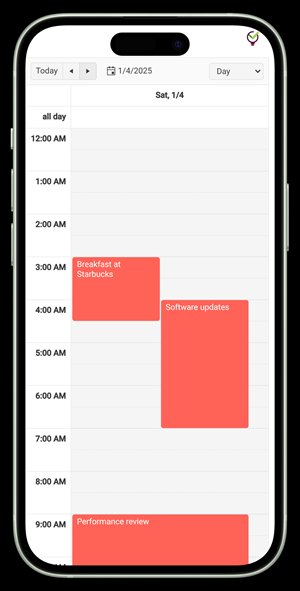
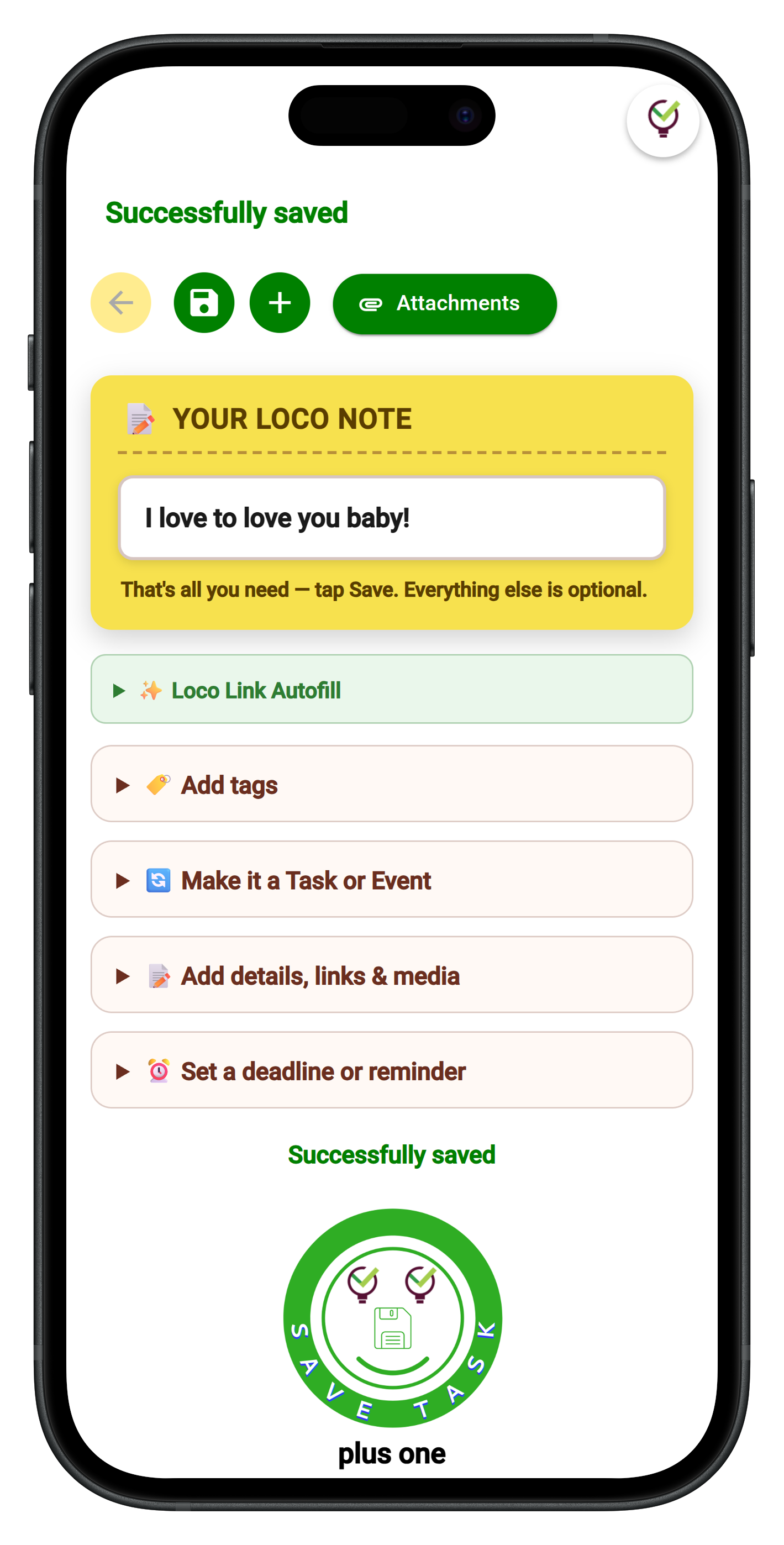
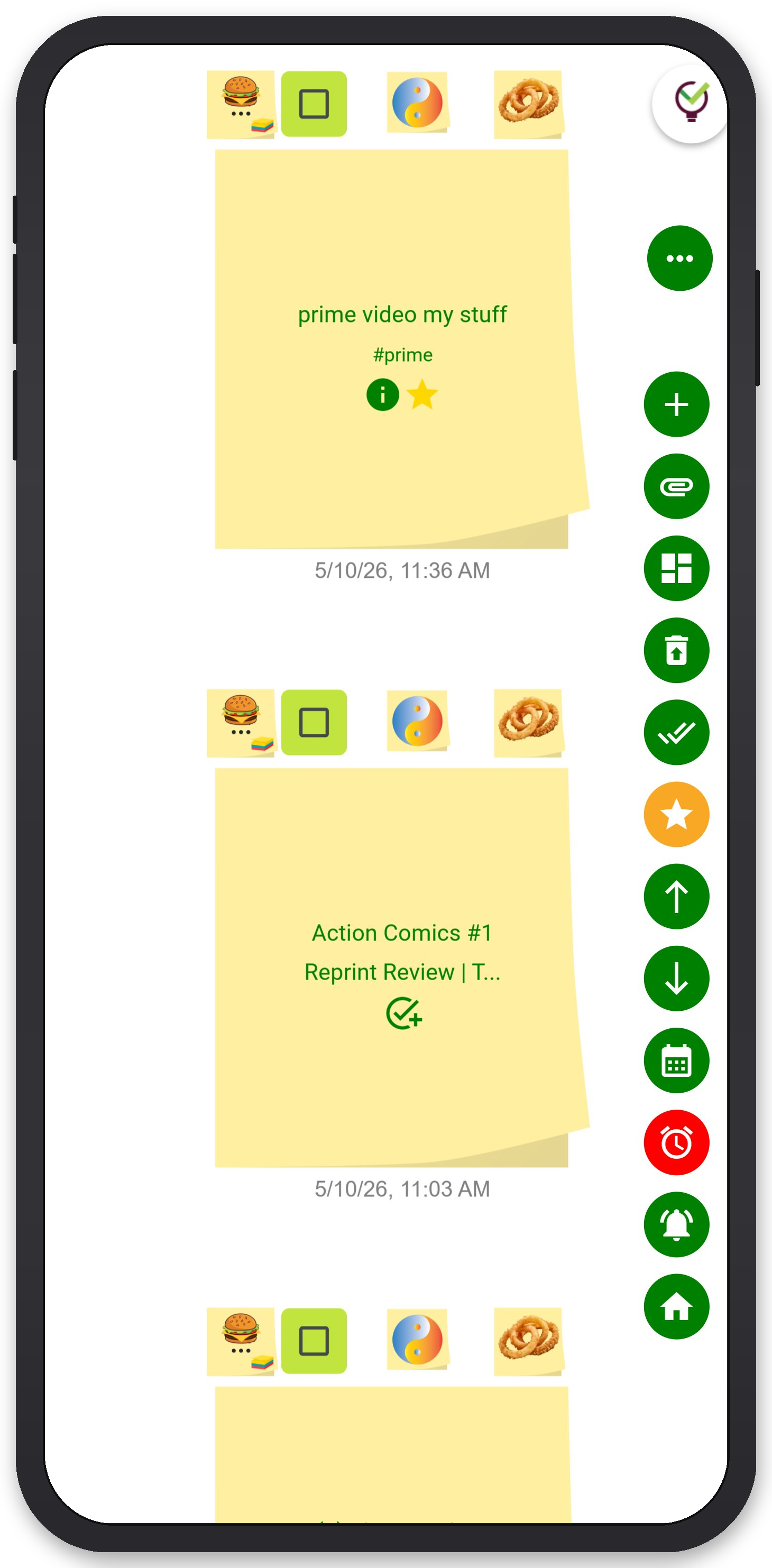
TaskLoco was built around sticky notes — a format that deliberately resists the urge to over-engineer. A sticky note is a unit of thought: one idea, one task, one reference. That constraint pushes you toward the kind of atomic note-taking that makes second brain systems actually retrievable, rather than giant walls of text you'll never re-read.
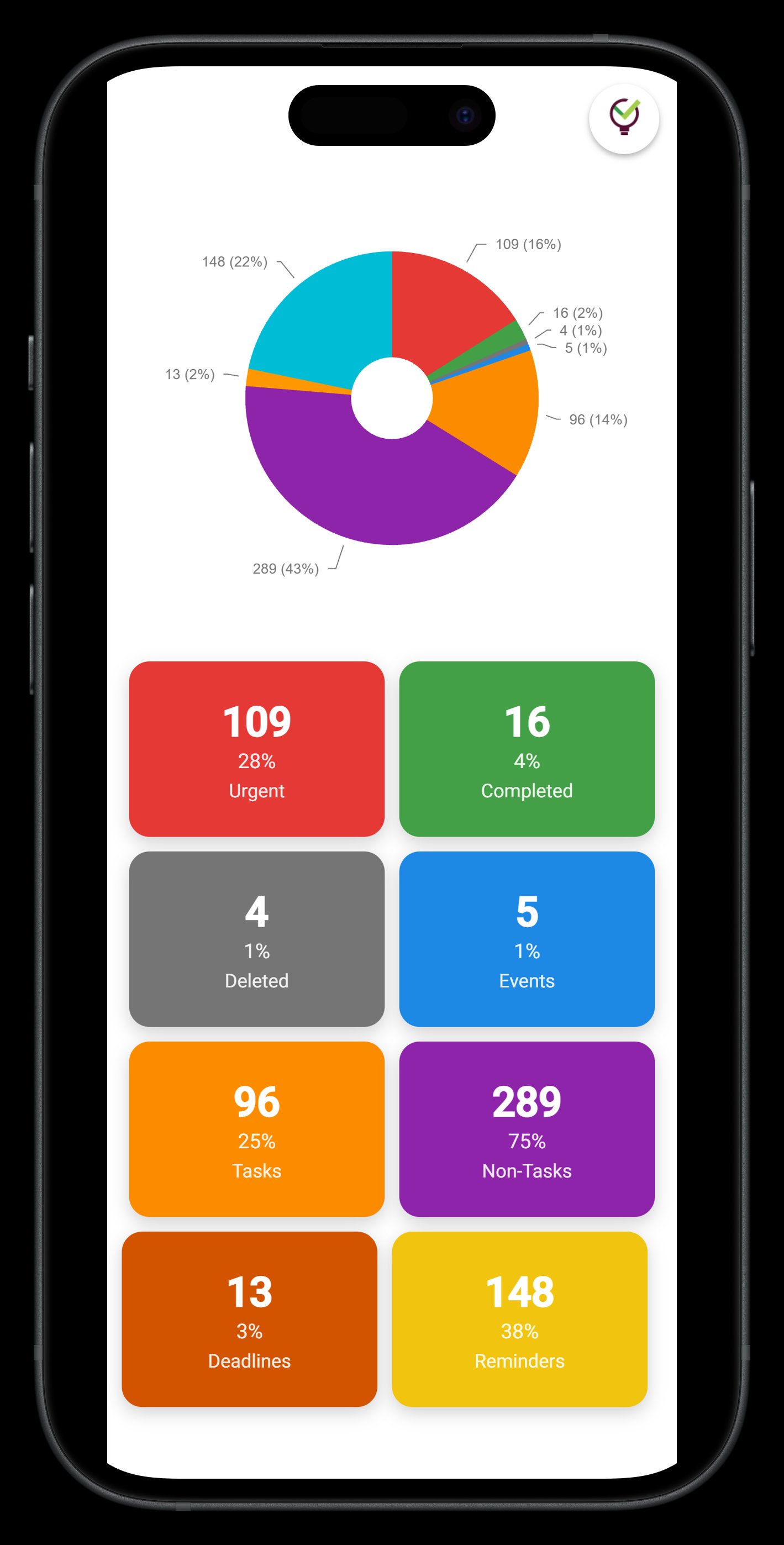
The free TaskLoco Lite Plus+ tier — available through the web app and the one-click Chrome extension — syncs up to 30 notes across all your devices and lets you capture any webpage instantly. That's a low-friction inbox that works on any device through your browser. When you need more — unlimited notes, file attachments (up to 10GB), a calendar view, push notification reminders that deep-link directly back to the original note, and team sharing — TaskLoco Premium adds all of it without changing the core metaphor. The system stays simple; the capacity expands.
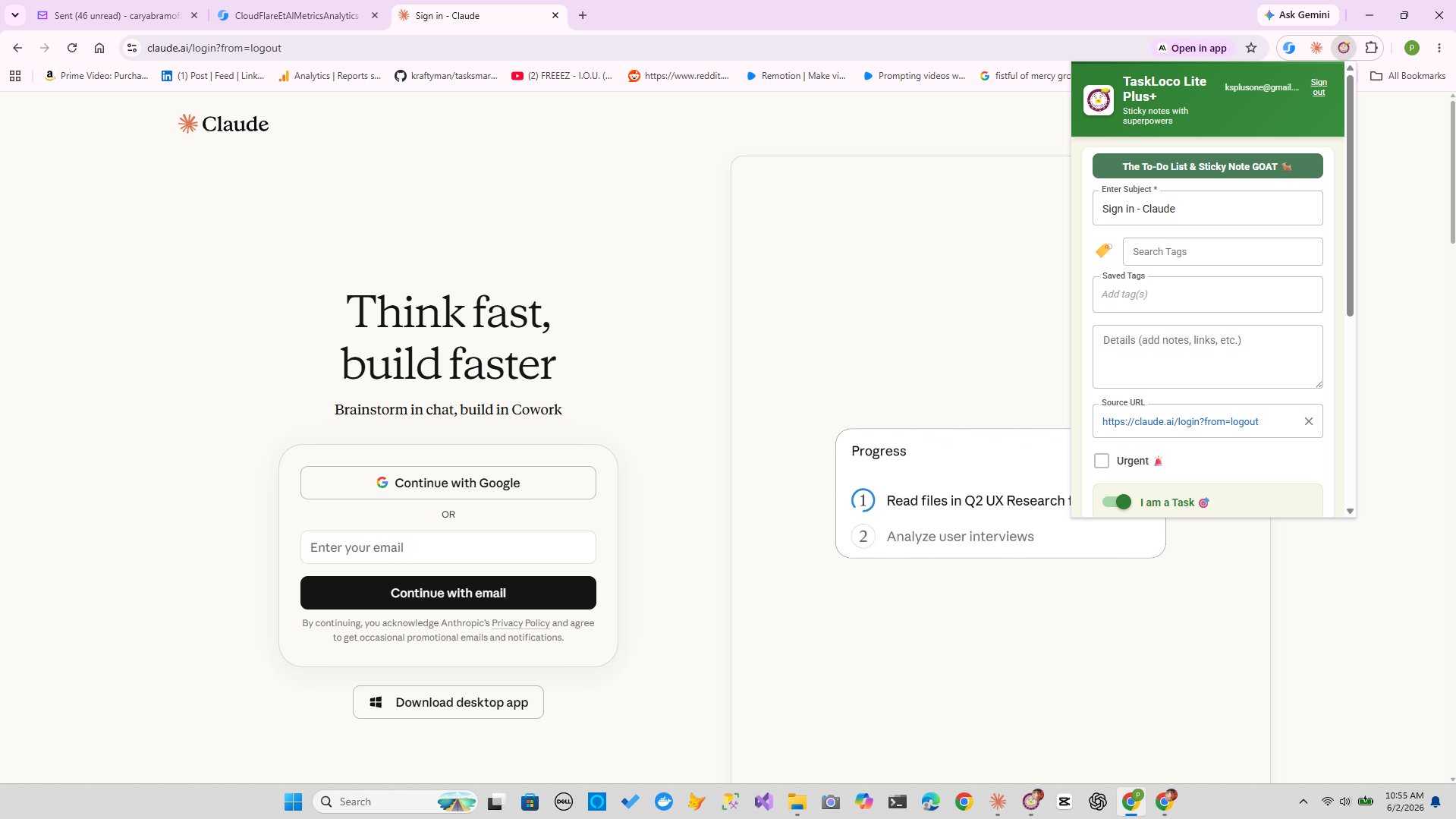
The Chrome extension in particular addresses one of the most common second brain failure points: the gap between 'I found something useful' and 'I captured it.' One click saves any webpage directly into your notes. No copy-pasting, no tab-switching, no formatting. That's the kind of friction reduction that makes the difference between a habit and a good intention.
TaskLoco doesn't do everything a second brain methodology might call for — it doesn't have Gantt charts, native project dependencies, or API access for deep integrations. If your system needs those, you'll want to supplement or use a different tool. But for the core loop — capture fast, organize simply, retrieve easily, get reminded when it matters — it fits the model without asking you to maintain the tool instead of your work.
TaskLoco Premium is regularly $9.99/month per person. Right now, charter members can lock in 50% off the regular price — forever. That means $4.99/month per person today. And if our price ever goes up, you still pay half. Always.
Code CHARTER50 auto-applies at checkout. First 500 spots only — once they're gone, this offer is gone permanently. Act fast while spots last.
Every Premium subscription includes unlimited notes, 10GB file storage, reminders, calendar, and team sharing. Each team member requires a separate subscription. 7-day free trial — no charge until day 8. Cancel anytime.
Free Options: TaskLoco
TaskLoco Lite
- Native iPhone & Android app
- Completely anonymous — no sign-in
- Data stays on your device
- Up to 20 notes
- Free forever
TaskLoco Lite Plus+
- Web app + Chrome extension
- Sign in with Google
- Wall syncs across all devices
- Up to 30 notes
- Free forever
Lock In 50% Off — Forever
7-day free trial. No charge until day 8. CHARTER50 auto-applies at checkout.
🔒 Lock In My Charter SpotSee TaskLoco in Action
Frequently Asked Questions
What exactly is a 'second brain' and where does the term come from?
A second brain is an external system — notes, files, tasks, references — that stores information your biological brain would otherwise have to hold in working memory. The term was popularized by productivity teacher Tiago Forte, whose book and course of the same name codified practices that thinkers from Leonardo da Vinci to Niklas Luhmann had used for centuries. The underlying science is cognitive load theory: when your brain doesn't have to remember something, it has more capacity to think about it.
What is the PARA method and do I have to use it?
PARA stands for Projects, Areas, Resources, and Archives — a four-category organizational structure Tiago Forte designed to be shallow enough to maintain. Projects are things with a deadline and an outcome. Areas are ongoing responsibilities with no end date. Resources are reference material you might use someday. Archives are inactive items from the other three. You don't have to use PARA — it's one framework, not a law. Many people use simpler structures or just rely on full-text search. The important thing is that your structure is consistent enough that you trust it.
Why do most people fail to maintain their second brain?
The most common cause is friction: when capturing information requires too many steps, people stop doing it. A system they don't use consistently can't be trusted, and a system they don't trust gets abandoned. The second most common cause is over-engineering — spending more energy on folder structures and tags than on actually capturing and using ideas. A second brain needs to be simple enough to use automatically, not a system that itself requires maintenance.
Does a second brain have to be digital, or can it be paper?
It can be either, and many serious practitioners use both. Paper is faster for raw capture and imposes no setup friction. Digital is better for retrieval, search, linking, and sharing. The Zettelkasten system Luhmann used was entirely paper — thousands of index cards in wooden boxes. The tradeoffs are real: paper can't be searched, linked, or synced; digital requires a device and a charged battery. Most people who maintain a long-term system use paper for quick capture and a digital tool for organization and retrieval.
What is progressive summarization?
Progressive summarization is a note-refinement technique associated with Tiago Forte. The idea is to capture roughly first, then improve notes in layers over time rather than trying to write the perfect note immediately. In practice: first pass is raw capture. Second pass, you bold the most important sentences. Third pass, you highlight the most important bolded sections. By the time a note is mature, you can understand its essence in seconds without re-reading everything. It mirrors how comprehension actually deepens — through repeated exposure and reflection, not in a single sitting.
How is a second brain different from just keeping notes?
The difference is intentionality and retrievability. Most people keep notes — meeting notes, to-do lists, random ideas — but those notes are rarely organized to be found again, connected to related information, or actively used. A second brain is designed around retrieval and use, not just storage. Notes link to each other. You review them regularly. Material you capture eventually becomes output — a decision made, a document written, a project completed. If nothing ever comes back out of your notes, you have a storage system, not a second brain.
Can TaskLoco work as a second brain tool?
TaskLoco's sticky-note model fits the atomic note-taking principle well — each note is a unit of thought rather than a sprawling document. The Chrome extension captures webpages in one click, which addresses the single biggest friction point in most capture workflows. Premium adds unlimited notes, 10GB of file attachments, a calendar view, and push notification reminders that deep-link back to the original note. It doesn't replace a full knowledge management setup for highly complex systems, but for the core second brain loop — capture fast, organize simply, get reminded, retrieve easily — it handles the job without requiring you to maintain the tool itself. $9.99/month per person (currently $4.99/month per person for first 500 charter members with code CHARTER50)
Born in Brooklyn. Powered by AWS. Your data stays yours.
TaskLoco is available on iPhone, Android, Chrome, and every web browser.