Free AI tools have gone from novelty to genuine work accelerators in a remarkably short time. You can draft a legal summary, generate a product image, debug a script, and summarize a 40-page report — all before lunch, all without spending a dollar. The tools are real, they're powerful, and most of the best ones have a free tier worth using every single day.
But here's the problem nobody talks about: AI tools generate output. They don't organize it. You get a brilliant draft, a generated image, a research summary — and then it lives in a browser tab, a downloads folder, or a chat history you'll never find again. The tools that win are the ones paired with a workspace that captures, stores, and reminds you to act on what you've created. That's where this guide goes beyond a simple list.
What to Look for in a Free AI Tool
Not all free AI tools are created equal. Some are genuinely free with meaningful limits. Others are loss-leader trials that cut off exactly when you need them most. Before you commit your workflow to any tool, three criteria actually matter.
1. Output quality on free tier. Some tools reserve their best models for paid plans. The free tier gives you a degraded experience designed to frustrate you into upgrading. The tools worth using are the ones where the free tier is legitimately useful for real work — not a crippled demo.
2. Data and privacy policy. If you're pasting client proposals, internal documents, or proprietary research into an AI tool, you need to know whether that content is used to train future models. Read the privacy policy. Reputable tools make this clear. Tools that don't are a risk you shouldn't take with sensitive work.
3. Output you can actually use. The best AI tools produce output in formats you can export, copy, store, and act on. A tool that locks its output behind a premium wall, watermarks every image, or won't let you download results without a subscription is not a free tool — it's a demo.
The Best Free AI Tools by Category
These are tools with genuinely usable free tiers — not trials dressed up as free plans. Each category represents a different kind of work AI has made dramatically faster.
Writing and text generation: ChatGPT (OpenAI) remains the most versatile free writing assistant available. The free tier runs on a capable model and handles drafting, editing, summarizing, and rewriting with impressive consistency. Claude by Anthropic is the strongest alternative — particularly good at nuanced writing, long documents, and following complex instructions. Both are genuinely free for everyday writing tasks.
Image generation: Adobe Firefly offers a meaningful free tier with commercially safe images — meaning you can use what it generates in client work without licensing anxiety. Microsoft Designer (powered by DALL-E) is free with a Microsoft account and produces high-quality images from text prompts. Canva's AI image generator is built directly into its free design tier, which makes it the fastest option if you're already designing there.
Research and summarization: Perplexity AI is the standout here. It answers questions with cited sources, which makes it vastly more useful than a standard chatbot for research. The free tier is generous and the citations alone make it worth bookmarking. Google NotebookLM lets you upload your own documents and have an AI reason over them — genuinely useful for long-form research and synthesis.
Code assistance: GitHub Copilot has a free tier for individual developers. It's context-aware, lives inside your editor, and handles boilerplate, debugging, and documentation faster than anything else in this category. For one-off code tasks without an IDE, ChatGPT and Claude both handle code well on their free tiers.
Audio and video: Otter.ai transcribes meetings and audio files with a solid free tier — 300 minutes per month of transcription, which covers most use cases. ElevenLabs offers free text-to-speech with a character limit that's enough for short-form audio content and prototyping.
The Missing Layer: Capturing What AI Generates
Here's what happens to most people's AI workflow: they generate something useful, copy it into a document or email, and move on. Two weeks later they're trying to recreate the same output from scratch because they can't find the original. Or they generate a research summary and forget to follow up on the three action items buried inside it.
The problem isn't the AI tools. The problem is that AI tools are generation engines, not organizational systems. Every output needs a destination — a note, a task, a reminder, a file store — or it disappears into the noise.
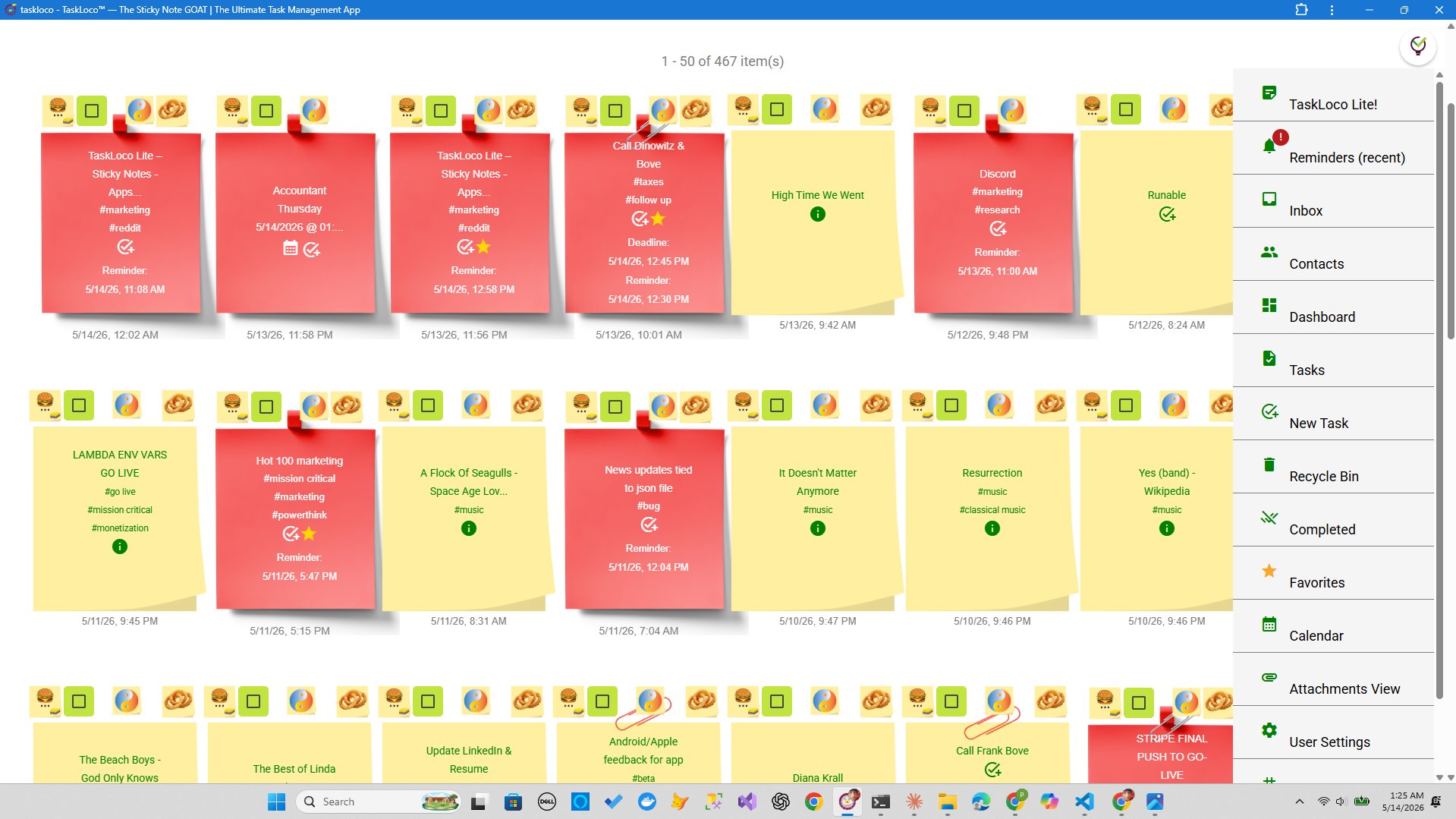
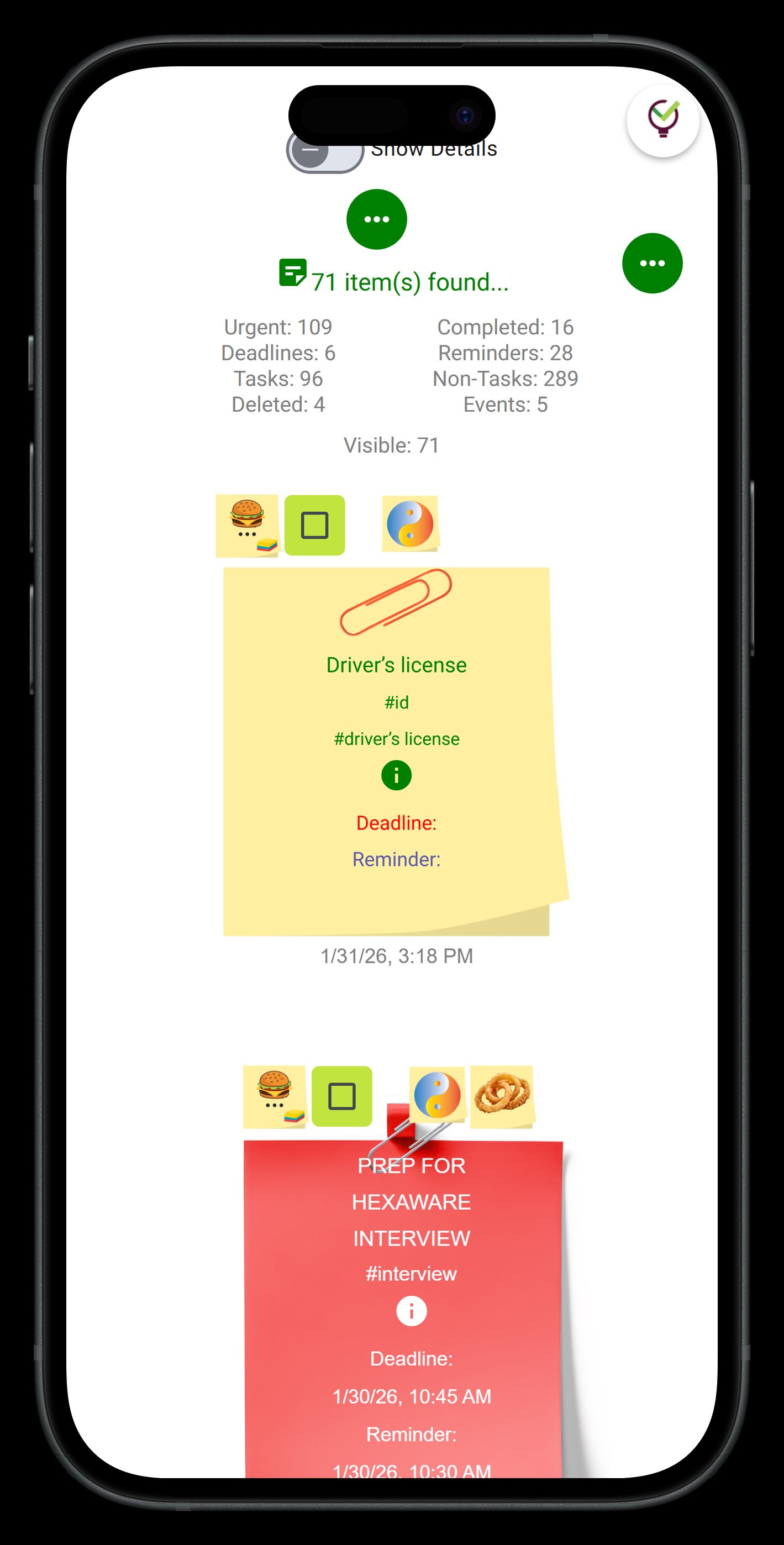
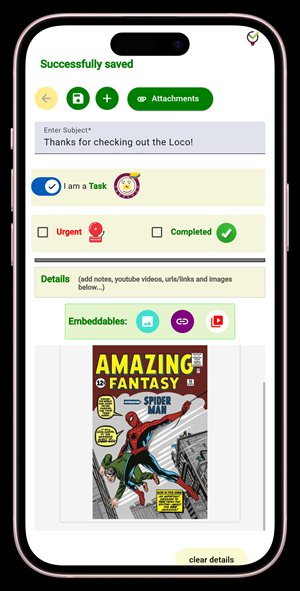
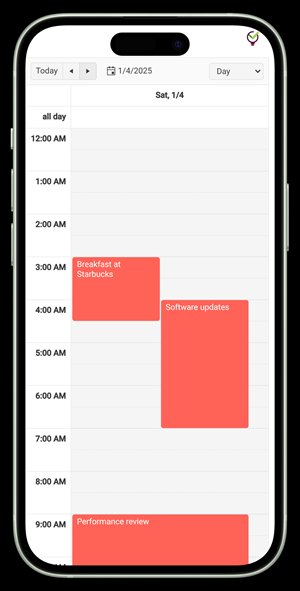
TaskLoco Premium is built exactly for this. When you generate content with any AI tool, you capture it as a note. That note can hold the full text, an attached file (with 10GB storage included), and a reminder that fires as a push notification directly to your phone or computer — and when you tap that notification, it deep-links straight back to the original note. No hunting. No context switching. The work is right there.
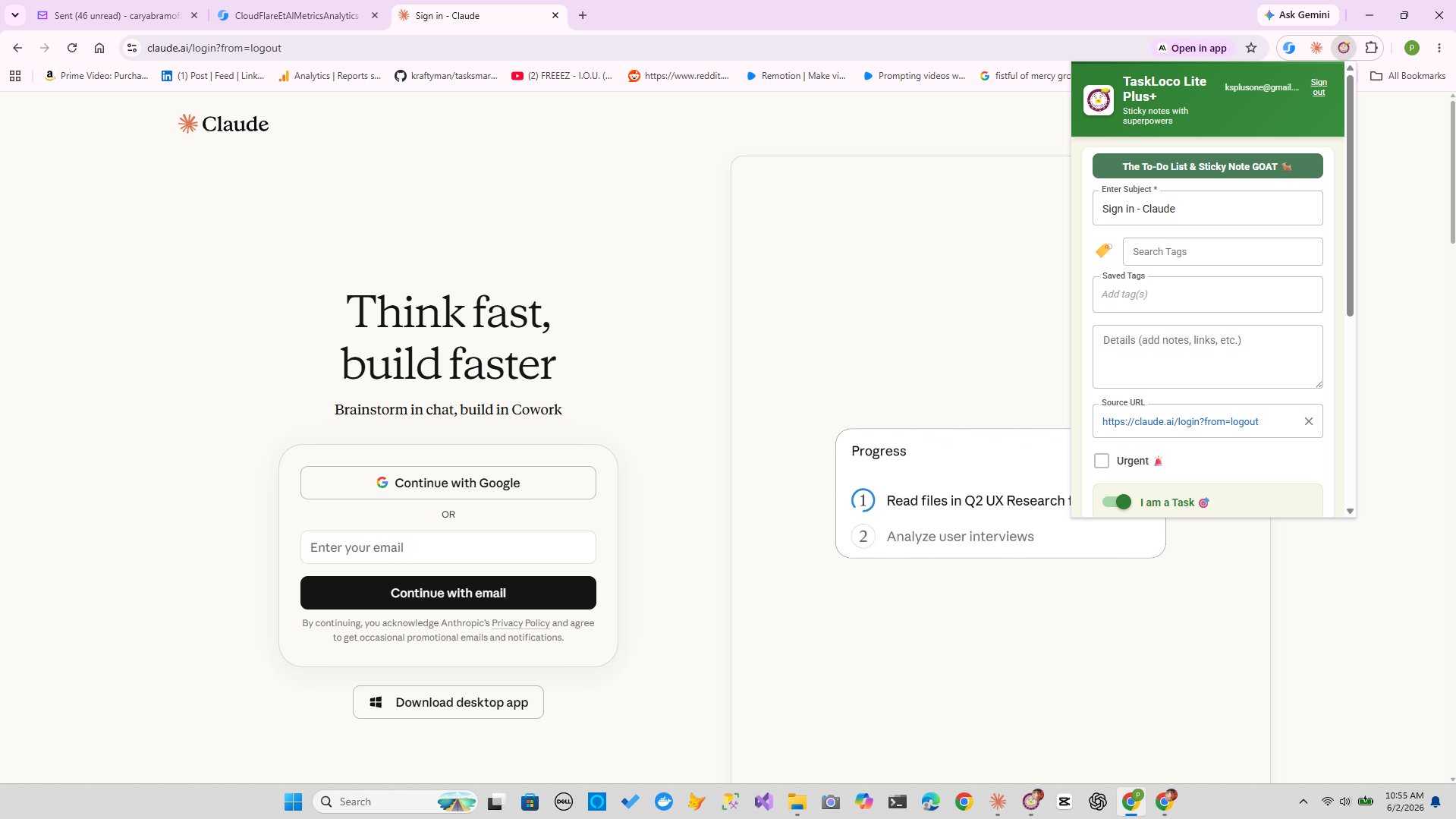
The Chrome extension is particularly useful here. One click on any page — including the output page of an AI tool — captures it as a note. If you've generated something worth keeping in ChatGPT, Claude, Perplexity, or anywhere else in your browser, you don't have to copy and paste. You capture it, tag it, and move on.
For teams, TaskLoco's sharing works the way email does — you share a note and the recipient can clone it and make it their own. No permissions to configure, no access levels to manage. If your team is using AI tools to generate briefs, research summaries, or content drafts, shared notes mean everyone works from the same source without version confusion.
Building an AI Workflow That Actually Works
The people who get real leverage from free AI tools aren't the ones who use the most tools. They're the ones who've built a repeatable system around a small set of tools they understand well.
A practical stack looks like this: Perplexity for research, ChatGPT or Claude for writing and editing, Adobe Firefly or Canva for visuals, Otter.ai for meeting transcription, and TaskLoco as the capture and action layer that ties everything together. Each tool does one thing well. TaskLoco makes sure none of it gets lost.
The specific workflow: when you finish a research session in Perplexity, use the Chrome extension to capture the key findings as a note. Add a reminder — delivered as a push notification — to review them before your next relevant meeting. If there's a file to attach (a downloaded report, a generated image, an audio transcript), attach it directly to the note. When you share findings with a collaborator, share the note directly. They clone it, add their own context, and you both stay aligned without a chain of forwarded emails.
This isn't a complicated system. It's a habit: generate, capture, remind, act. The AI tools handle generation. TaskLoco handles everything after.
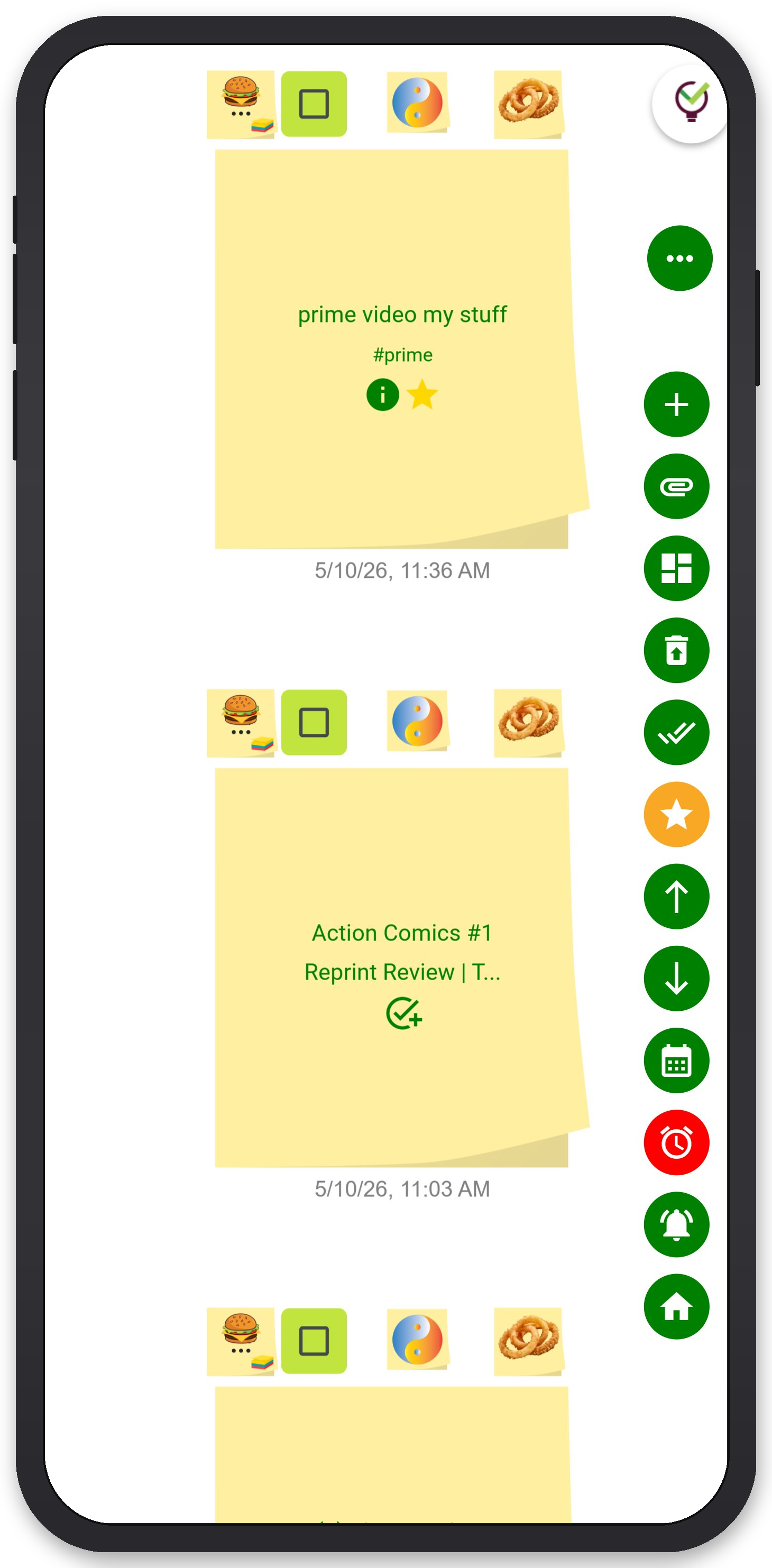
TaskLoco Premium is regularly $9.99/month per person. Right now, charter members can lock in 50% off the regular price — forever. That means $4.99/month per person today. And if our price ever goes up, you still pay half. Always.
Code CHARTER50 auto-applies at checkout. First 500 spots only — once they're gone, this offer is gone permanently. Act fast while spots last.
Every Premium subscription includes unlimited notes, 10GB file storage, reminders, calendar, and team sharing. Each team member requires a separate subscription. 7-day free trial — no charge until day 8. Cancel anytime.
Free Options: TaskLoco
TaskLoco Lite
- Native iPhone & Android app
- Completely anonymous — no sign-in
- Data stays on your device
- Up to 20 notes
- Free forever
TaskLoco Lite Plus+
- Web app + Chrome extension
- Sign in with Google
- Wall syncs across all devices
- Up to 30 notes
- Free forever
Lock In 50% Off — Forever
7-day free trial. No charge until day 8. CHARTER50 auto-applies at checkout.
🔒 Lock In My Charter SpotSee TaskLoco in Action
Frequently Asked Questions
What is the best free AI tool for writing?
ChatGPT and Claude are the strongest free options for writing. Both handle drafting, editing, summarizing, and rewriting on their free tiers without significant quality degradation. Claude tends to follow complex instructions more precisely; ChatGPT has a broader plugin and integration ecosystem. For most writing tasks, either will outperform what you'd get from a dedicated writing app's built-in AI feature.
Are free AI tools actually free, or do they have hidden limits?
Most reputable free AI tools are genuinely free within defined limits — usage caps, message limits, image quotas, or access to older model versions. The ones to be careful about are tools that call themselves free but watermark all output, block export behind a paywall, or use your content to train models without disclosure. Always read the terms. The tools listed in this guide — ChatGPT, Claude, Perplexity, Adobe Firefly, Otter.ai — have transparent free tiers with real, usable functionality.
How do I organize and save the output from AI tools?
This is the most underrated problem in AI workflows. AI tools generate fast, but they don't organize anything. The most effective approach is a dedicated capture workspace — like TaskLoco Premium — where AI-generated content lands as a note with an attached file if needed, a reminder that fires as a push notification and deep-links back to the original note, and optional sharing with collaborators. The TaskLoco Chrome extension captures any browser page in one click, which means you never have to manually copy-paste output from a web-based AI tool.
Can I use free AI tools for commercial work?
It depends on the tool and the type of output. For text, most tools allow commercial use of generated content on free tiers, but you should verify the specific terms. For images, Adobe Firefly is explicitly designed for commercial use — its training data is licensed, which means the output is safe for client work. DALL-E via Microsoft Designer also permits commercial use. Always check the specific tool's terms of service before using AI-generated content in commercial projects.
What is the best free AI tool for research?
Perplexity AI is the strongest free research tool available. Unlike standard chatbots, it answers with cited sources — so you can verify claims, follow citations, and build on real information rather than AI-generated summaries that may be inaccurate. Google NotebookLM is the best option when you have your own documents to analyze: upload a PDF or research paper and ask questions directly against that source material.
How does TaskLoco fit into an AI tool workflow?
TaskLoco acts as the organizational layer that AI tools lack. When you generate something useful — a draft, a research summary, an image, a transcript — you capture it as a TaskLoco note using the Chrome extension or by pasting directly. You can attach files (10GB storage with Premium), set a reminder that fires as a push notification and deep-links straight back to the note, and share with teammates who can clone the note and make it their own. The result is that AI-generated work actually gets acted on instead of disappearing into a browser tab. $9.99/month per person (currently $4.99/month per person for first 500 charter members with code CHARTER50)
Is there a free version of TaskLoco?
Yes — two of them. TaskLoco Lite is a native iPhone and Android app that's completely anonymous, requires no sign-in, and stores up to 20 notes locally on your device. TaskLoco Lite Plus+ is a free web app and Chrome extension that syncs up to 30 notes across all your devices when you sign in with Google — the Chrome extension lets you capture any webpage in one click. For unlimited notes, file attachments, reminders with push notifications, calendar view, and team sharing, TaskLoco Premium adds all of that with a 7-day free trial. $9.99/month per person (currently $4.99/month per person for first 500 charter members with code CHARTER50)
Born in Brooklyn. Powered by AWS. Your data stays yours.
TaskLoco is available on iPhone, Android, Chrome, and every web browser.