Every semester, students waste hours hunting for AI tools that are free, actually useful, and won't disappear behind a paywall the moment they get good. The real problem isn't finding one great AI tool — it's that the best ones are scattered across a dozen tabs, and nothing ties them together into a workflow that survives finals week.
This guide covers the free AI tools worth your time across writing, research, math, and productivity — then shows how TaskLoco acts as the connective tissue: a note-taking and task hub where everything you produce with AI has a place to live, a reminder attached to it, and files stored alongside it. No more copying outputs into random Google Docs you'll never find again.
What to Look for in a Free AI Tool for Students
Before downloading anything, it helps to know what separates a genuinely useful student AI tool from one that looks impressive in a demo and fails you at 11pm before a deadline. There are really only three criteria that matter.
1. Does it solve a real academic problem? Writing assistance, research summarization, math step-by-step solving, and citation generation are the four pillars of student AI. A tool that does one of these exceptionally well is worth keeping. A tool that claims to do all four mediocrely is usually worth skipping.
2. Is the free tier actually functional — not just a teaser? Many AI tools offer a free plan that limits you to five queries a day or cuts off access to the model that actually works. Look for tools where the free tier covers your core use case without a usage cap that kicks in mid-assignment.
3. Can you trust the output enough to act on it? For writing tools, that means checking whether the AI hallucinates citations or fabricates quotes. For math tools, it means verifying step-by-step reasoning rather than just a final answer. For research tools, it means confirming that summaries link back to real, checkable sources. The best free AI tools are honest about their limitations — and the best students double-check anyway.
The Best Free AI Tools by Category
Here's a category-by-category breakdown of the free AI tools that actually hold up under real academic pressure — not just in marketing screenshots.
Writing & Editing
- ChatGPT (free tier) — Still the most versatile writing assistant available for free. Best for drafting outlines, rewriting awkward sentences, and brainstorming thesis angles. The free tier runs on a capable model with no daily cap on standard usage. Caveat: never submit AI-generated text as your own work — use it to think, not to replace thinking.
- Grammarly (free tier) — The free plan catches grammar, spelling, and basic clarity issues. The AI suggestions on the paid tier are better, but the free grammar engine alone is worth having in your browser.
- QuillBot (free tier) — Paraphrasing and summarizing tool with a free tier that covers most student use cases. Useful for rewriting dense academic text into something readable, or for checking whether your own writing is too close to a source.
Research & Summarization
- Perplexity AI (free tier) — Answers research questions with cited sources in real time. Unlike ChatGPT, Perplexity links to actual web pages, which makes fact-checking faster. The free tier is generous and the interface is clean.
- Consensus (free tier) — Searches peer-reviewed papers and summarizes findings. If you're writing anything that needs academic citations, Consensus saves hours of database hunting. Free tier has monthly search limits but covers most light research needs.
- Elicit (free tier) — Similar to Consensus but stronger at extracting specific data points from papers. Useful for literature reviews and methodology comparisons.
Math & STEM
- Wolfram Alpha (free tier) — The gold standard for mathematical computation, equation solving, and STEM problem-checking. The free tier shows results and basic steps for most problems. Step-by-step solutions require a paid plan, but the answer-plus-graph view is often enough to verify your work.
- Photomath (free) — Point your phone camera at a handwritten math problem and get a solution. The free tier includes basic step-by-step reasoning. Best for algebra through calculus.
Note-Taking & Organization
- TaskLoco — Not an AI tool itself, but the missing piece in every student AI workflow. More on this below.
Why Every AI Workflow Needs a Central Hub — and How TaskLoco Fills That Role
Here's the pattern that kills student productivity: you get a great outline from ChatGPT, copy it somewhere temporary, run a search on Perplexity, save the links in a browser tab, solve a problem with Wolfram, screenshot the answer, and by the time your assignment is due, you're hunting across five apps and a camera roll to find what you produced two days ago.
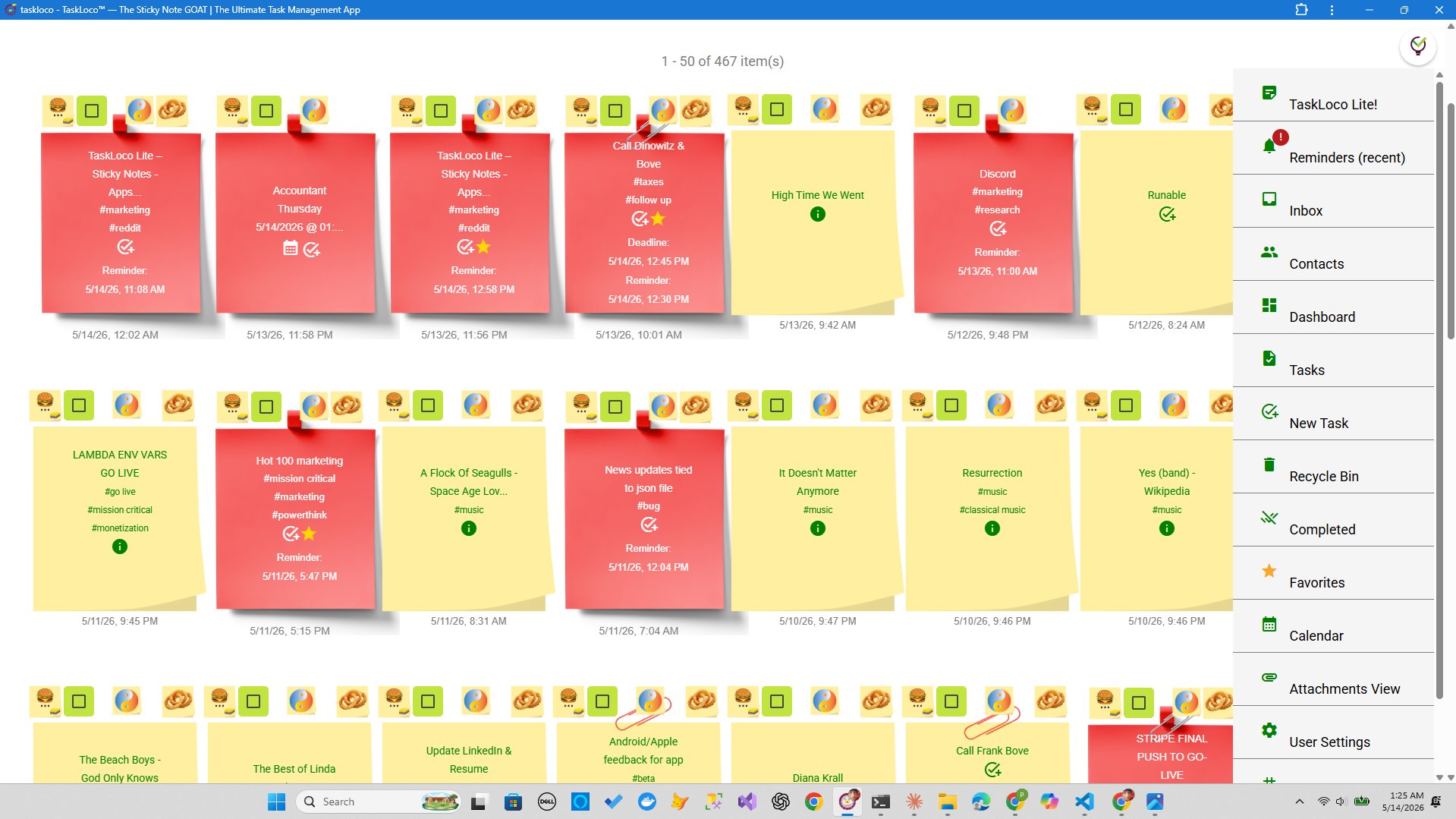
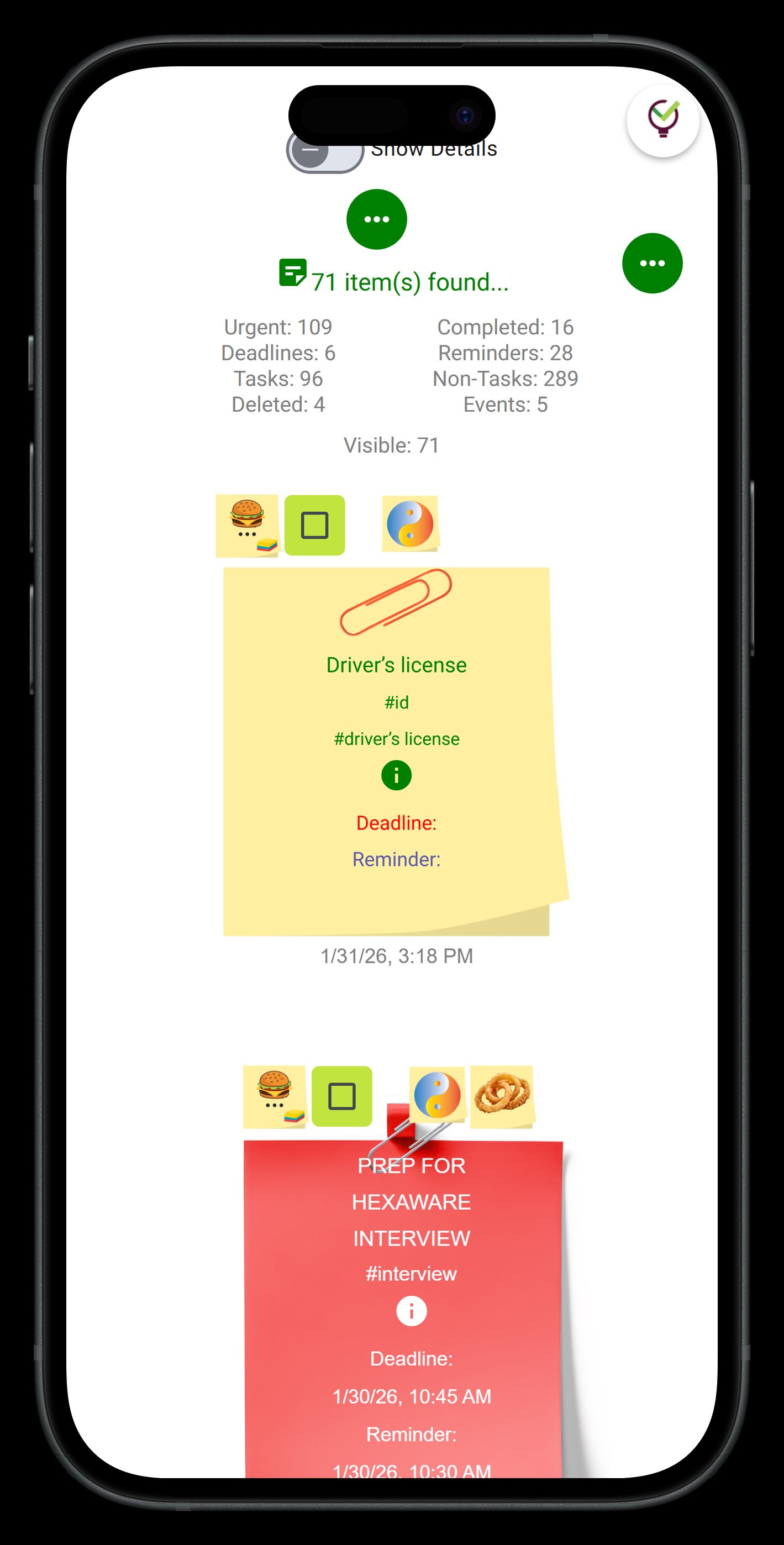
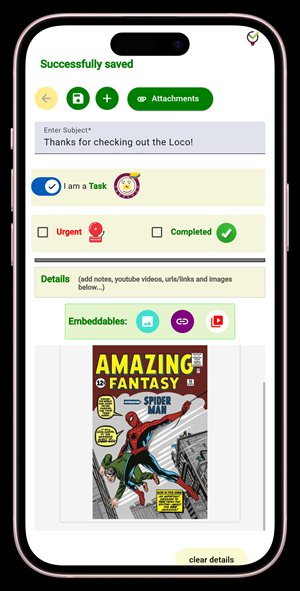
TaskLoco is where that chaos stops. It's a note-taking and task management app built around sticky notes — fast to create, easy to organize, and designed to hold everything from a one-line task to a full research dump with attached files.
For students, the key Premium features are:
- Unlimited notes — One note per paper, one note per class, one note per AI conversation you want to save. No cap, no archiving required.
- 10GB file storage — Attach PDFs, screenshots, exported AI outputs, or lecture slides directly to the note they belong to. Not in a separate folder. Not in a cloud drive you have to navigate separately. Right there, on the note.
- Reminders with push notifications — Set a reminder on any note and get a push notification delivered to your phone and computer. That notification deep-links directly back to the original note — so when your phone buzzes the night before a paper is due, one tap takes you straight to your outline, sources, and attached files. Optional email and SMS notifications are also available.
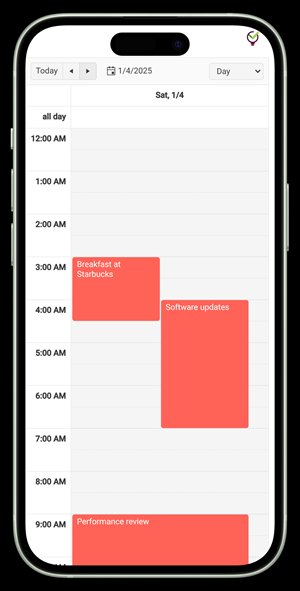
- Calendar view — See all your deadlines in a calendar layout. Every note with a reminder appears here, so you can see your entire semester's workload at a glance.
- Team sharing — Share notes with study group members. Recipients can clone the shared note and make it their own — no permissions system, no access levels to manage. It works like forwarding an email, except the recipient gets a fully editable copy of your note, tasks, and attached files.
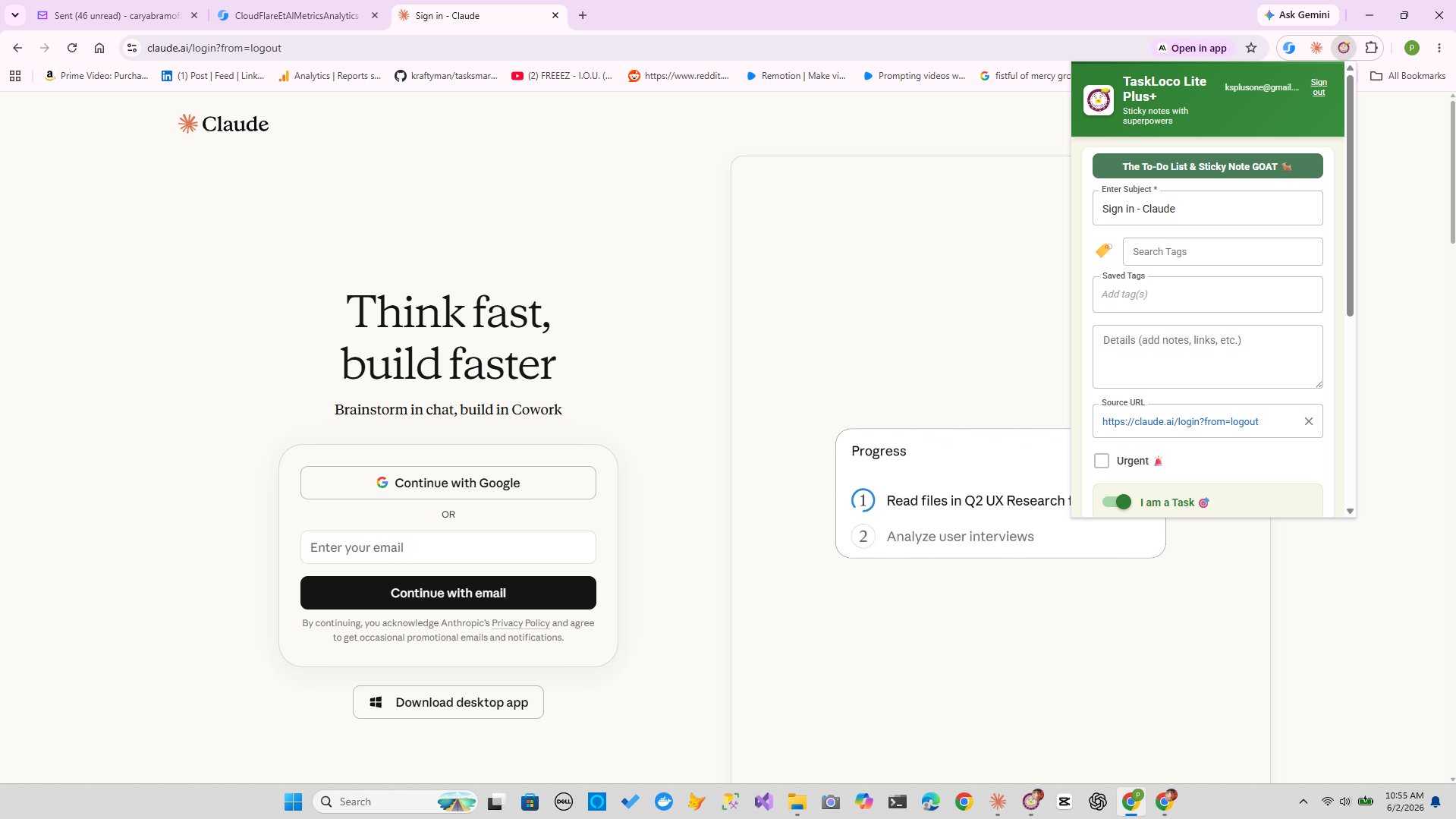
TaskLoco Lite Plus+ is free and syncs across all your devices — your notes on your phone's browser match your notes on your laptop. The Chrome extension lets you capture any webpage — a Perplexity result, a Consensus paper summary, a ChatGPT conversation — in one click, saved as a note instantly. For students who want reminders, file attachments, and unlimited notes, Premium is the upgrade worth considering.
Building a Student AI Workflow That Actually Holds Together
The tools above are only as useful as the system you wrap around them. Here's a practical workflow that uses free AI tools effectively and keeps TaskLoco at the center.
Step 1: Start every assignment with a TaskLoco note. Title it with the assignment name and due date. Set a reminder. That reminder will fire as a push notification and deep-link you back to this note — so even if you forget about it for a week, you'll land exactly where you left off.
Step 2: Use AI tools for their specific strengths. Perplexity for initial research, Consensus for academic source validation, ChatGPT for outlining and drafting, Wolfram or Photomath for STEM problem verification. Don't use one tool for everything — use the right tool for each job.
Step 3: Capture everything into TaskLoco. Use the Chrome extension to clip Perplexity results. Paste ChatGPT outlines into notes. Attach downloaded PDFs directly to the assignment note. Screenshot Wolfram solutions and attach them. Everything stays in one place, tied to the task it belongs to.
Step 4: Share with your study group through TaskLoco. If you're working collaboratively, share the note. Your groupmates get their own editable copy — no shared document permissions to manage, no version control headaches. Everyone works from the same starting point and customizes their own copy.
Step 5: Review your calendar view before each week starts. TaskLoco's calendar shows every reminder you've set. A five-minute Sunday review tells you what's due, what has materials attached, and where you're behind before the week starts rather than during it.
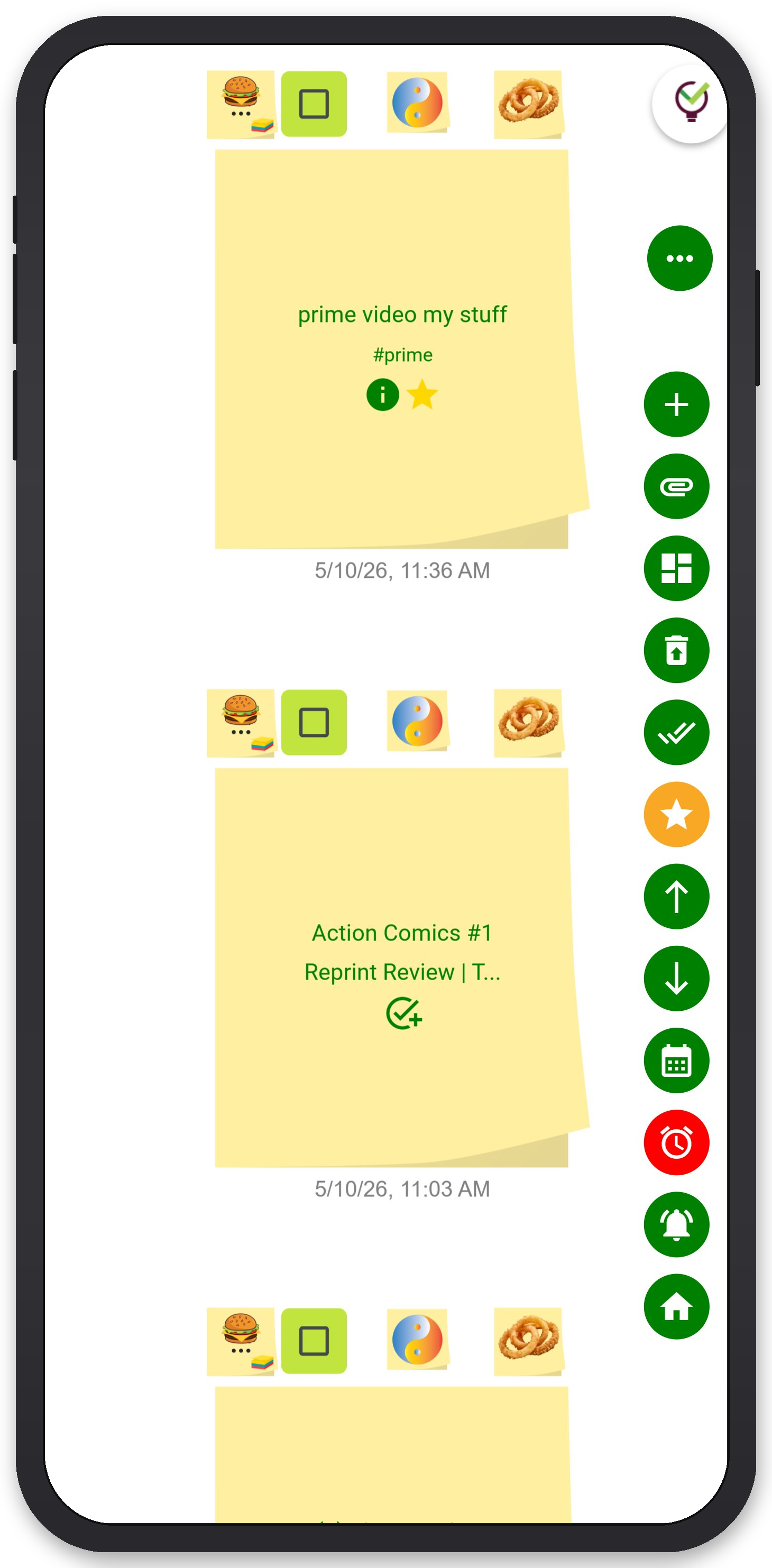
TaskLoco Premium is regularly $9.99/month per person. Right now, charter members can lock in 50% off the regular price — forever. That means $4.99/month per person today. And if our price ever goes up, you still pay half. Always.
Code CHARTER50 auto-applies at checkout. First 500 spots only — once they're gone, this offer is gone permanently. Act fast while spots last.
Every Premium subscription includes unlimited notes, 10GB file storage, reminders, calendar, and team sharing. Each team member requires a separate subscription. 7-day free trial — no charge until day 8. Cancel anytime.
Free Options: TaskLoco
TaskLoco Lite
- Native iPhone & Android app
- Completely anonymous — no sign-in
- Data stays on your device
- Up to 20 notes
- Free forever
TaskLoco Lite Plus+
- Web app + Chrome extension
- Sign in with Google
- Wall syncs across all devices
- Up to 30 notes
- Free forever
Lock In 50% Off — Forever
7-day free trial. No charge until day 8. CHARTER50 auto-applies at checkout.
🔒 Lock In My Charter SpotSee TaskLoco in Action
Frequently Asked Questions
What is the best free AI tool for students overall?
There's no single best tool — the answer depends on what you're working on. For writing assistance, ChatGPT's free tier is the most versatile. For research with real citations, Perplexity AI is stronger. For academic papers specifically, Consensus pulls from peer-reviewed sources. For math and STEM, Wolfram Alpha and Photomath are the most reliable. The smartest approach is to use each tool for what it does best, then capture everything into a central note-taking hub like TaskLoco so nothing gets lost between tools.
Is TaskLoco free for students?
Yes — TaskLoco has two free tiers. TaskLoco Lite is a native iPhone and Android app: completely anonymous, no sign-in required, stores up to 20 notes on your device. TaskLoco Lite Plus+ is a web app and Chrome extension: free, sign in with Google, syncs up to 30 notes across all your devices. The Chrome extension lets you capture any webpage — AI results, research summaries, anything — in one click. For reminders, file attachments (10GB), unlimited notes, and calendar view, TaskLoco Premium is the upgrade. $9.99/month per person (currently $4.99/month per person for first 500 charter members with code CHARTER50)
Can AI tools help students without getting them in trouble for academic dishonesty?
Yes, when used correctly. The key distinction is using AI as a thinking tool rather than a writing replacement. Using Perplexity to find sources, Consensus to validate them, and Wolfram to check your math is no different from using a search engine — these tools augment your research, not your submitted work. Using ChatGPT to generate an outline you then write from is legitimate. Submitting AI-generated paragraphs as your own writing is where most academic policies draw the line. Always check your institution's specific AI policy, which varies significantly across schools and courses.
How does the TaskLoco Chrome extension help with AI research tools?
The Chrome extension captures any webpage into a TaskLoco note in one click. When you're working in Perplexity, Consensus, or reviewing a ChatGPT conversation, you can save the entire page directly to a note without copying and pasting. That note then lives alongside your other assignment materials, can have a reminder attached, and can hold file attachments. It's the fastest way to prevent good research from disappearing into a forgotten browser tab.
What free AI tools are best for writing essays?
ChatGPT (free tier) is the most flexible for drafting outlines, rewriting sentences, and brainstorming arguments. QuillBot's free tier is strong for paraphrasing and checking whether your writing is too close to a source. Grammarly's free tier handles grammar and clarity. None of these should write your essay for you — but all three can make the writing process faster, cleaner, and less frustrating when used as thinking partners rather than ghostwriters.
Do AI research tools like Perplexity actually cite real sources?
Perplexity AI links to real web pages for its answers, which makes it more reliable than tools that generate citations without linking to sources. Consensus goes further by pulling specifically from peer-reviewed academic papers. That said, no AI tool is infallible — always click through to the actual source and verify the claim before including it in academic work. AI tools speed up the research process; they don't replace the judgment required to evaluate sources critically.
How do TaskLoco reminders work for student deadlines?
When you set a reminder on a TaskLoco note, it fires as a push notification to your phone and computer. That notification deep-links directly back to the original note — so tapping it takes you straight to your outline, attached files, and task list for that assignment. Optional email and SMS notifications are also available. It's a meaningful difference from reminder tools that just buzz at you with a generic alert and leave you hunting for context.
Born in Brooklyn. Powered by AWS. Your data stays yours.
TaskLoco is available on iPhone, Android, Chrome, and every web browser.