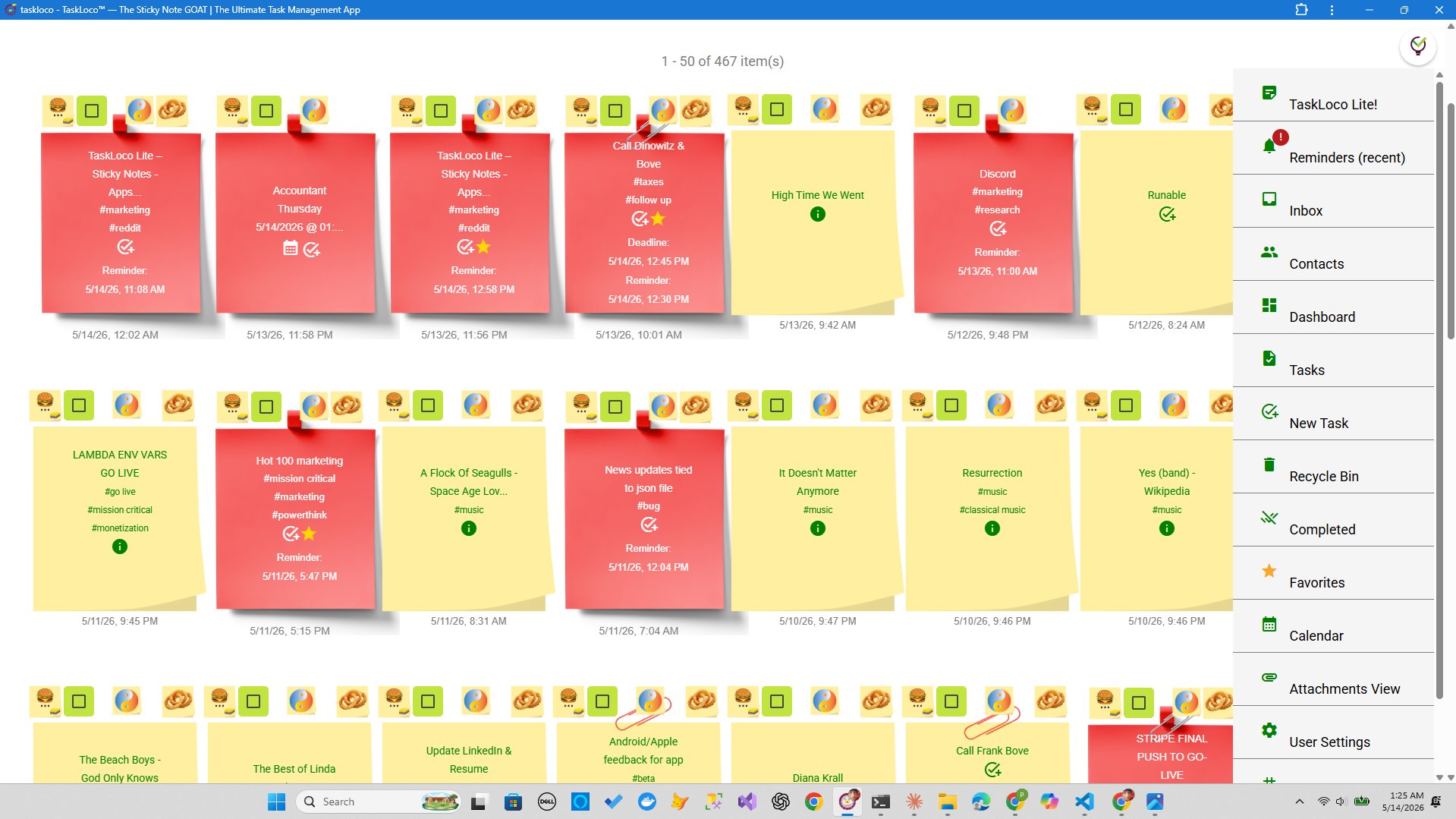
The gap between a great plan and a completed plan is usually not creativity — it's capture. ChatGPT can draft a flawless weekly schedule, a project breakdown, a list of priorities for Q3, or a daily routine in under thirty seconds. But then what? You copy it into a doc, a spreadsheet, a chat thread, or nowhere at all, and by Wednesday it's gone.
This article gives you the actual prompts that produce useful, actionable output — not vague inspiration, but structured plans you can work from immediately. It also shows you how to take that output directly into TaskLoco, where it becomes a living set of notes, tasks, and reminders instead of a dead block of text in a closed browser tab.
What makes a productivity prompt actually work
Most people's first instinct is to type something like "help me be more productive." The result is a wall of generic advice that could apply to anyone on earth. Useful prompts do the opposite — they constrain the model so the output fits your specific situation.
Three things separate a prompt that generates a working plan from one that generates filler:
- Context about your role or situation. "I'm a freelance designer with three active clients and a four-hour focused work window each morning" produces a completely different output than "I have a lot of work to do."
- A specific output format. Ask for a numbered list, a table, a daily time-block schedule, or a set of sticky-note-sized tasks. If you don't specify format, ChatGPT defaults to paragraphs that are hard to act on.
- A real constraint. Deadlines, energy levels, team dependencies, available hours. Constraints force the model to make trade-offs, which is exactly what planning is.
Keep those three rules in mind as you use the prompts below. Swap in your own role, hours, and deadlines. The prompts are templates, not scripts.
The prompts: copy, paste, and customize
These are grouped by use case. Each prompt is written to produce structured, immediately usable output. Adjust the bracketed sections to match your actual situation.
Weekly planning
- "I'm a [role] with the following priorities this week: [list 3-5 priorities]. My most focused hours are [time range]. Draft a day-by-day plan that front-loads the hardest tasks and builds in a weekly review on Friday afternoon. Format it as a numbered list of tasks per day."
- "Review this list of tasks: [paste your task list]. Group them by urgency and effort level (high/low on each axis). Output a 2x2 priority matrix with specific tasks in each quadrant."
Project breakdown
- "I need to [describe project] by [deadline]. Break this into phases, then break each phase into specific tasks of no more than two hours each. Format as a numbered list with phase headers."
- "I'm starting a [type of project]. List every task, decision, and deliverable involved from kickoff to completion, organized chronologically. Flag the three highest-risk items."
Daily planning
- "It's [day]. I have [X] hours of focused work available. My top three outcomes for today are [list them]. Give me a time-blocked schedule including breaks, and flag which tasks should not be interrupted."
- "I'm feeling overwhelmed. Here's everything on my mind right now: [brain dump]. Sort this into: (1) things I must do today, (2) things I can schedule for later, (3) things I should delegate or drop."
Meeting and communication planning
- "Write an agenda for a [length] meeting about [topic] with [audience]. Include time allocations and a clear decision we need to make by the end."
- "I have a difficult conversation coming up about [situation]. Help me prepare: what are the key points I need to make, what objections should I anticipate, and how should I open?"
Habit and routine building
- "Design a morning routine for someone who [describe your situation — e.g., has a 7am school run, works from home, has 45 minutes before calls start]. Optimize for energy and focus, not discipline."
- "I want to build a habit of [habit]. Based on habit-stacking principles, suggest three existing routines in my day I could attach this to, and write a specific implementation intention for each."
Goal setting and review
- "I want to achieve [goal] in [timeframe]. Break it into monthly milestones, then break the first month into weekly actions. Be specific — no vague advice like 'work consistently.'"
- "Here are my goals from last quarter: [list]. Here's what actually happened: [describe]. Write a honest retrospective that identifies what worked, what didn't, and what I should change next quarter."
Turning AI output into a system that actually sticks
Here's the pattern most people follow: they run a great prompt, get a genuinely useful plan, feel briefly energized, and then close the tab. Three days later, the plan is gone. This isn't a willpower problem — it's a capture problem. AI output with no permanent home is just expensive brainstorming.
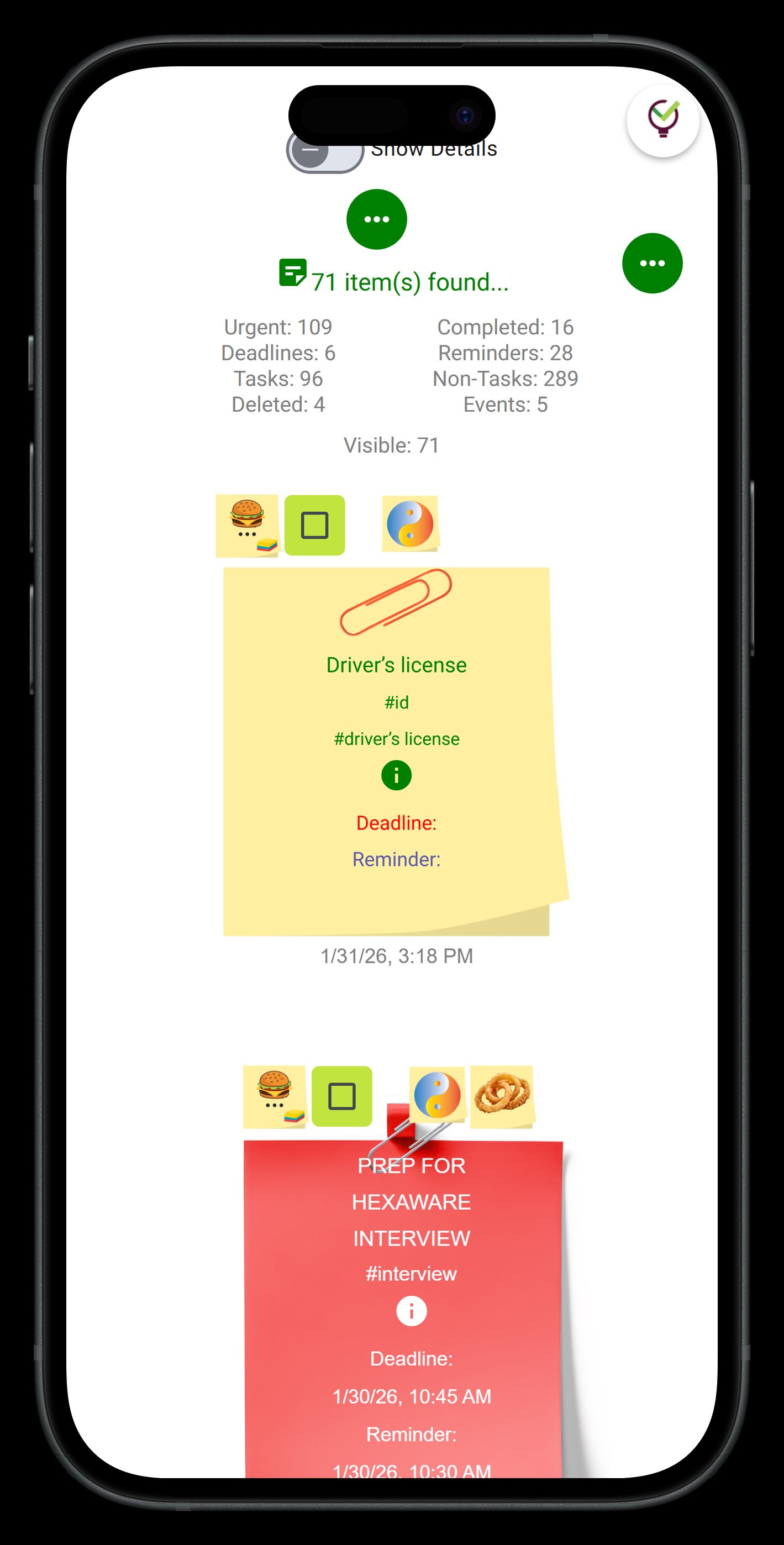
The fix is a one-step habit: every time ChatGPT produces a plan, task list, or decision framework you want to use, it goes directly into TaskLoco as a note. Not a document. Not a Slack message. A note, with a reminder attached, living on your board where you can see it.
How the workflow looks in practice:
- Run your weekly planning prompt on Sunday evening. Copy the day-by-day output.
- Create one note per day in TaskLoco — paste Monday's tasks into Monday's note, and so on.
- Set a push notification reminder on each note to fire at the start of that workday. The reminder deep-links straight back to the note, so you open your phone, tap the notification, and you're looking at your tasks immediately.
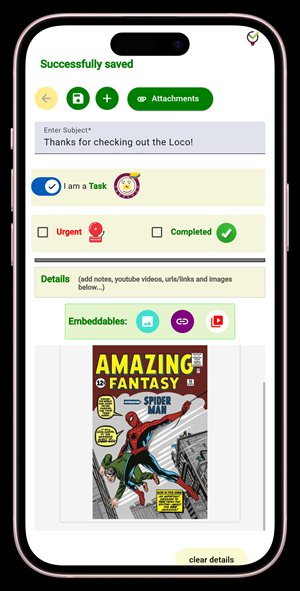
- Attach any relevant files — briefs, specs, reference docs — directly to the note using TaskLoco's file storage. No hunting through email or downloads folders.
- If you're working with others, share the note. Recipients can clone it and make it their own — no permissions dance, no access levels to configure.
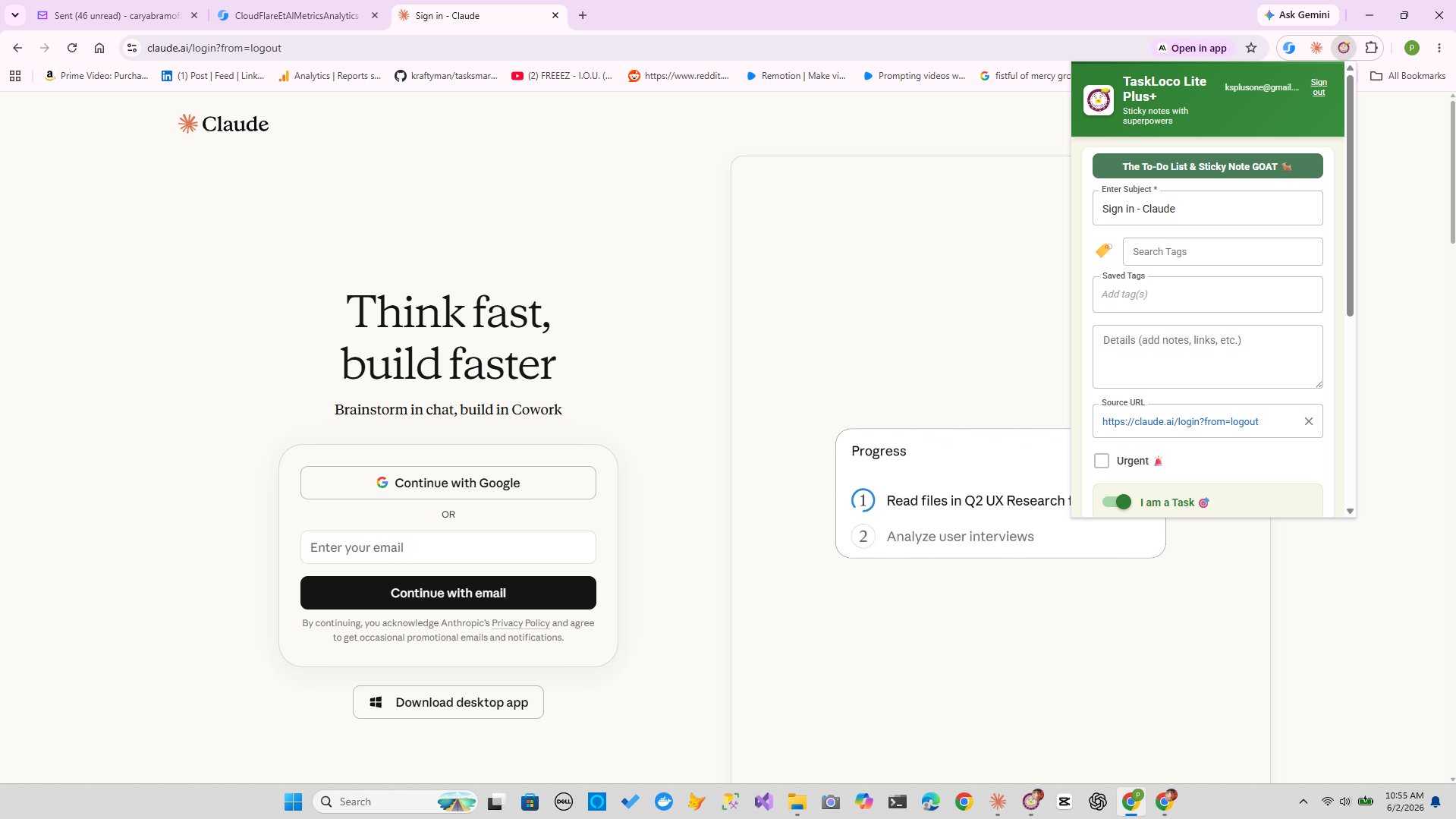
The Chrome extension makes this even faster. When you're reading a webpage that's relevant to a project — a research article, a tool comparison, a client's website — one click captures it directly into a TaskLoco note. Paste your ChatGPT output into the same note and you have context and plan in one place.
TaskLoco Premium: where your AI plans live
TaskLoco Lite is free, anonymous, and needs no account — it's a great scratchpad for capturing ideas fast. But if you're using ChatGPT to build real plans you intend to act on, Premium is where those plans belong.
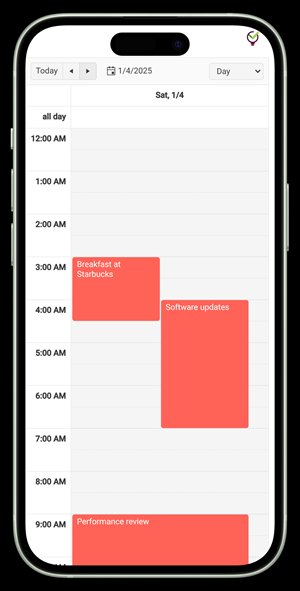
Unlimited notes means you never have to delete a plan to make room for a new one. The calendar view lets you see your AI-generated weekly plan laid out as an actual calendar, not just a list. Reminders arrive as push notifications — tapping one takes you straight back to the note it's attached to. File storage means your plan and its supporting documents live together. And team sharing means you can hand a plan to a colleague and they get their own copy to work from immediately.
The Chrome extension — free for everyone — is the fastest way to feed context into your notes. Find a source online, capture it in one click, and build your ChatGPT prompt around real material instead of memory.
TaskLoco Premium is regularly $9.99/month per person. Right now, charter members can lock in 50% off the regular price — forever. That means $4.99/month per person today. And if our price ever goes up, you still pay half. Always.
Code CHARTER50 auto-applies at checkout. First 500 spots only — once they're gone, this offer is gone permanently. Act fast while spots last.
Every Premium subscription includes unlimited notes, 10GB file storage, reminders, calendar, and team sharing. Each team member requires a separate subscription. 7-day free trial — no charge until day 8. Cancel anytime.
Free Options: TaskLoco
TaskLoco Lite
- Native iPhone & Android app
- Completely anonymous — no sign-in
- Data stays on your device
- Up to 20 notes
- Free forever
TaskLoco Lite Plus+
- Web app + Chrome extension
- Sign in with Google
- Wall syncs across all devices
- Up to 30 notes
- Free forever
Lock In 50% Off — Forever
7-day free trial. No charge until day 8. CHARTER50 auto-applies at checkout.
🔒 Lock In My Charter SpotSee TaskLoco in Action
Frequently Asked Questions
What's the best ChatGPT prompt for weekly planning?
The most effective weekly planning prompt includes your role, your top priorities for the week, your available focused-work hours, and a request for day-by-day output in list format. Something like: "I'm a [role] with these priorities this week: [list]. My focused hours are [time]. Draft a day-by-day plan, front-loading the hardest work. Format as a numbered list per day." Specificity is what separates a useful plan from generic advice.
How do I turn ChatGPT output into tasks I can actually track?
End any planning prompt with "output this as a list of discrete tasks I can copy into a task manager." ChatGPT will reformat its response into clean, actionable items. Then paste them directly into TaskLoco — one note per day or per project — and set push notification reminders so the tasks surface when you need them, not when you happen to remember them.
Can ChatGPT help with daily planning, not just big projects?
Yes, and it's one of the best use cases. Try: "It's [day]. I have [X] hours available. My top three outcomes today are [list]. Give me a time-blocked schedule including breaks, and flag which tasks need uninterrupted focus." Run this every morning, paste the output into a TaskLoco note, and you have a working daily plan in under two minutes.
What should I do with ChatGPT-generated plans so I don't lose them?
The biggest mistake is leaving the output in the chat window. The moment you close it or start a new conversation, it's effectively gone. Copy the output into a TaskLoco note immediately — give it a clear title, set a reminder, and attach any relevant files. Premium gives you unlimited notes and 10GB of file storage, so there's no reason to delete old plans to make room for new ones.
What's the difference between TaskLoco Lite and TaskLoco Premium for this kind of workflow?
TaskLoco Lite is the native iPhone and Android app — completely free, no account, no sign-in, stores up to 20 notes on your device. It's great for quick capture but has no reminders, no file attachments, and no syncing. TaskLoco Lite Plus+ is free, syncs across devices via the web app, and holds up to 30 notes — but also has no reminders or attachments. Premium is where serious planning workflows live: unlimited notes, reminders with push notifications, 10GB file storage, calendar view, and team sharing. $9.99/month per person (currently $4.99/month per person for first 500 charter members with code CHARTER50)
Does the TaskLoco Chrome extension work with ChatGPT?
The Chrome extension captures any webpage into a TaskLoco note in one click — so if you're doing research to inform a ChatGPT prompt, you can capture your sources first, then build your prompt around real material. It won't directly pipe ChatGPT output into a note, but it closes the loop between finding context online and getting it into your planning system.
How do I use ChatGPT to prioritize a task list I already have?
Paste your existing task list into ChatGPT and use this prompt: "Review this list of tasks: [paste list]. Group them by urgency and effort level using a 2x2 priority matrix — urgent/not urgent on one axis, high/low effort on the other. Output the matrix with specific tasks in each quadrant and flag the three I should tackle first." The structured output is easy to copy directly into TaskLoco notes organized by priority.
Born in Brooklyn. Powered by AWS. Your data stays yours.
TaskLoco is available on iPhone, Android, Chrome, and every web browser.