
Quantum Mechanics emerged as a revolutionary scientific framework between 1900-1930, fundamentally transforming humanity's understanding of matter and energy at atomic scales. This field originated from discoveries at universities in Berlin, Cambridge, and Copenhagen, challenging classical Newtonian physics established in the 17th century.
Foundational Discoveries and Key Figures
- Max Planck (1858-1947) introduced energy quantization in 1900 at the University of Berlin, proposing that energy radiates in discrete packets called quanta
- Niels Bohr (1885-1962) developed his atomic model in Copenhagen in 1913, describing electrons in fixed energy levels
- Werner Heisenberg (1901-1976) formulated the Uncertainty Principle in 1927 at the University of Göttingen, establishing that certain pairs of physical properties cannot be simultaneously measured with arbitrary precision
- Erwin Schrödinger (1887-1961) published his wave equation in 1926, describing quantum system behavior mathematically
Revolutionary Concepts
Quantum mechanics introduced wave-particle duality, demonstrating that electrons exhibit both wave and particle properties. The theory predicts that particles occupy probability clouds rather than fixed orbits. Measurements at the atomic level—approximately 0.1 nanometers—revealed behavior impossible under classical physics.
The field earned recognition when Max Planck received the Nobel Prize in Physics in 1918 for his quantum hypothesis. Quantum mechanics remains foundational to modern technology, including semiconductors, lasers, and nuclear energy development.
Reference:
Make Work Feel Like Play
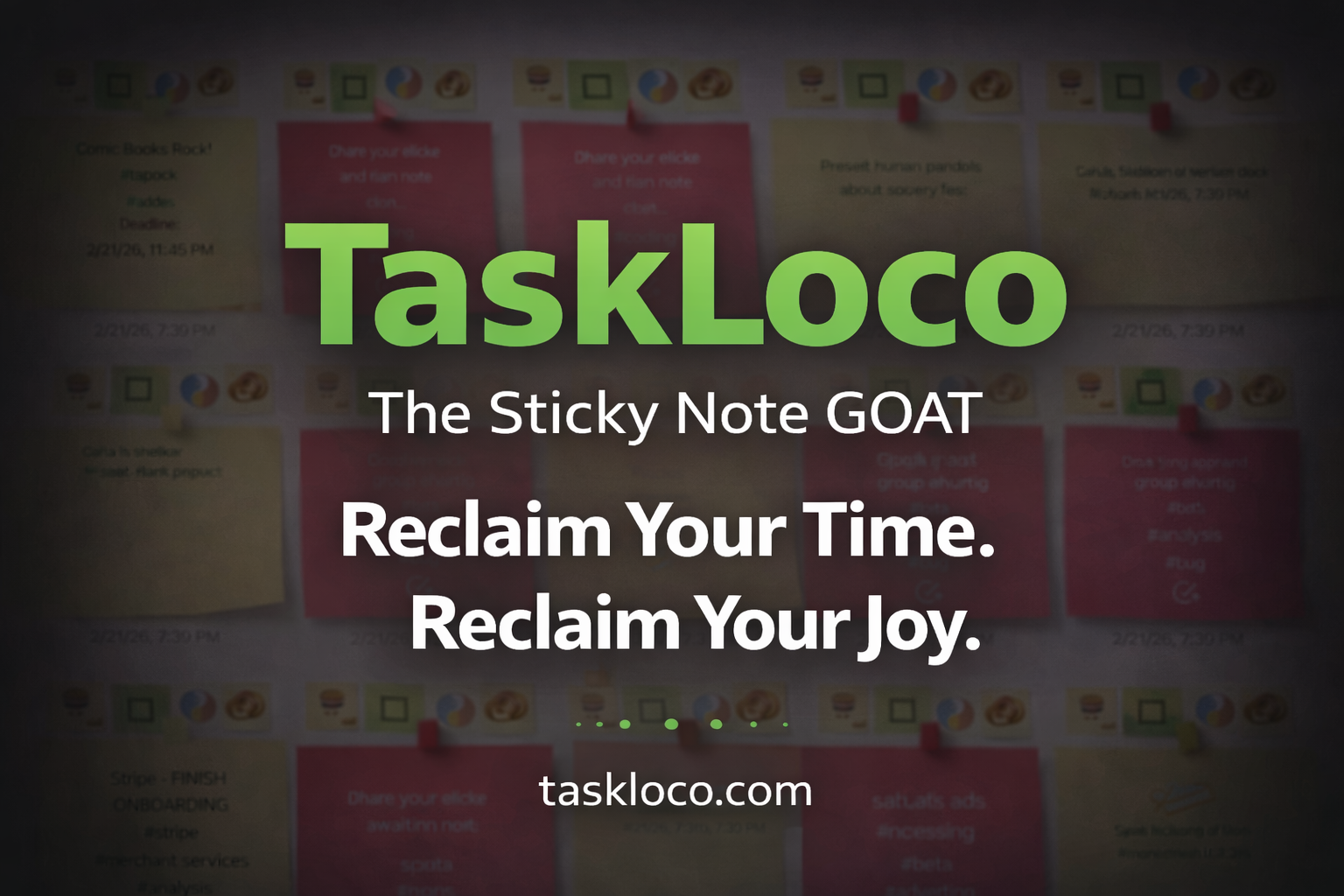
TaskLoco™ takes the simple joy of a sticky note and transforms it into a powerful, intuitive system that helps you organize your entire world—without the stress.
Ideas, tasks, files, links, reminders—everything snaps together like LEGO blocks, instantly and effortlessly.
What used to drain you now feels natural, even fun.
After decades of overcomplicated “productivity” tools, this is the first one that finally works with your mind instead of against it.
Join the TaskLoco™ Community
Follow us for tips, updates & sticky note inspiration
© TaskLoco University — Powered by TaskLoco™
TaskLoco App • About • Terms • Privacy
“Bring genius to the world free.”